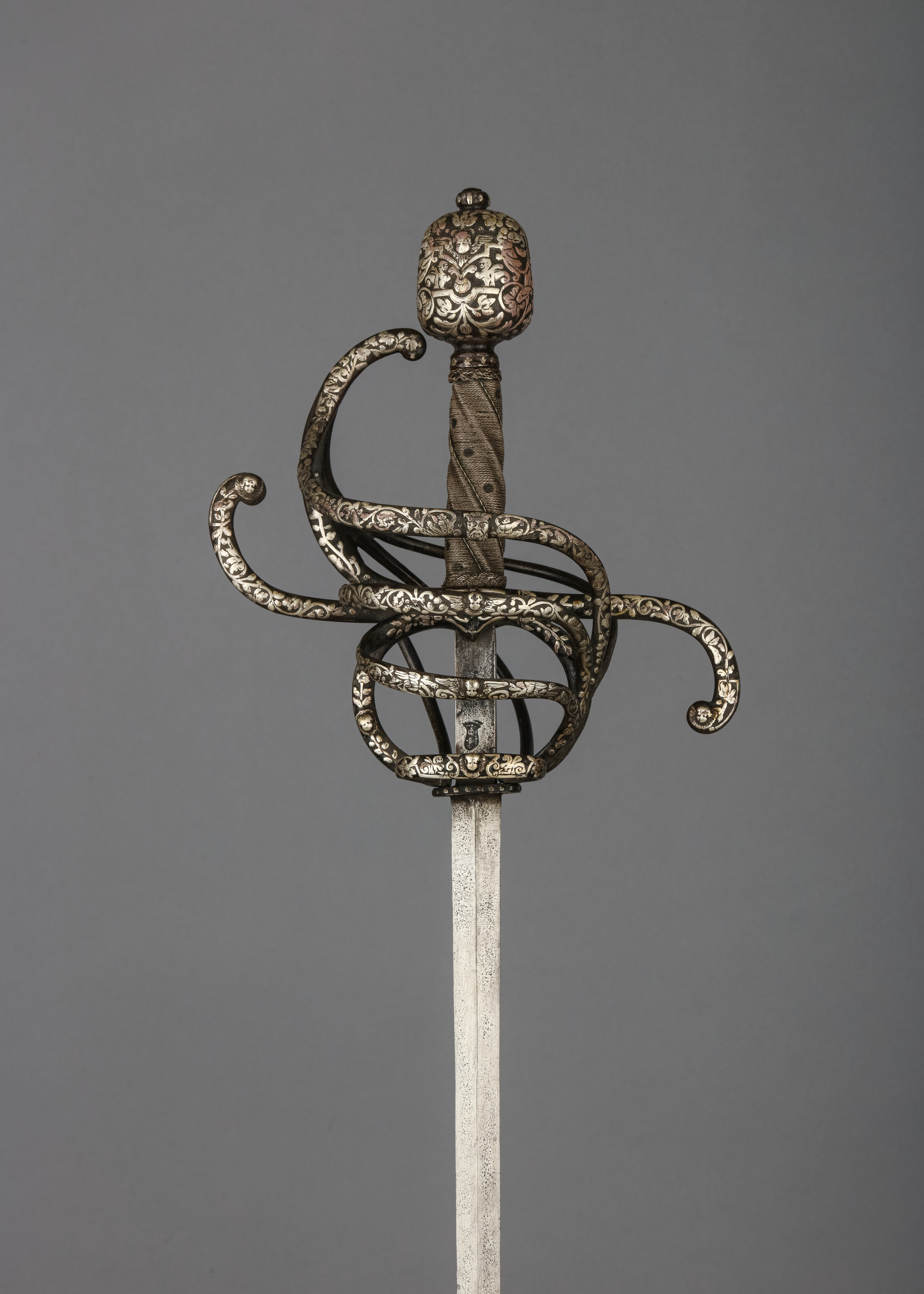
The Rapier Deconstructed: A Study in Steel, Silver, and Historical Silence
In the hallowed halls of haute couture, where fabric and form engage in a perpetual dialogue, Katherine Fashion Lab turns its discerning eye to an artifact of singular elegance and lethal purpose: the rapier. This is not a garment, nor an accessory in the conventional sense, but a standalone study in material mastery and historical tension. The subject—a rapier with a British hilt and a Spanish blade, forged in steel and adorned with silver—presents a unique paradox. It is a weapon of war, yet its craftsmanship whispers of courtly grace; it is an object of violence, yet its lines speak the language of pure, unyielding design. This analysis dissects the rapier not as a tool of combat, but as a couture object, exploring the interplay of its origins, materials, and the silent narrative they weave.
Origins and the Couture of Conflict: British Hilt, Spanish Blade
The rapier’s provenance is a study in geopolitical artistry. The hilt, of British origin, speaks to a tradition of functional restraint and robust engineering. British smiths of the late 16th and early 17th centuries favored a pragmatic approach, crafting hilts that prioritized hand protection and balance. The cup-hilt, often seen in this era, is a masterpiece of ergonomic design—a steel bowl that shields the hand without sacrificing dexterity. The silver inlay, likely applied as a mark of status, transforms this utilitarian form into a canvas for subtle opulence. The silver’s cool luster against the dark steel creates a chiaroscuro effect, a visual tension between the weapon’s deadly purpose and its decorative finish. This is not mere ornamentation; it is a statement of identity, a silent proclamation that the bearer commands not only a blade but also a piece of wearable art.
In stark contrast, the blade is Spanish—a testament to the legendary steel of Toledo. Spanish blades were the gold standard of the Renaissance, renowned for their flexibility, sharpness, and resilience. The Toledo steel, forged through a meticulous process of folding and tempering, produced a blade that could bend without breaking, a quality essential for the rapier’s thrusting technique. This blade is not just a component; it is the soul of the rapier. Its slender, tapering form embodies the couture principle of structural integrity—every curve and point is a calculated response to the physics of combat. The British hilt and Spanish blade together create a hybrid object, a fusion of two distinct design philosophies. This is not a harmonious marriage but a deliberate juxtaposition, a dialogue between the pragmatic and the poetic, the northern and the southern, the defensive and the offensive.
Materiality as Narrative: Steel and Silver in Dialogue
In the world of Katherine Fashion Lab, materials are never passive. They are active participants in the story of the object. Here, steel and silver engage in a profound conversation. Steel, the primary substance, is the voice of endurance and transformation. It is born from fire and hammer, shaped by force, and tempered by water. Its surface, when polished, reflects the world around it, yet it remains cold and unyielding. The steel of the blade carries the memory of the forge—the heat, the strain, the precision. It is a material that demands respect, for it has been tested in ways that fabric never can be. The rapier’s steel is not just a metal; it is a record of human skill and ambition, a physical manifestation of the desire to control and to dominate.
Silver, by contrast, is the voice of luxury and transience. Applied to the hilt, it softens the steel’s austerity. Silver tarnishes, it breathes, it ages with the touch of human hands. Its presence on the rapier is a reminder that this object was not merely a weapon but a status symbol, worn in courts and dueling grounds alike. The silver’s gleam catches the light, drawing the eye to the hand that wields the blade. In couture terms, the silver is the accent, the unexpected detail that elevates a functional piece into a work of art. Together, steel and silver create a visual rhythm—a dark, matte expanse punctuated by flashes of brilliance. This is not a static composition; it is a dynamic interplay, a dance between the permanent and the perishable, the brutal and the beautiful.
Form and Function: The Couture Principles of the Rapier
To analyze the rapier as a couture object is to recognize its adherence to principles that transcend fashion. The first principle is silhouette. The rapier’s form is a study in linearity—a straight, narrow blade that extends from a compact hilt. This is not a weapon of sweeping arcs but of precise, directed movement. The silhouette is aggressive yet elegant, a line that cuts through space with intention. In couture, a garment’s silhouette defines its presence; here, the rapier’s silhouette defines its purpose. The second principle is balance. A well-made rapier is a marvel of weight distribution. The hilt, often heavier due to the metal guard and pommel, counterbalances the blade, allowing for swift, controlled thrusts. This balance is not accidental; it is the result of painstaking calculation. In fashion, balance is achieved through proportion and fit; in the rapier, it is achieved through physics and craftsmanship.
The third principle is detail. The silver inlay on the hilt, the subtle grooves on the blade, the precise curve of the quillons—these are the details that separate a masterwork from a mere tool. The British hilt’s silver work, whether etched, chased, or filigreed, is a testament to the artisan’s skill. Each detail serves a dual purpose: it enhances the visual appeal while reinforcing the object’s integrity. The rapier’s details are not decorative in the superficial sense; they are integral to its identity. In the same way that a couture gown’s hand-stitched seams or bespoke embroidery define its quality, the rapier’s details define its pedigree. This is an object that rewards close inspection, revealing layers of meaning with every glance.
Context and Silence: The Standalone Study
The rapier presented here exists in a state of contextual silence. It is not paired with a doublet, a glove, or a scabbard. It is not displayed in a historical diorama or a dramatic tableau. It stands alone, stripped of the narratives that typically surround it—the duel, the court, the battlefield. This isolation forces the viewer to confront the object on its own terms. Without the distraction of period costume or setting, the rapier becomes a pure form, a study in material and design. This is a deliberate curatorial choice, one that aligns with Katherine Fashion Lab’s ethos of deconstruction and recontextualization. By removing the rapier from its historical context, we invite a new kind of analysis—one that focuses on its intrinsic qualities rather than its extrinsic associations.
This silence is powerful. It allows the steel and silver to speak without interruption. The British hilt and Spanish blade no longer represent a historical conflict or a cultural exchange; they become elements in a visual composition. The rapier is no longer a weapon; it is a sculpture, a tool for contemplation. This shift in perspective is central to the couture analysis. It asks us to see the rapier not as a relic of the past but as a timeless object of design, one that can inform and inspire contemporary fashion. The lines of the blade, the weight of the hilt, the gleam of the silver—these are not just historical details; they are lessons in proportion, materiality, and the art of the made object.
Conclusion: The Rapier as a Mirror
In the end, the rapier is a mirror, reflecting the values of the society that created it and the individual who wielded it. The British hilt speaks of discipline and protection; the Spanish blade, of passion and precision. The steel whispers of endurance; the silver, of beauty. As a standalone study, the rapier challenges us to see beyond its function and into its essence. For Katherine Fashion Lab, this is the ultimate couture analysis: to find the narrative in the object, the art in the artifact, and the fashion in the form. The rapier is not just a weapon; it is a testament to the human capacity for creation, a dialogue between material and maker that transcends time. And in its silence, it speaks volumes.