Deconstructing the Vessel: The Inscribed Bowl as a Paradigm of Couture Philosophy
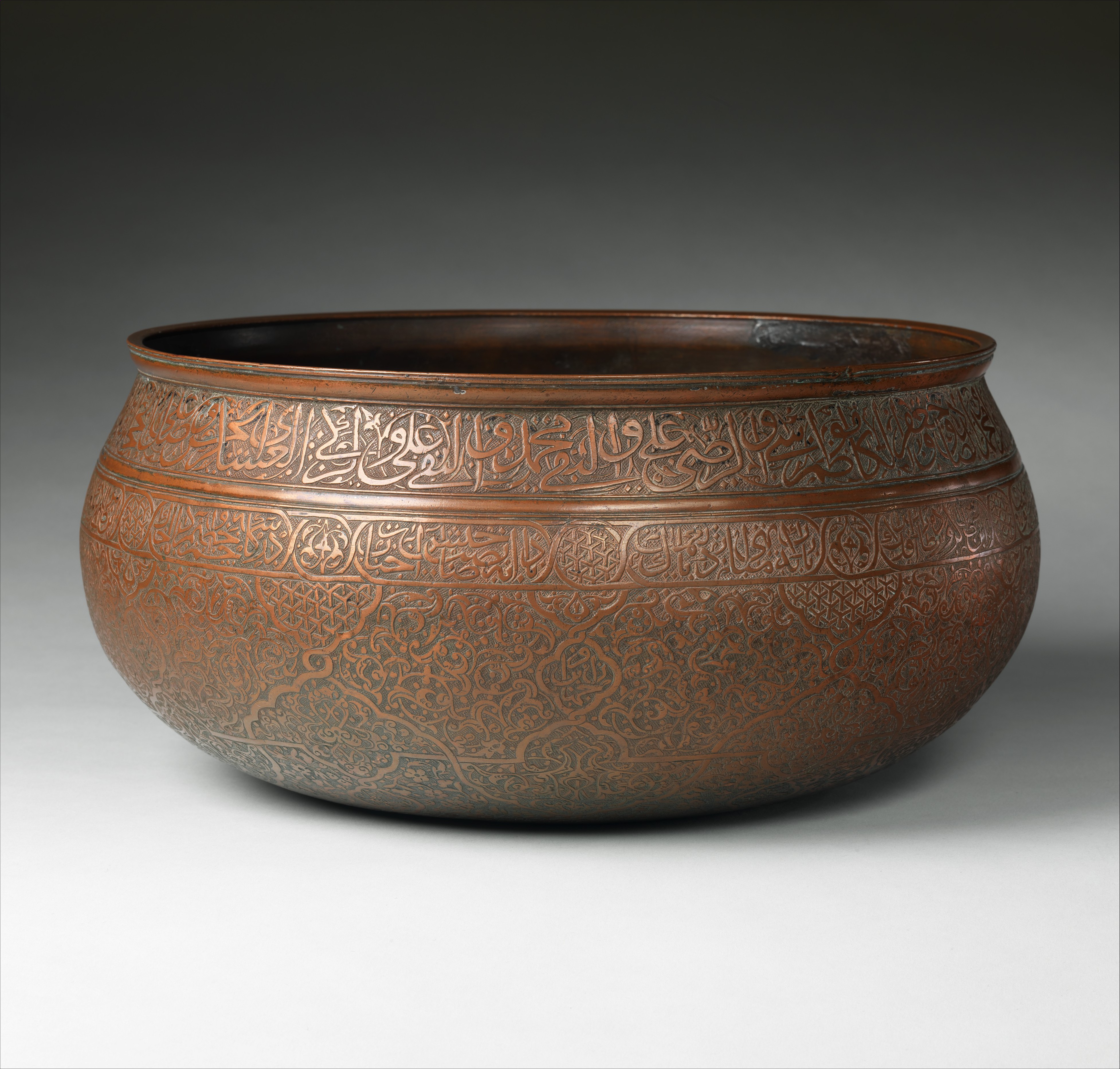
Within the hallowed archives of global heritage, objects of daily ritual often hold the most profound aesthetic codes. The subject of this standalone study—an inscribed bowl of copper, tinned, engraved, and inlaid with a black compound—transcends its utilitarian origins to emerge as a potent metaphor for the foundational principles of haute couture. At Katherine Fashion Lab, we engage not with literal replication, but with the extraction and transposition of embedded narratives, techniques, and tensions. This bowl, a silent vessel of history and hand, offers a masterclass in structural integrity, surface semiotics, and the alchemy of material transformation—cornerstones of our own design methodology.
Material Alchemy: The Substrate of Luxury
The primary material, copper, is a deliberate and eloquent choice. Unlike the immediate, cold brilliance of silver or the mute heaviness of iron, copper possesses a warm, organic resonance. It is a living metal, prone to a dignified patina, echoing the very nature of the human form which couture seeks to adorn. However, the artisans did not leave the copper in its raw state. The process of tinning—applying a layer of tin to the interior surface—is a critical intervention. This act is both practical, preventing oxidation and contamination, and profoundly symbolic. It represents the couturier’s imperative to interface between the body and the structure, creating a hidden, protective barrier. It is the unseen lining of a jacket, the silk against the skin, the foundational canvas that ensures the integrity and wearability of the complex artistry to come.
This duality of the material—the warm, public copper and the cool, private tin—establishes a dialectic of interiority and exteriority. In couture terms, this mirrors the relationship between a garment’s internal architecture (boning, seams, corsetry) and its external manifestation. The strength and malleability of copper as a substrate directly parallel the couture obsession with foundational fabrics: the crisp hold of a silk organza understructure, the fluid drape of a wool crepe. The material is never merely decorative; it is the essential, load-bearing armature.
The Grammar of the Line: Engraving as Structural Embroidery
The surface treatment of the bowl moves beyond mere ornamentation into the realm of structural storytelling. Engraving, the act of incising lines into the metal, is a subtractive technique. It requires confidence, a flawless hand, and an acceptance of permanence—there is no recourse for error. This is the exacting discipline of the petite main in the atelier, wielding a scalpel to cut a bias panel or a needle to create pinpoint embroidery. Each engraved line weakens the material in one dimension while simultaneously strengthening its visual and narrative complexity.
The patterns, likely geometric, calligraphic, or foliate, are not arbitrarily applied. They follow the bowl’s curvature, respecting and amplifying its form. This is the principle of directional seaming and contour-aware embellishment in couture. A master embroiderer does not simply cover a bodice in beads; the flow of the design follows the anatomy, enhancing the shoulder, cinching the waist, radiating from a focal point. The engraved lines on the bowl are its seams and darts—they articulate its form, guide the eye, and create a play of light and shadow as fundamental as the interplay of matte and satin fabrics on a gown.
Negative Space as Narrative: The Inlay’s Semiotic Weight
The most decisive couture gesture, however, lies in the inlay of the black compound. This is not a superficial application of pigment but a deliberate filling of the negative spaces created by the engraving. The black material—likely a hardened lacquer, bitumen, or niello—settles into the grooves, creating a stark, indelible contrast. This technique transforms the line from a mere incision into a bold, graphic statement. It gives the pattern weight, depth, and legibility.
In the lexicon of Katherine Fashion Lab, this inlay is analogous to the most dramatic couture interventions: the jet beading on noir tulle, the intarsia of contrasting leathers, the appliqué of velvet on chiffon. It is the art of defining form through counterpoint. The black compound does not obscure the copper; it elevates it, making the positive space shine brighter. This speaks to the strategic use of emptiness and fullness in a garment’s silhouette—the severe restraint of a columnar skirt juxtaposed with the extravagant volume of a sleeve. The inlay is the final, authoritative edit, the moment where the sketch becomes irrevocably real, where the negative space is acknowledged not as absence but as a critical component of the design’s voice.
From Vessel to Vestment: A Couture Transposition
As a standalone study, this inscribed bowl provides a closed, perfect system for analysis. Its lessons, however, are vibrantly applicable. Transposed to the couture form, its principles manifest in a hypothetical ensemble we might term "The Chryselephantine Collection." Imagine a structural coat, its base a warm, hammered copper-hued silk faille (the tinned copper substrate). Its seams are not hidden but celebrated as deeply engraved channels, top-stitched with a rigid, contrasting cord. Into these architectural seams, and across the yoke, are inlaid intricate patterns in black—achieved through tightly packed soutache braid, strips of patent leather, or dense fields of onyx micro-beads.
The interior of the coat, the tinned surface, would be a cool, silver-gray silk duchesse satin, protecting the wearer and providing a moment of serene contrast. The silhouette would be vessel-like, acknowledging the body’s form while imposing a majestic, ceremonial architecture. The ensemble would carry the bowl’s narrative of protection and presentation, foundation and flourish, the permanence of the engraved line and the dramatic finality of the inlay.
Ultimately, the inscribed bowl teaches us that true luxury lies in the synthesis of antitheses: the robust and the delicate, the hand-wrought and the impeccably finished, the symbolic and the functional. At Katherine Fashion Lab, we decode these material grammars to forge a future for couture that is deeply inscribed with the wisdom of the hand and the timeless narratives of global heritage. The object is not a relic; it is a blueprint.