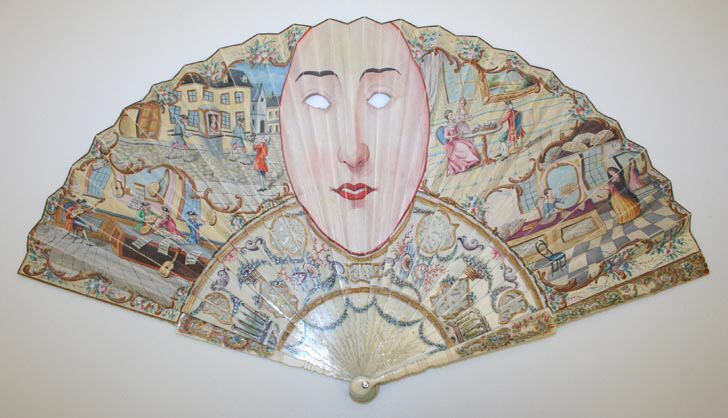
Heritage Analysis: The Spanish Fan as a Symbol of Power and Luxury
The Spanish fan, or abanico, is far more than a mere instrument for cooling. Within the context of Katherine Fashion Lab’s strategic research, it emerges as a profound artifact of cultural symbolism, historical adornment, and spiritual meaning. This analysis deconstructs the fan’s legacy—crafted from ivory, parchment, mother-of-pearl, and glass—to inform a 2026 high-end luxury strategy that leverages its untapped symbolic power.
Symbolic Power: The Language of Silent Authority
In 17th- and 18th-century Spanish society, the fan operated as a sophisticated tool of non-verbal communication. Its movements—a rapid flutter indicating passion, a slow wave suggesting indifference, a closed fan pointed toward the heart signaling desire—constituted a codified lexicon of power. For the elite, the fan was not merely an accessory; it was a instrument of social control, allowing women to navigate patriarchal spaces with agency and subtlety. The ivory and mother-of-pearl used in its construction were not chosen arbitrarily. Ivory, sourced from colonial trade routes, signified global reach and economic dominance. Mother-of-pearl, with its iridescent play of light, evoked the celestial and the unattainable. Together, these materials transformed the fan into a portable throne—a symbol of the bearer’s ability to command attention without uttering a word.
For a 2026 luxury strategy, this symbolic power translates into a brand narrative of silent influence. Katherine Fashion Lab can position the fan as a metaphor for modern power: the ability to communicate status, desire, and authority through curated, non-verbal cues. This aligns with the current luxury market’s shift toward quiet luxury—where understatement signals the highest form of prestige.
Historical Adornment: Craftsmanship as Cultural Capital
The Spanish fan’s construction is a testament to artisanal mastery. The parchment leaves, often hand-painted with scenes from mythology or courtly life, required the collaboration of painters, carvers, and goldsmiths. The glass inlays, sometimes set into the rivets or guard sticks, added a reflective quality that caught candlelight in ballrooms, ensuring the fan was always the center of visual gravity. The mother-of-pearl handles were carved into intricate floral or geometric patterns, each requiring weeks of labor. This multi-material complexity made each fan a unique work of art, a status marker that distinguished the aristocracy from the bourgeoisie.
Historically, the fan’s adornment also served as a political statement. During the Spanish Inquisition, fans painted with religious iconography demonstrated piety and loyalty. Conversely, fans with secular, erotic imagery were used in clandestine courtship, defying moral codes. This duality—the fan as both a conformist and subversive object—offers a rich narrative for a luxury brand. In 2026, Katherine Fashion Lab can revive this tradition by offering bespoke fan commissions that allow clients to embed personal symbols, family crests, or even encrypted messages. This transforms the fan from a historical relic into a contemporary heirloom, merging heritage with hyper-personalization.
Spiritual Meaning: The Fan as a Bridge Between Worlds
Beyond the secular, the Spanish fan carried deep spiritual resonance. In Spanish Catholic culture, the palm fan (palma) was used in religious processions, symbolizing martyrdom and victory over death. The ivory material, often associated with purity and incorruptibility, reinforced this sacred connotation. The fan’s opening and closing motion was interpreted as a metaphor for the cycle of life and death—the spread of the leaves representing the soul’s expansion toward the divine, and the closure representing the return to the earthly. The glass inlays, reflecting light, were seen as conduits for divine illumination, while the mother-of-pearl evoked the moon, a celestial body linked to femininity and intuition.
For a 2026 luxury strategy, this spiritual dimension offers a differentiation point in a market saturated with materialistic branding. Katherine Fashion Lab can frame the fan as a ritual object for modern self-care and meditation. Limited-edition fans, crafted from ethically sourced ivory alternatives (e.g., tagua nut) and recycled glass, can be marketed as tools for intentional living. Each fan could be accompanied by a “code of gestures”—a contemporary reinterpretation of the historical language—encouraging users to practice mindfulness through deliberate movement. This positions the brand at the intersection of luxury and wellness, a rapidly growing segment in high-end markets.
2026 High-End Luxury Strategy: Reviving the Fan as a Status Icon
To integrate the Spanish fan into a 2026 luxury portfolio, Katherine Fashion Lab must execute a three-pronged strategy: heritage revival, material innovation, and experiential exclusivity.
Heritage Revival: The brand should partner with surviving Spanish ateliers in Seville and Valencia, where fan-making traditions persist. A “Master Artisan Series” could produce 100 numbered fans per year, each using authentic techniques—hand-painted parchment, carved mother-of-pearl, and glass inlays. This scarcity aligns with the luxury principle of rarity as value. The narrative should emphasize that each fan requires 200+ hours of craftsmanship, positioning it as a wearable investment akin to a fine watch.
Material Innovation: Given ethical concerns over ivory, the brand must lead in sustainable luxury. Replace ivory with fossilized mammoth tusk (legal and ethically sourced) or compressed resin that mimics ivory’s weight and patina. Mother-of-pearl can be sourced from certified aquaculture. Glass can be replaced with recycled Murano glass, adding a contemporary, eco-luxury edge. This approach satisfies both environmental standards and the desire for authentic, historical texture.
Experiential Exclusivity: The fan’s spiritual and symbolic power can be leveraged through private rituals. Katherine Fashion Lab could host “Fan Salons” in historic Spanish palaces, where clients learn the historical gesture language and commission custom fans. A digital component—an NFT certificate of authenticity linked to the fan’s provenance—adds a layer of modern collectibility. This creates a closed ecosystem where ownership grants access to exclusive events, reinforcing the fan as a symbol of belonging to an elite cultural circle.
Conclusion: The Fan as a Strategic Asset
The Spanish fan, with its roots in ivory, parchment, mother-of-pearl, and glass, is a repository of symbolic power, historical adornment, and spiritual meaning. For Katherine Fashion Lab, it offers a unique strategic asset in a luxury market seeking depth, narrative, and authenticity. By reviving its craftsmanship, innovating its materials, and elevating its experiential value, the brand can position the fan not as a nostalgic accessory, but as a 21st-century icon of quiet power. In 2026, the fan will not merely cool the air—it will command the room.