The Manchurian Crane Rank Badge: A Study in Imperial Hierarchy and Textile Mastery
Historical and Symbolic Context of the Rank Badge
The rank badge, or buzi, represents one of the most sophisticated systems of visual hierarchy in Chinese imperial history. Worn by civil and military officials during the Ming (1368–1644) and Qing (1644–1912) dynasties, these embroidered squares served as immediate identifiers of rank, status, and bureaucratic function. The Manchurian crane (Grus japonensis) was reserved for the highest echelons of civil service—specifically, first-rank civil officials. This bird, known for its elegance, longevity, and association with celestial purity, symbolized the ideal administrator: wise, dignified, and morally upright. The crane’s placement against a backdrop of clouds, waves, and auspicious motifs further reinforced the wearer’s role as a mediator between the earthly realm and the cosmic order.
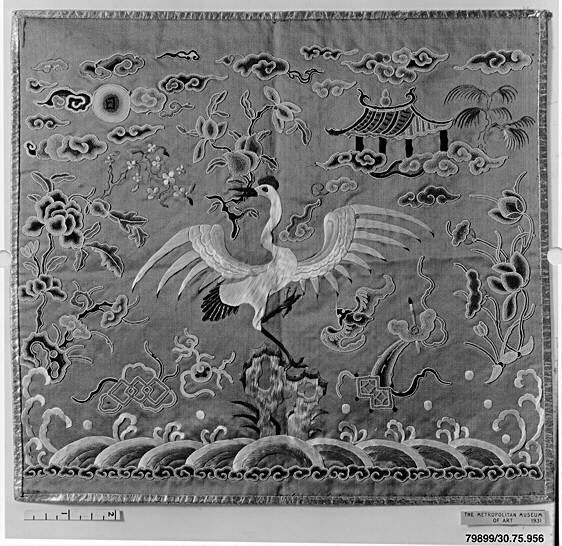
This standalone study of a rank badge with Manchurian crane from the Katherine Fashion Lab collection offers a rare opportunity to examine the intersection of textile artistry, political symbolism, and material culture. The piece, crafted from silk and metallic thread, exemplifies the technical precision and aesthetic refinement demanded by the imperial court. Its preservation allows for a deep analysis of how material choices—silk’s luster, metallic thread’s durability—were not merely decorative but functional, conveying authority across vast distances during public ceremonies.
Material Analysis: Silk and Metallic Thread as Statements of Power
The choice of silk as the primary fabric is no accident. Silk, produced through centuries of Chinese sericulture, was a controlled commodity, often used exclusively by the elite. Its natural sheen and ability to hold intricate embroidery made it ideal for displaying the crane’s plumage and the surrounding cloud motifs. The silk ground of this badge is a deep, indigo blue—a color associated with the heavens, authority, and the emperor’s mandate. This hue, achieved through complex dyeing processes involving indigo plants, would have been both rare and expensive, further underscoring the wearer’s status.
The metallic thread used in the embroidery is equally significant. Composed of fine strips of gold or silver wrapped around a silk core, this thread added weight, texture, and a reflective quality that caught light during processions. The metallic elements are concentrated in the crane’s beak, legs, and the sun disk at the top of the badge, creating focal points that draw the eye. This technique, known as kesi (silk tapestry) or xiu (embroidery), required extraordinary skill. Each stitch had to be precisely placed to avoid distorting the fabric, and the metallic thread’s stiffness demanded careful handling. The result is a surface that appears almost three-dimensional, with the crane seemingly poised to take flight.
Design and Iconography: The Crane in Cosmic Context
The Manchurian crane is depicted in a dynamic, forward-facing posture, its wings slightly raised as if alighting. This pose is deliberate: it conveys readiness, vigilance, and the ability to navigate between earth and sky. The crane’s white body is rendered through negative space in the silk, while its black wing tips and red crown are embroidered with fine silk threads. The red crown, a natural feature of the Manchurian crane, was also a symbol of the sun and imperial favor. Surrounding the crane are stylized clouds, waves, and rocks—all standard motifs in Qing official regalia. These elements represent the cosmos: clouds for the heavens, waves for the sea, and rocks for the earth. Together, they position the official as a harmonious figure within the tripartite order of nature.
The badge’s square shape (approximately 30 cm per side) is itself symbolic. In Chinese cosmology, the square represents the earth, while the circle represents heaven. By wearing a square badge, the official was literally grounded in earthly duty, even as the crane motif elevated him spiritually. The borders of the badge are trimmed with a narrow band of metallic thread, creating a frame that separates the sacred space of the emblem from the garment’s fabric. This framing technique, common in Qing badges, ensures that the design remains visually contained and does not bleed into the surrounding robe.
Technique and Craftsmanship: The Art of Imperial Embroidery
The embroidery on this badge is executed in a combination of satin stitch, couching, and seed stitch. The crane’s body uses long, parallel satin stitches to simulate smooth feathers, while the metallic thread is couched—laid on the surface and secured with small silk stitches—to create the beak and legs. This couching technique prevents the metallic thread from fraying and allows for crisp, defined lines. The clouds are filled with seed stitches, tiny knots that add texture and depth, mimicking the ethereal quality of vapor. The waves at the bottom are rendered in horizontal bands of blue and white silk, with metallic highlights that suggest foam.
The precision required for such work is staggering. Each stitch must align with the grain of the silk to avoid puckering. The metallic thread, being less flexible than silk, demands a steady hand and an intimate knowledge of tension. Artisans in imperial workshops, often specializing in a single technique, would have spent months on a single badge. This piece shows no evidence of repair or reworking, suggesting it was either never worn or was preserved with exceptional care. The lack of fading or fraying indicates that the dyes were of high quality and the thread was well-bound.
Standalone Study: Significance for Contemporary Couture Analysis
As a standalone study, this rank badge offers invaluable insights for modern fashion analysis. First, it demonstrates how hierarchical systems can be encoded through material and design—a concept that resonates in today’s luxury branding, where logos and fabric choices signal status. Second, the badge’s use of metallic thread as a light-capturing element anticipates contemporary techniques in evening wear and performance costumes. Third, the crane’s iconography—a symbol of longevity and wisdom—aligns with current trends in sustainable fashion, where natural motifs and ethical craftsmanship are prized.
From a textile engineering perspective, the badge’s construction reveals principles of durability and flexibility. The combination of silk and metallic thread creates a fabric that is both rigid (for the badge’s shape) and pliable (for attachment to a robe). This balance is analogous to modern innovations in smart textiles, where functional and aesthetic elements are integrated. Furthermore, the badge’s preservation underscores the importance of archival practices in fashion. The silk’s pH level, the thread’s tension, and the storage environment all influence longevity—lessons that apply to contemporary haute couture pieces.
Finally, the Manchurian crane rank badge serves as a case study in cross-cultural influence. During the Qing dynasty, China’s trade with Europe brought these badges to the attention of Western collectors, influencing embroidery techniques in France and England. Today, Katherine Fashion Lab’s study of this piece contributes to a global dialogue about heritage, appropriation, and the reinterpretation of historical motifs in modern design. By analyzing the badge’s materiality and symbolism, we gain a deeper appreciation for how fashion can articulate power, identity, and artistry across centuries.