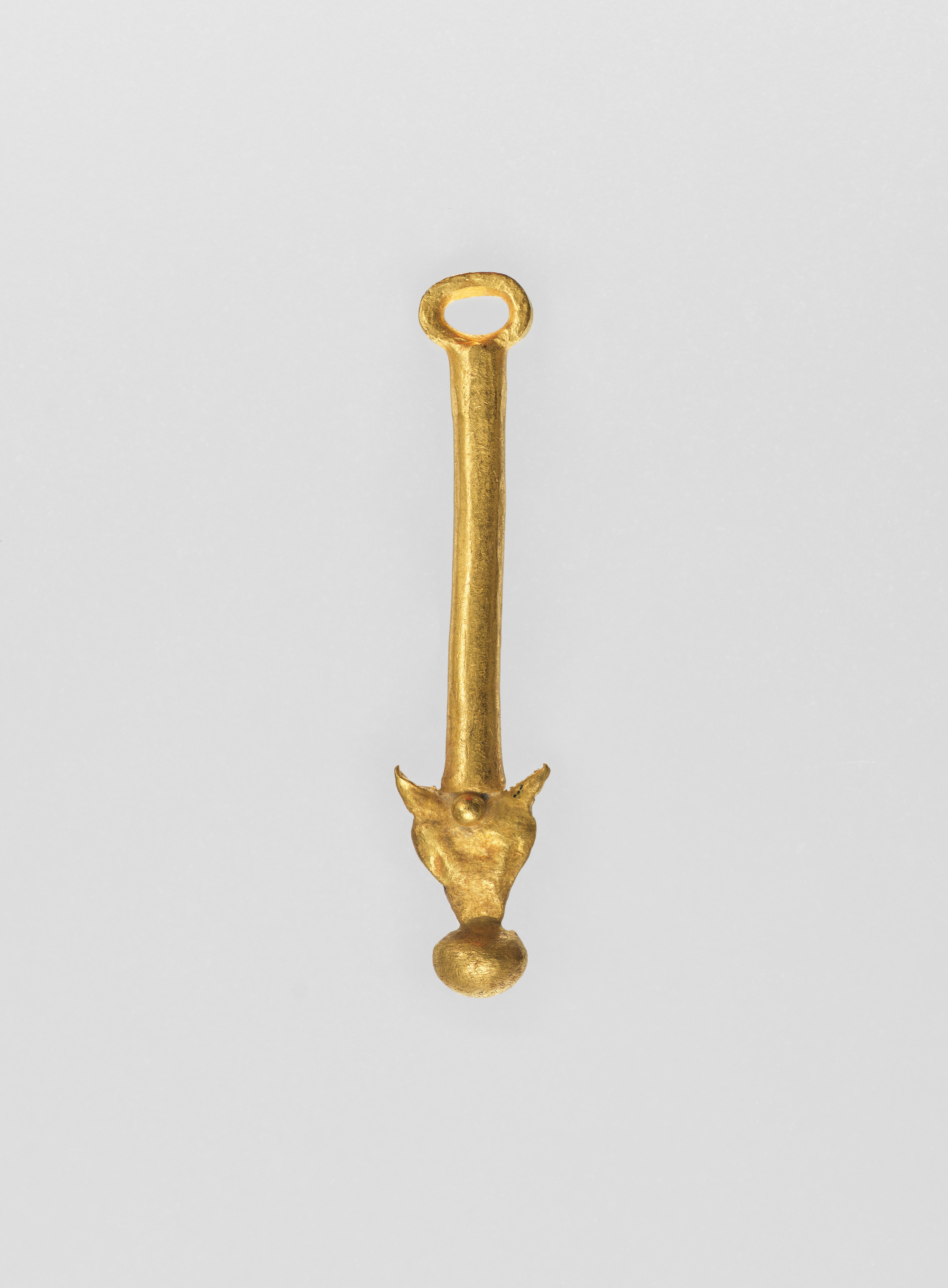
Heritage Analysis: The Gold Pendant Amulet and Its Resonance with the Mirror with Split-Leaf Motif
In the pursuit of defining a new lexicon for high-end luxury in 2026, Katherine Fashion Lab turns to the enduring power of ancient adornment. The subject of this analysis—a gold pendant amulet from an ancient civilization—serves as a profound case study in symbolic power, historical adornment, and spiritual meaning. This artifact is not merely a decorative object; it is a condensed universe of belief, status, and protection. Its DNA correlates directly with the lab’s ongoing study of the Mirror with Split-Leaf, a dual-faced object that juxtaposes a polished silver mirror inlaid with intricate gold palm-leaf motifs against a cold sarcophagus lid narrating a life story through relief. Together, these artifacts illuminate a critical tension for luxury strategy: the interplay between luminous surface and profound depth, between transient reflection and eternal narrative.
The Symbolic Power of the Gold Pendant Amulet
The gold pendant amulet, typically worn close to the heart or throat, was a repository of concentrated symbolic meaning. In ancient civilizations—from Egypt to Mesopotamia to the Indus Valley—gold was not merely a metal of monetary value but a substance imbued with the divine essence of the sun, incorruptibility, and eternal life. The amulet’s form, whether an eye, a scarab, a crescent, or a stylized leaf, functioned as a visual incantation. Its power lay in its ability to anchor cosmic forces to the human body. The split-leaf motif, as seen in the mirror study, represents duality: life and death, growth and decay, the visible and the hidden. When rendered in gold on a pendant, this motif becomes a talisman of regeneration, a promise that fragmentation leads to renewal. For the wearer, the amulet was a constant companion in negotiating the liminal spaces between the mundane and the sacred, the living and the ancestral.
Historical Adornment: The Body as a Canvas for Cosmic Narrative
Historical adornment in ancient civilizations was never mere ornamentation; it was a sophisticated system of embodied communication. The gold pendant amulet was integral to this system, worn by elites, priests, and warriors to signal their alignment with specific deities, dynasties, or cosmic orders. The placement of the amulet on the body—often at the neck, over the heart, or suspended from a headdress—transformed the wearer into a living monument. This practice finds a direct parallel in the Mirror with Split-Leaf, where the polished silver side reflects the transient beauty of the wearer’s face, while the reverse side, carved into a sarcophagus relief, narrates the permanent journey of the soul. The amulet, like the mirror, is a dual-narrative device: it projects status and beauty outward while simultaneously guarding the wearer’s spiritual integrity inward. For Katherine Fashion Lab, this historical practice underscores the importance of adornment as a layered storytelling tool, where every piece carries both a public face and a private, sacred meaning.
Spiritual Meaning: Protection, Transition, and the Eternal Self
At its core, the gold pendant amulet served a spiritual function that transcended aesthetic appeal. It was a protective device against malevolent forces, a guide for the soul in the afterlife, and a marker of the wearer’s place in the cosmic hierarchy. The split-leaf motif, in particular, evokes the fracturing of the self that occurs at the threshold of death and rebirth. In many ancient traditions, the soul was believed to split into multiple aspects—the ka, ba, and akh in Egyptian thought—each requiring guidance and protection. The amulet, with its gold construction and symbolic design, acted as a spiritual anchor that ensured the coherence of the self through these transitions. This concept resonates deeply with the mirror study: the silver side reflects the physical, ephemeral self, while the sarcophagus relief encodes the eternal, narrative self. The amulet bridges these two states, offering the wearer a tangible connection to the continuity of identity across life, death, and rebirth. For modern luxury consumers, this spiritual dimension translates into a desire for objects that provide psychological grounding and a sense of continuity in a fragmented world.
2026 High-End Luxury Strategy: Translating Ancient Resonance into Modern Value
As Katherine Fashion Lab develops its 2026 high-end luxury strategy, the gold pendant amulet and the Mirror with Split-Leaf offer a powerful blueprint for differentiation and emotional depth. The future of luxury lies not in conspicuous consumption but in meaningful possession. The amulet’s DNA—its symbolic power, historical resonance, and spiritual function—can be translated into a luxury strategy that prioritizes heritage as a living value. Specifically, the lab should focus on three key pillars:
1. Dual-Narrative Design: Just as the amulet and the mirror carry dual meanings (protection and beauty, reflection and narrative), 2026 collections should incorporate hidden or reversible elements. A pendant that opens to reveal an engraved personal mantra, or a ring with an interior inscription, creates a private dialogue between the wearer and the object. This strategy elevates the product from a commodity to a personalized talisman.
2. Material as Metaphor: Gold, in ancient contexts, was not just a metal but a carrier of solar and eternal properties. For 2026, Katherine Fashion Lab should source and market materials with provenanced backstories—gold from ethical mines with historical significance, or recycled metals that carry a narrative of transformation. The material itself becomes a symbolic asset, aligning with the consumer’s desire for authenticity and sustainability.
3. Ritual and Experience: The ancient amulet was activated through ritual—blessings, incantations, and daily wearing. Luxury in 2026 should embrace ritualistic experiences. This could include a “blessing ceremony” at point of sale, a digital companion that narrates the piece’s heritage, or a subscription service that provides seasonal amulets for different life transitions. By embedding the product in a ritual ecosystem, the lab transforms a purchase into a lifelong relationship.
Conclusion: The Amulet as a Blueprint for Timeless Luxury
The gold pendant amulet from an ancient civilization is far more than a historical artifact; it is a strategic archetype for the future of high-end luxury. Its symbolic power, rooted in cosmic and spiritual systems, offers a counterpoint to the superficiality of fast fashion. Its historical role as a dual-narrative adornment—public status and private protection—resonates with the contemporary consumer’s search for authenticity and depth. And its spiritual meaning, as a guide through transitions, speaks to a market increasingly interested in wellness, mindfulness, and continuity. By weaving these elements into a coherent 2026 strategy, Katherine Fashion Lab can position itself not merely as a purveyor of goods, but as a custodian of meaning. The amulet, like the mirror with its split-leaf motif, reminds us that true luxury is not about what is seen, but about what is felt, remembered, and carried forward—a golden thread connecting the ancient soul to the modern self.