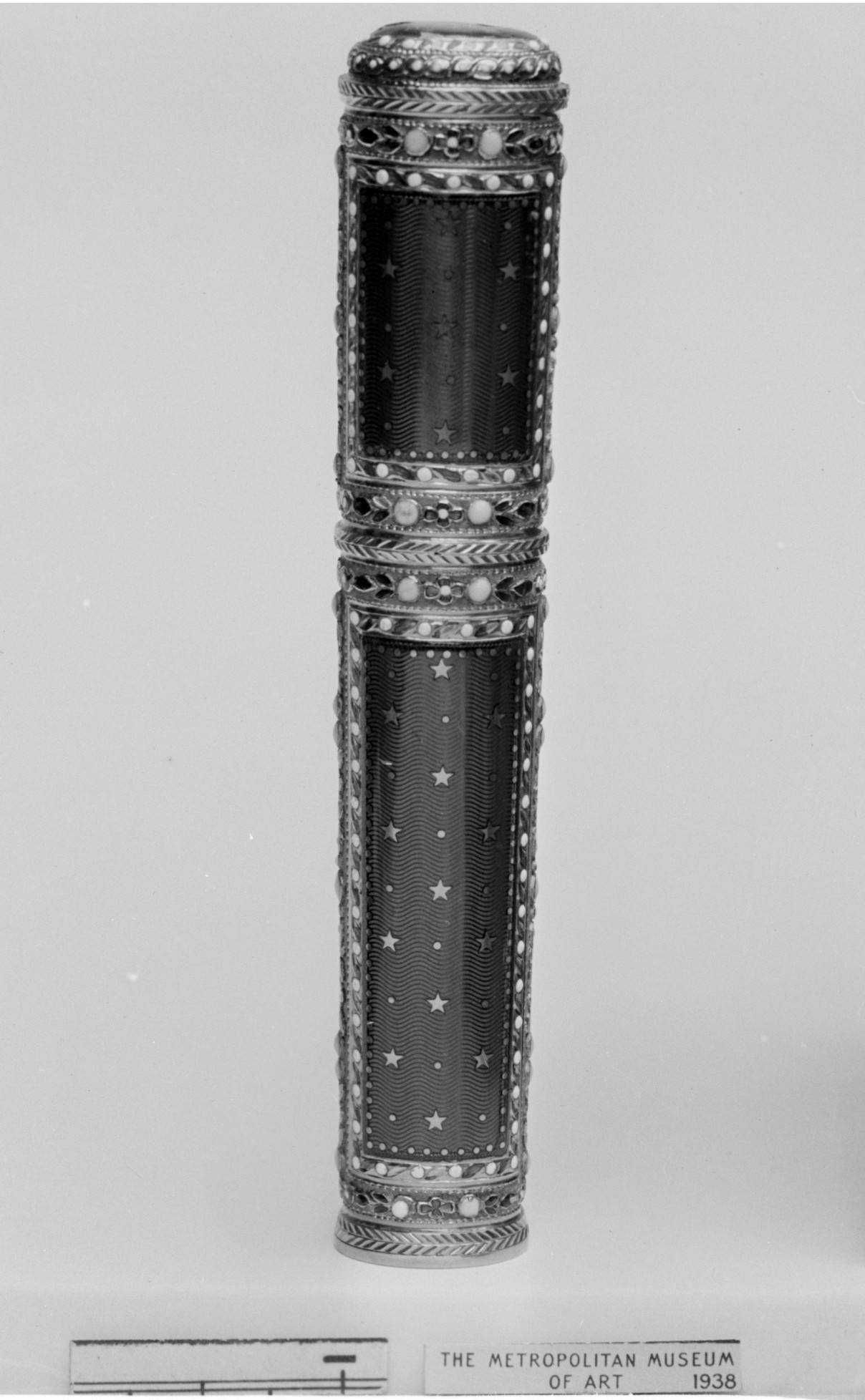
The Sealing Wax Étui: A Couture Analysis of Global Heritage in Gold and Enamel
Within the hallowed archives of Katherine Fashion Lab, few objects command the same intersection of utility, artistry, and historical gravitas as the sealing wax case—or, in its more refined nomenclature, the étui. This standalone study dissects a singular specimen: a global heritage artifact crafted from gold and enamel. More than a mere container for wax, this étui emerges as a microcosm of couture philosophy, where material mastery, cross-cultural narrative, and functional elegance converge. As Lead Curator, I present an analysis that deconstructs its design DNA, contextualizes its provenance, and argues for its enduring relevance in the lexicon of luxury.
Materiality as Narrative: Gold and Enamel
The choice of gold and enamel is not arbitrary; it is a declaration of permanence and prestige. Gold, malleable yet indestructible, has served as a universal currency of power across civilizations—from the pharaohs of Egypt to the courts of Ming China. In this étui, the gold base is not merely a structural element but a canvas. Its warm luster evokes the sun, a symbol of divine authority and eternal value. The enamel, a vitreous coating fused to the metal at high temperatures, introduces a counterpoint of fragility and vibrancy. Enamel work, particularly the cloisonné or champlevé techniques often employed in such pieces, demands precision and patience—qualities that mirror the slow, deliberate craft of haute couture.
Together, these materials create a dialogue between the enduring and the ephemeral. The gold whispers of wealth and lineage; the enamel sings of artistic intervention. In a couture context, this duality is paramount: a garment or accessory must be both structurally sound and visually arresting. The étui’s metallic hardness contrasts with the enamel’s glassy finish, producing a tactile and visual symphony. For Katherine Fashion Lab, this synergy informs our approach to fabric and embellishment—where silk might be juxtaposed with metallic threads, or leather with lacquer.
Design Archetypes: Form Follows Function
The étui’s form is deceptively simple: a slender, cylindrical or tapered case, often with a hinged lid, designed to hold sticks of sealing wax. Yet its proportions betray a deep understanding of ergonomics and symbolism. The sealing wax itself—typically a rod of resin, beeswax, and pigment—was a tool of authentication, used to seal letters and documents with a personal mark. The étui, therefore, was not just a holder but a vessel of authority. Its length, typically between 10 and 15 centimeters, was calibrated to fit comfortably in the hand or within a pocket, while its diameter accommodated the wax sticks without excess bulk.
From a couture perspective, this is a lesson in silhouette and proportion. The étui’s streamlined profile anticipates the modern minimalist aesthetic, yet its decorative surface—often adorned with enamel patterns, filigree, or gemstone accents—refuses to be anonymous. The lid’s hinge mechanism, often concealed or integrated into the design, echoes the hidden closures of a tailored jacket or the invisible zippers of a couture gown. Every detail serves a purpose, yet every purpose is elevated by artistry.
Global Heritage: A Tapestry of Influences
To label this étui as “global heritage” is to acknowledge its roots in multiple cultural traditions. The art of enameling, for instance, reached its zenith in Byzantine and Ottoman courts, where intricate patterns of arabesques and floral motifs adorned everything from reliquaries to jewelry. The goldsmithing techniques, meanwhile, owe debts to Indian kundan work, Chinese filigree, and European Renaissance guilds. The sealing wax itself—a fusion of beeswax, shellac, and pigment—has origins in ancient China, where it was used for official documents, and later adopted by European nobility as a mark of authenticity.
In this étui, we see a convergence of these lineages. The enamel might feature Chinoiserie-inspired landscapes or Mughal floral patterns, while the gold base could incorporate European neoclassical motifs. This is not cultural appropriation but cultural synthesis—a hallmark of global luxury since the Silk Road. For Katherine Fashion Lab, this inspires our own design philosophy: to borrow and blend traditions with respect, creating pieces that speak to a borderless aesthetic. The étui is a testament to the idea that true heritage is not static but evolving, a conversation across time and geography.
Contextual Analysis: The Standalone Study
As a standalone study, this étui is removed from its original function—the practical act of sealing letters—and recontextualized as an object of contemplation. In the 18th and 19th centuries, such cases were often part of a nécessaire or travel kit, alongside writing instruments and wax seals. Today, its value lies not in utility but in its ability to encapsulate a lost ritual. The act of sealing a letter was a deliberate, performative gesture—a fusion of secrecy, identity, and ceremony. The étui, therefore, is a relic of a slower, more tactile era of communication.
In the context of modern couture, this object challenges us to reconsider the role of accessories. Are they merely functional, or do they carry symbolic weight? The sealing wax étui, like a vintage brooch or a hand-painted fan, demands that we pause. It is a conversation piece, not in the trivial sense, but as an artifact that invites dialogue about craftsmanship, history, and the ephemeral nature of luxury. For Katherine Fashion Lab, this inspires a curatorial approach that elevates the overlooked—turning a simple case into a thesis on material culture.
Comparative Analysis: From Étui to Couture
To understand the étui’s place in fashion history, we might compare it to other portable luxury objects: the chatelaine, the reticule, or the minaudière. Each served a specific purpose—holding keys, coins, or cosmetics—yet each was also a canvas for personal expression. The étui’s narrow form and precious materials place it in the lineage of the cigarette case or the vanity case, objects that blur the line between tool and ornament.
In contemporary couture, designers like Karl Lagerfeld or Alexander McQueen have drawn inspiration from such historical objects, reimagining them as sculptural pieces or integrating their motifs into embroidery. The étui’s enamel patterns, for instance, could translate into a jacquard weave or a beaded appliqué. Its gold accents might inspire metallic leathers or gilded hardware. This cross-pollination between historical artifacts and modern design is central to Katherine Fashion Lab’s mission: to mine the past for timeless principles, not mere replicas.
Conclusion: The Eternal Sealed
In this analysis, the sealing wax étui emerges as a masterclass in restrained opulence. Its gold and enamel speak to a world where materials were chosen for their permanence and beauty, not their disposability. Its global heritage reminds us that luxury has always been a borderless pursuit, a dialogue between cultures. And its standalone study underscores the importance of context—how an object’s meaning shifts when removed from its original purpose.
For Katherine Fashion Lab, this étui is not a relic but a blueprint. It teaches us that craftsmanship is timeless, that detail is paramount, and that the most profound statements are often made in miniature. As we continue to design for the modern connoisseur, we carry forward the ethos of this golden case: to seal not just wax, but legacy itself.