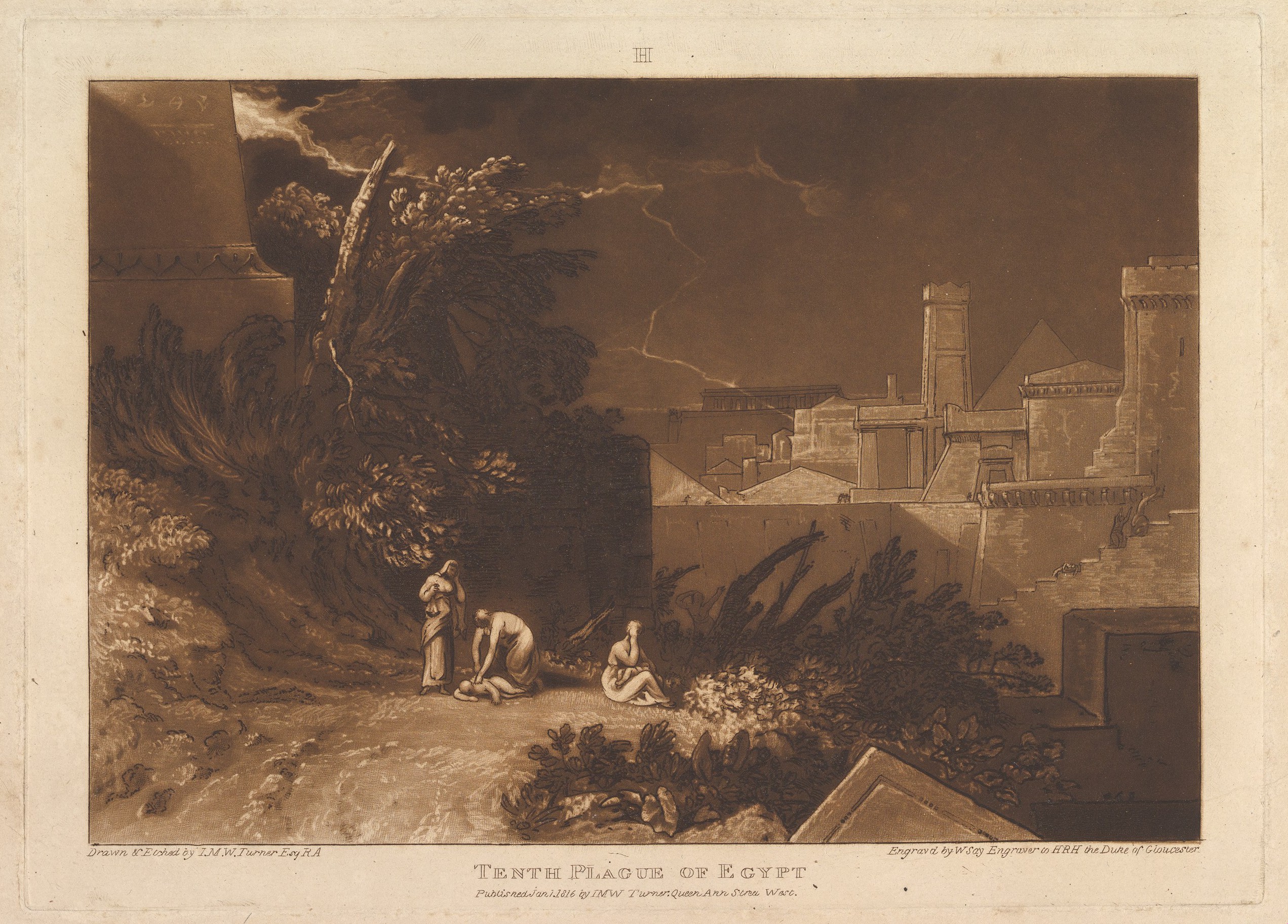
Heritage Analysis: The Tenth Plague of Egypt, Part XII, Plate 61 from "Liber Studiorum"
Symbolic Power and Cultural Resonance
J.M.W. Turner’s The Tenth Plague of Egypt, part of his seminal Liber Studiorum series, captures a pivotal moment of divine judgment and human fragility. The subject, drawn from the biblical narrative of Exodus, depicts the final plague—the death of the firstborn—that compelled Pharaoh to release the Israelites from bondage. In this etching and mezzotint, Turner masterfully contrasts the monumental architecture of ancient Egypt with the intimate tragedy of loss, symbolized by the shadowed figures and the stark, luminous sky. The symbolic power here is twofold: it represents the collapse of imperial hubris in the face of spiritual authority, and it underscores the transience of earthly power. For contemporary luxury strategy, this narrative offers a potent metaphor: true prestige is not derived from material accumulation but from moral and cultural legitimacy. A brand that channels this symbolism positions itself as a steward of heritage, not merely a purveyor of opulence.
Historical Adornment and Material Culture
The plate’s depiction of ancient Egyptian adornment—though subdued in Turner’s chiaroscuro—evokes a civilization renowned for its ritualistic use of jewelry, textiles, and regalia. Pharaohs and priests wore elaborate collars, pectorals, and headdresses inlaid with lapis lazuli, carnelian, and gold, each material imbued with cosmic significance. The ankh, the scarab, and the uraeus were not mere decorations but conduits for divine protection and eternal life. In this scene, the absence of such adornment—the starkness of grief—amplifies the humanity beneath the crown. For Katherine Fashion Lab, this tension between opulence and vulnerability is a rich vein for design. A 2026 collection could reinterpret ancient Egyptian motifs through a minimalist lens: gold filigree scarabs on matte silk, lapis-lazuli-toned embroideries on sheer linen, or hieroglyphic patterns rendered in micro-beading. The historical accuracy of these elements, when abstracted, elevates the collection from costume to cultural artifact.
Spiritual Meaning and Transcendence
Spiritually, the Tenth Plague is a catalyst for liberation and transformation. In the Judaic tradition, it marks the birth of a covenantal identity; in Egyptian cosmology, it represents the disruption of ma’at—the cosmic order. Turner’s composition emphasizes the vertical axis: the towering obelisks and pyramids contrast with the horizontal lament of the mourners, creating a visual prayer for transcendence. This duality—mortality and immortality, judgment and mercy—is central to the plate’s spiritual meaning. For a luxury brand, this narrative invites a reflection on purpose beyond profit. A 2026 strategy could embed ritualistic storytelling into the customer experience: limited-edition pieces accompanied by digital scrolls explaining their symbolic origins, or immersive exhibitions that recreate the sensory atmosphere of an ancient temple. The spiritual dimension becomes a differentiator in an era where consumers seek authenticity and meaning.
Strategic Implications for 2026 High-End Luxury
To translate this heritage analysis into a 2026 high-end luxury strategy, Katherine Fashion Lab must consider three pillars: narrative depth, material integrity, and cultural stewardship.
Narrative Depth: The Tenth Plague offers a macro-narrative of power, fall, and redemption. A capsule collection titled “Exodus” could feature pieces that tell a story through sequential design—a gown with a descending hemline symbolizing descent into humility, or a reversible cloak representing dual identities (oppressor/liberated). Each garment would be numbered and documented, with a provenance card referencing the plate’s historical context. This approach aligns with the 2026 luxury consumer’s desire for uniqueness and backstory.
Material Integrity: Turner’s use of mezzotint—a labor-intensive process—mirrors the artisanal craftsmanship that defines high-end luxury. Katherine Fashion Lab should source ethically mined gold, recycled silver, and hand-loomed silks, with each piece requiring 200+ hours of handwork. The etching technique itself can inspire surface treatments: laser-etched leather mimicking the plate’s cross-hatching, or hand-painted organza with subtle gradients of sepia and indigo. These materials become carriers of memory, much like Turner’s ink on paper.
Cultural Stewardship: Engaging with ancient Egyptian heritage requires sensitivity and collaboration. A 2026 strategy should include partnerships with Egyptian cultural institutions (e.g., the Grand Egyptian Museum) for research access and authentication. A portion of proceeds could fund conservation of ancient textiles and jewelry, reinforcing the brand’s commitment to preserving rather than appropriating cultural heritage. This builds trust and prestige among discerning clients who value ethical luxury.
Conclusion: From Plate to Podium
Turner’s The Tenth Plague of Egypt is more than a historical print; it is a blueprint for luxury’s evolution. By decoding its symbolic power, historical adornment, and spiritual meaning, Katherine Fashion Lab can craft a 2026 strategy that elevates brand identity from commercial to cultural. The collection would not merely reference the past but recontextualize it for a generation that craves depth, craftsmanship, and ethical resonance. In doing so, the brand positions itself as a curator of timeless narratives, where each garment is a plate in the Liber Studiorum of modern luxury.