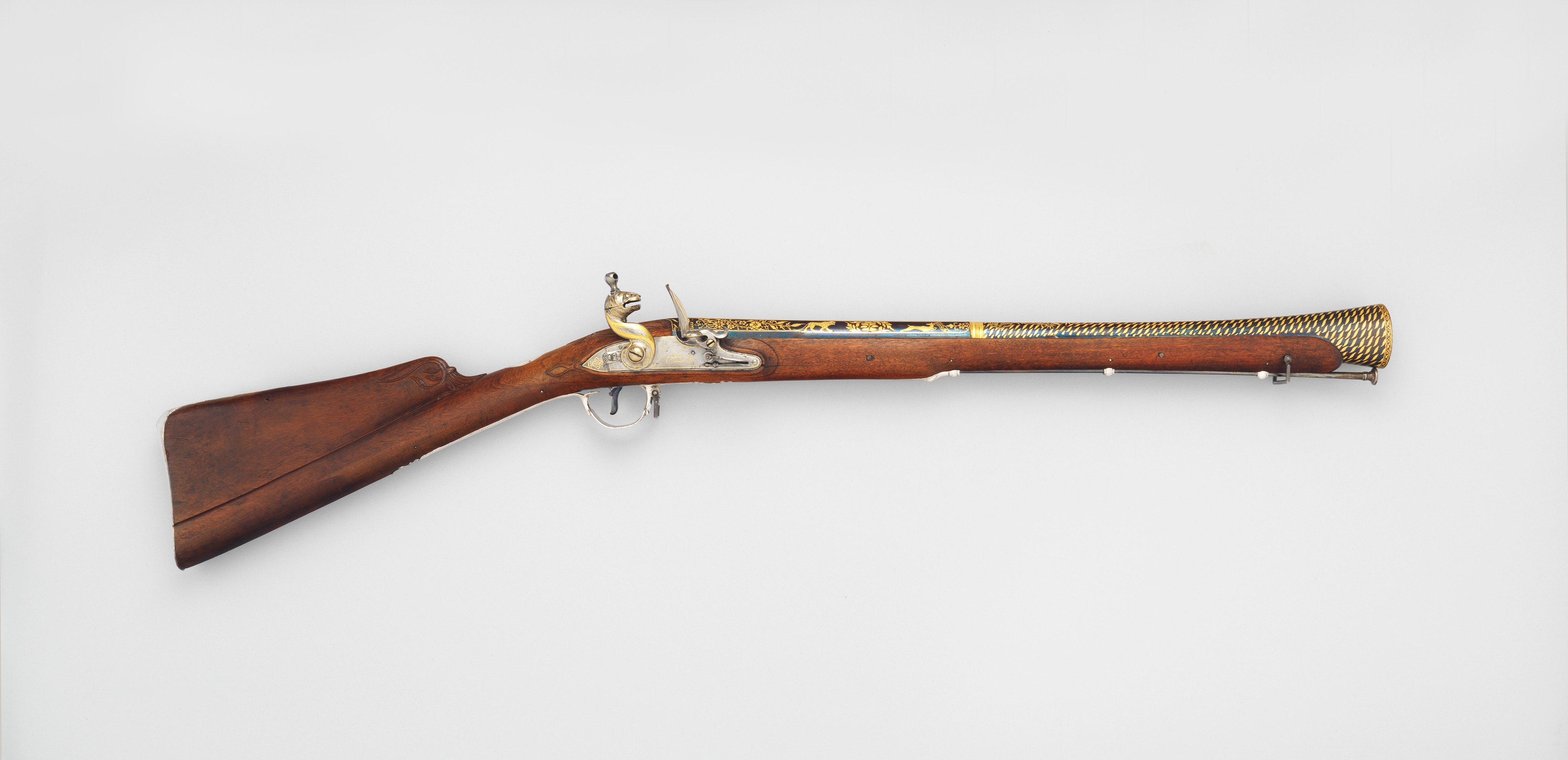
The Flintlock Blunderbuss: A Study in Martial Opulence from Seringapatam
The Flintlock Blunderbuss from Seringapatam, India, stands as a singular artifact within the annals of historical weaponry, transcending its functional role as a firearm to embody a profound synthesis of martial utility and artistic opulence. Crafted from steel, wood, gold, and silver, this piece is not merely an instrument of war but a testament to the sophisticated material culture of the late 18th-century Kingdom of Mysore under Tipu Sultan. In the context of a standalone study, this blunderbuss reveals itself as a masterclass in the fusion of indigenous craftsmanship with global influences, where every material choice and design element speaks to power, prestige, and the theater of conflict.
Historical and Cultural Resonance: The Seringapatam Legacy
The provenance of this blunderbuss—traced to Seringapatam, the fortified capital of Tipu Sultan—immediately elevates its significance. Tipu Sultan, known as the "Tiger of Mysore," was a formidable adversary to British colonial expansion and a patron of the arts who weaponized aesthetics as a means of asserting sovereignty. The Flintlock Blunderbuss from this period is not a mere relic; it is a narrative device that encapsulates the tensions of the Anglo-Mysore Wars. Its wide, flared muzzle, characteristic of blunderbusses, was designed for close-quarters combat, often from horseback or within the chaotic confines of a battlefield, scattering shot to maximize damage. However, the lavish use of gold and silver inlay suggests that this particular piece was never intended for crude skirmishes. Instead, it likely served as a ceremonial weapon or a symbol of elite status, carried by a high-ranking officer or even the Sultan himself during parades or diplomatic displays.
The choice of materials further underscores this duality. The steel barrel, forged with precision, speaks to the advanced metallurgical skills of Indian artisans, who had long mastered the art of wootz steel—a material prized for its strength and distinctive patterns. Yet, the application of gold and silver in intricate damascening and overlay work transforms the blunderbuss from a utilitarian object into a canvas. This is not merely decoration; it is a deliberate statement of wealth, technological prowess, and cultural identity. The wooden stock, likely from a local hardwood, provides a tactile contrast to the cold, reflective metals, grounding the piece in the organic traditions of Indian craftsmanship while supporting the ergonomic demands of handling.
Material Analysis: The Alchemy of Steel, Gold, and Silver
A deeper examination of the materials reveals a sophisticated hierarchy of value. The steel forms the core—the functional backbone that must withstand the explosive force of gunpowder. In Indian context, steel was not just a material but a symbol of resilience and martial honor. The barrel’s surface, when examined closely, may exhibit subtle koftgari or bidri techniques, where gold and silver are hammered into etched grooves, creating intricate floral or geometric patterns. These motifs, often inspired by Mughal and Persian aesthetics, reflect the syncretic culture of Mysore, where Hindu and Islamic artistic traditions coalesced. The gold inlay, particularly around the breech and lock plate, serves to highlight critical mechanical components, drawing the eye to the flintlock mechanism—a European innovation adapted by Indian gunsmiths. This fusion of foreign technology with indigenous artistry is a hallmark of the Seringapatam arsenal, where Tipu Sultan actively imported European firearms and reverse-engineered them, infusing them with local decorative sensibilities.
The silver accents, often applied as wire inlay or as part of the trigger guard and butt plate, introduce a cooler, more reflective tone against the warmth of the gold. This interplay of metals is not accidental; it creates a visual rhythm that guides the observer’s gaze along the length of the weapon, from the muzzle to the stock. The wood, meanwhile, is likely polished to a high sheen, its grain visible through a lacquer that may have been tinted with natural pigments. The ergonomics of the stock—its curve, the placement of the cheek rest—suggest careful consideration of the user’s comfort, yet the lavish materials indicate that this blunderbuss was more about being seen than used. It is an object of conspicuous consumption, where the artisan’s skill and the patron’s wealth are displayed in equal measure.
Design and Symbolism: The Language of Power
The design of the Flintlock Blunderbuss is a lexicon of power. The flared muzzle, often compared to a trumpet, is not merely functional—it is a visual cue that evokes the roar of a tiger, a creature central to Tipu Sultan’s iconography. The Sultan’s emblem, the bubri (tiger stripe) pattern, may be subtly incorporated into the metalwork, serving as a heraldic signature. The length of the barrel, typically shorter than standard muskets, suggests mobility, while the wide bore implies devastating force at close range. This is a weapon designed for intimidation as much as destruction. The flintlock mechanism itself, with its cock, frizzen, and pan, is a marvel of engineering, and its exposure in this piece is often highlighted with gold accents, celebrating the marriage of form and function.
The gold and silver inlays often depict motifs of victory, such as floral arabesques, mythical beasts, or calligraphic inscriptions. In the context of Seringapatam, these designs may include verses from the Quran or praises to the Sultan, reinforcing the weapon’s role as a talisman of divine favor. The wooden stock may be carved with relief patterns that mimic tiger claws or foliage, further embedding the blunderbuss within the natural and spiritual world of Mysore. This is not a weapon of anonymous mass production; it is a bespoke artifact, each detail a deliberate choice that communicates the owner’s identity, faith, and authority.
Comparative and Technical Context: A Standalone Masterpiece
In a standalone study, this blunderbuss must be appreciated not in isolation but in conversation with contemporaneous pieces from other cultures. European blunderbusses of the same era, such as those from England or France, often prioritized simplicity and utility, with minimal ornamentation. In contrast, the Seringapatam example elevates the form to a level of artistic excess that rivals the finest Mughal jade-hilted daggers or Ottoman jeweled rifles. The technical execution—the precision of the gold inlay, the balance of the steel barrel, the seamless integration of the lock mechanism—demonstrates a mastery that challenges Western-centric narratives of technological superiority. Indian gunsmiths were not merely copying European designs; they were reinterpreting them through a lens of indigenous aesthetics, creating objects that were both functional and transcendent.
The blunderbuss as a type also holds a unique place in the history of firearms. Its wide muzzle allowed for the use of multiple projectiles, making it ideal for defending fortifications or suppressing rebellions—a fitting tool for a ruler like Tipu Sultan, who faced constant threats from within and without. Yet, the lavish materials of this specific piece suggest it was a status symbol first and a weapon second. It may have been displayed in the Sultan’s armory, a curated collection that served as a theater of power, or presented as a diplomatic gift to allies. In either case, it embodies the convergence of art and war, where the act of carrying such a weapon was a performance of dominance.
Conclusion: The Enduring Allure of the Seringapatam Blunderbuss
The Flintlock Blunderbuss from Seringapatam remains a compelling subject for connoisseurs of couture and history alike. Its materials—steel, wood, gold, and silver—are not merely components but protagonists in a story of cultural synthesis, technological innovation, and imperial ambition. In a standalone study, this piece invites us to reconsider the boundaries between art and armament, luxury and lethality. It is a silent witness to the tumultuous era of Tipu Sultan, a relic that continues to speak of a kingdom that dared to forge its own path, blending the best of East and West into objects of breathtaking beauty and formidable power. For the modern observer, it serves as a reminder that the most enduring artifacts are those that transcend their original purpose, becoming timeless symbols of human creativity and conflict.