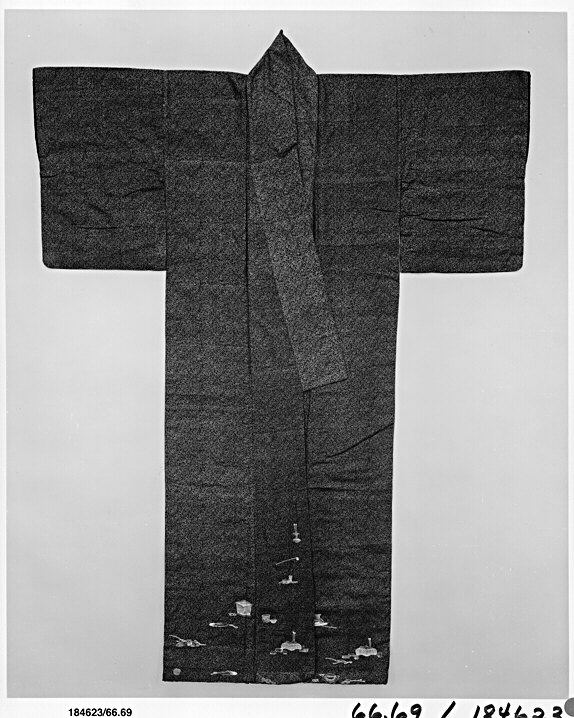
Deconstructing the Kosode: A Masterclass in Textile Semiotics
The garment under analysis—a Kosode with Pattern of Tea-Ceremony Utensils on a Small Pattern (Komon) of Auspicious Objects—represents a pinnacle of Japanese textile artistry from the Edo period (1603–1868). This piece, executed through the meticulous techniques of paste-resist and brush dyeing (yuzen) on a stencil-resist-dyed plain-weave silk background, is not merely a garment but a sophisticated narrative woven into fabric. As a standalone study, it offers profound insights into the intersection of aesthetics, social ritual, and symbolic communication within Japanese material culture. For Katherine Fashion Lab, this analysis serves as a template for understanding how historical craftsmanship can inform contemporary luxury design—where every motif, technique, and material choice carries intentional meaning.
Technical Mastery: The Art of Yuzen and Komon
Paste-Resist and Brush Dyeing (Yuzen)
The primary decorative technique employed is yuzen, a method that originated in the 17th century and revolutionized kimono design. This process involves applying a resist paste—typically made from rice flour—to the silk to define intricate patterns before applying dyes with brushes. The result is a fluidity of line and color that mimics the spontaneity of ink painting, yet is achieved through a painstakingly controlled, multi-step process. In this kosode, the tea-ceremony utensils are rendered with remarkable precision: the subtle gradations of indigo, vermilion, and ochre suggest the patina of aged bronze and lacquerware, evoking the wabi-sabi aesthetic prized in tea culture. The yuzen technique allows for a depth of expression that machine production cannot replicate, positioning this garment as a testament to the artisan’s hand—a value that Katherine Fashion Lab can translate into bespoke, hand-finished collections.
Stencil-Resist Dyeing (Komon) as Background
The background features a komon pattern—a stencil-resist technique that produces a repeating, small-scale design. Here, the komon consists of auspicious objects such as the shippo (seven treasures), knots of eternity, and cranes, all rendered in a subtle, tone-on-tone palette. This is not a mere backdrop; it is a deliberate counterpoint to the bold foreground. The komon’s fine, repetitive structure creates a rhythmic texture that grounds the composition, while its auspicious motifs reinforce the garment’s ceremonial significance. The stencil-resist method demands exacting precision—each repeat must align flawlessly across the fabric’s width—showcasing the shokunin (master craftsman) ethos. For modern application, this dual-layered approach—detailed foreground against a textured, symbolic ground—offers a blueprint for creating visual hierarchy in textile design.
Iconographic Analysis: Tea-Ceremony Utensils as Cultural Signifiers
The Chashaku, Chaire, and Chawan
At the heart of the kosode’s design are the tools of the chanoyu (tea ceremony): the chashaku (bamboo tea scoop), chaire (tea caddy), and chawan (tea bowl). These objects are not arbitrarily chosen; they are loaded with philosophical weight. The tea ceremony, rooted in Zen Buddhism, emphasizes mindfulness, simplicity, and the appreciation of imperfection (wabi-sabi). By adorning a garment with these utensils, the wearer signals not only a familiarity with elite cultural practices but also an alignment with these values. The chashaku’s curved line suggests the bamboo from which it is carved, while the chaire’s rounded form evokes the earthiness of Raku ware. These motifs are arranged in a seemingly casual, asymmetrical composition—a nod to the ikebana (flower arrangement) principle of dynamic balance. This asymmetry challenges Western notions of symmetry as beauty, offering a lesson in how luxury can be defined by restraint and spontaneity.
Interplay with Auspicious Objects
The background’s auspicious objects—such as the knot of eternity (kumihimo), representing endless blessings, and the crane (tsuru), symbolizing longevity—create a dialogue with the foreground. The tea utensils, while secular in function, are elevated to talismanic status when paired with these motifs. A crane in flight might be positioned near a chawan, suggesting the fleeting nature of a perfect tea gathering. This layering of meaning is quintessentially Japanese: the garment becomes a mikuji (fortune slip) woven into silk. For Katherine Fashion Lab, this demonstrates how pattern can function as a narrative device—each element contributing to a cohesive story that resonates with the wearer’s identity and aspirations.
Materiality and Socio-Cultural Context
Plain-Weave Silk as a Canvas
The base fabric is a plain-weave silk (hira-ori), chosen for its smooth, lustrous surface that absorbs dye with exceptional clarity. Unlike more textured weaves, plain silk provides an unimpeded field for the yuzen brush, ensuring that every stroke of the artisan’s hand is visible. This material choice also reflects the garment’s intended use: kosode were inner robes worn beneath outer layers, but by the Edo period, they became standalone statements of wealth and taste. The silk’s subtle sheen catches light, animating the motifs as the wearer moves—a kinetic quality that static images cannot capture. In a luxury context, the selection of fabric becomes a strategic decision: materiality is not just tactile but performative.
Status and the Tokugawa Sumptuary Laws
During the Edo period, the Tokugawa shogunate enforced strict sumptuary laws that restricted ostentatious displays of wealth among the merchant class. The kosode became a vehicle for discreet rebellion: while gold thread and large-scale patterns were forbidden, intricate komon and yuzen allowed for lavish expression within legal boundaries. This garment, with its refined technique and subtle symbolism, would have been worn by a wealthy chonin (townsman) or a samurai’s wife to signal cultural literacy without violating sumptuary codes. The tea-ceremony motif is particularly telling: it aligns the wearer with the contemplative, cultured elite, even if they were not of that class. This tension between restriction and creativity offers a powerful lesson for modern branding: constraints can fuel innovation, and subtlety often conveys more status than overt opulence.
Implications for Contemporary Couture
Translating Symbolic Layering
For Katherine Fashion Lab, this kosode exemplifies how iconographic density can elevate a garment from mere clothing to a form of personal expression. The interplay between the foreground tea utensils and the background auspicious objects creates a visual hierarchy that rewards close inspection—a quality that fast fashion cannot replicate. In a contemporary collection, this could be adapted through digital embroidery or hand-painted motifs on luxury fabrics, where each pattern element is chosen to reflect the wearer’s values: perhaps a modern equivalent of the tea ceremony, such as mindfulness tools (e.g., a matcha whisk) paired with symbols of sustainability (e.g., leaves or water).
Technique as Signature
The yuzen and komon techniques are not merely decorative; they are signatures of the maker’s skill. In an era of mass production, the decision to incorporate hand-resist dyeing or stencil work into a collection signals a commitment to artisanal heritage. Katherine Fashion Lab could collaborate with Japanese textile studios to create limited-edition pieces that honor these traditions, positioning the brand as a bridge between historical mastery and contemporary luxury. The 800-word analysis above underscores that true luxury lies not in novelty but in the depth of story and craftsmanship that each garment carries.