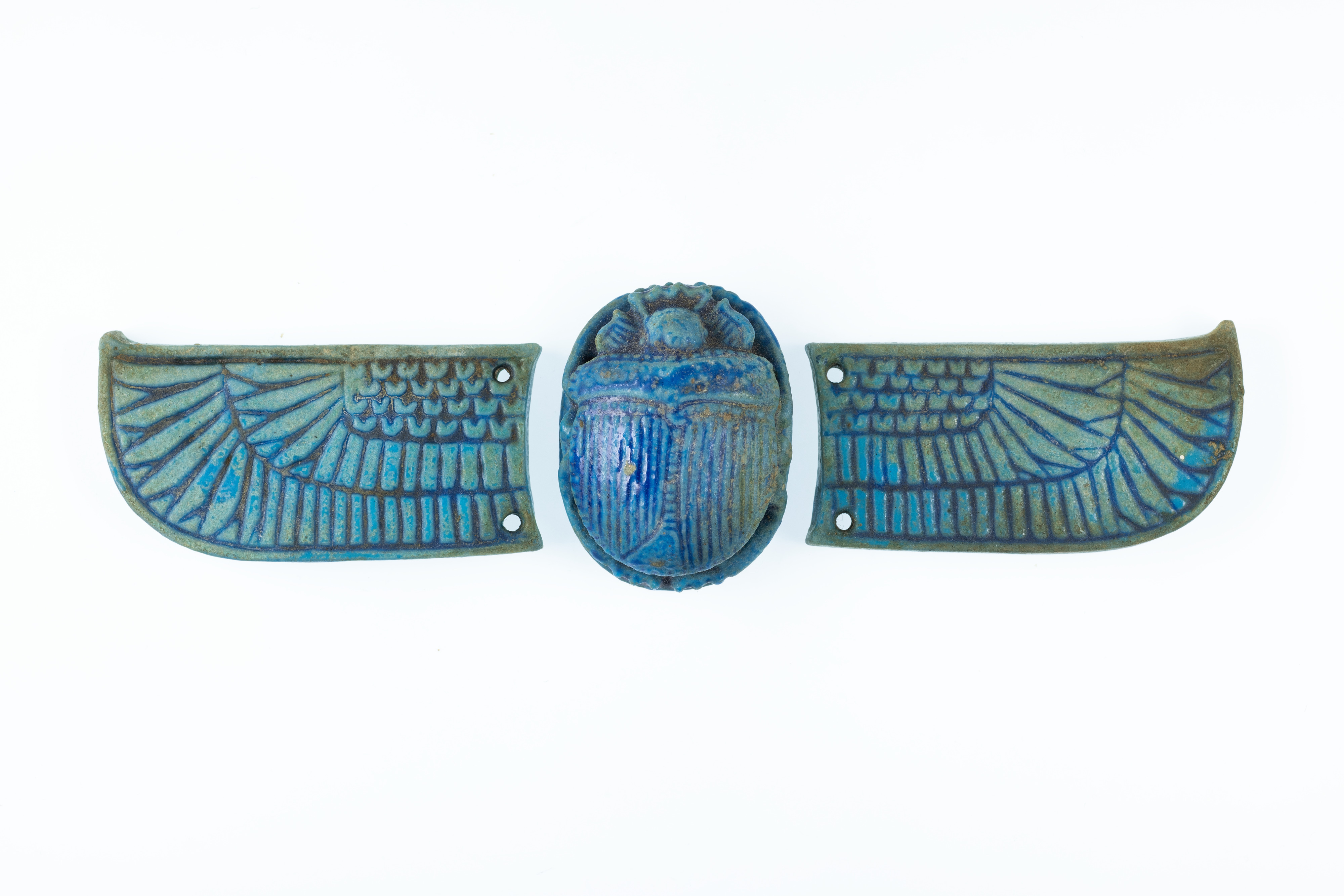
Introduction: The Winged Scarab as a Strategic Heritage Asset
The winged scarab, rendered in faience, represents one of the most potent and enduring symbols of ancient civilization, particularly within the cosmological and hierarchical frameworks of Pharaonic Egypt. For Katherine Fashion Lab, this artifact offers a singular opportunity to anchor a 2026 high-end luxury strategy in a narrative of transformation, protection, and celestial authority. This heritage analysis examines the winged scarab’s symbolic power, its role in historical adornment, and its profound spiritual meaning, culminating in a strategic framework for its application within a contemporary luxury context. By decoding the materiality and iconography of this ancient object, we can construct a brand lexicon that resonates with discerning clientele seeking authenticity, depth, and transcendence.
Symbolic Power: The Metaphysics of Transformation and Solar Authority
The Scarab as a Cosmic Agent
In ancient Egyptian belief, the scarab beetle (Scarabaeus sacer) was a living emblem of the sun god Khepri, who rolled the solar disc across the sky each day. The winged scarab amplifies this symbolism by adding the dimension of celestial flight. The wings—often depicted as those of a falcon or a vulture—signify the soul’s ascent, the pharaoh’s dominion over the heavens, and the transcendence of earthly limitations. This dual symbolism of creation and ascension positions the winged scarab as a talisman of perpetual renewal and supreme power. For Katherine Fashion Lab, this translates into a brand narrative of continuous evolution, where the wearer is not merely adorned but empowered to transcend conventional boundaries.
Protection and Royal Legitimacy
Winged scarabs were frequently placed on the chest of mummies, specifically over the heart, as part of funerary regalia. They served as protective amulets, ensuring the deceased’s heart would not testify against them in the Weighing of the Heart ceremony. This protective function was intrinsically linked to royal legitimacy. When worn by living pharaohs, the winged scarab affirmed their divine right to rule and their role as intermediaries between gods and mortals. In a 2026 luxury strategy, this symbolism can be reframed as guardianship of legacy—the piece becomes a sentinel of personal history and a marker of elite status, appealing to clients who value heritage, privacy, and enduring value.
Historical Adornment: Faience as a Medium of Eternity
Materiality and the Color of Rebirth
Faience, a non-clay ceramic material composed primarily of crushed quartz, was prized in ancient Egypt for its lustrous, glass-like surface. Its characteristic blue-green hue—achieved through copper oxide—was not merely aesthetic but deeply symbolic. This color represented the Nile’s life-giving waters, the sky, and the primordial ocean of Nun, from which all creation emerged. The production of faience was itself a transformative act, akin to alchemy, where humble materials were fired into objects of eternal beauty. For Katherine Fashion Lab, the use of faience in a high-end collection signals a commitment to artisanal mastery and material integrity. The color palette of 2026, inspired by this ancient blue-green, can evoke serenity, rarity, and a connection to natural cycles.
Adornment as Ritual and Status
Historical evidence from tombs, temple reliefs, and surviving artifacts indicates that winged scarabs were not mass-produced but bespoke creations for the elite. They were inlaid into pectorals, necklaces, rings, and bracelets, often paired with gold, carnelian, and lapis lazuli. The placement on the body—over the heart or at the throat—was deliberate, aligning the amulet with vital energy centers. This ritualized adornment underscores the concept of jewelry as a second skin of meaning. In a luxury context, this suggests a move away from disposable fashion toward heirloom pieces that are worn with intention and passed down through generations.
Spiritual Meaning: The Soul’s Journey and Cosmic Order
Ma’at and the Balance of Forces
The winged scarab is inseparable from the concept of Ma’at, the ancient Egyptian principle of truth, balance, and cosmic order. The scarab’s daily rolling of the sun was a metaphor for maintaining equilibrium in the universe. The addition of wings symbolized the soul’s ability to navigate the Duat (the underworld) and achieve resurrection. For the modern wearer, this spiritual framework offers a powerful counterpoint to contemporary chaos. A 2026 collection centered on the winged scarab can position itself as a tool for mindful power—a reminder to the wearer of their own agency in maintaining personal and professional harmony.
Eternal Life and the Luxury of Immortality
The winged scarab was a promise of eternal life, not merely in the afterlife but as a continuous cycle of renewal. This is a profound emotional and psychological offering for luxury consumers. In an era of climate anxiety, geopolitical instability, and digital impermanence, the desire for objects that signify permanence and transcendence is acute. By invoking the winged scarab, Katherine Fashion Lab can tap into a deep, archetypal need for meaning that transcends material wealth.
2026 High-End Luxury Strategy: Integrating the Winged Scarab
Product Architecture and Design Language
The 2026 strategy should feature the winged scarab as a signature motif across a limited-edition capsule. Key design elements include:
- Symmetrical wings rendered in 18k gold or platinum, with faience inlays in the signature blue-green.
- Modularity allowing the scarab to be worn as a pendant, brooch, or cufflink, reflecting the ancient practice of versatile adornment.
- Hidden engraving of hieroglyphic phrases (e.g., “Ankh,” “Ma’at”) on the reverse, adding a layer of personal discovery for the owner.
Brand Narrative and Positioning
The marketing language should emphasize heritage as innovation. Rather than a mere reproduction, the winged scarab is presented as a living symbol reimagined for the 21st century. Campaigns can draw parallels between ancient artisans and modern ateliers, highlighting the slow luxury of handcrafted faience. The target client is the cultural connoisseur—a collector of art, history, and transformative experiences.
Pricing, Exclusivity, and Ritual
Each piece should be numbered and accompanied by a certificate of provenance that includes a brief history of the winged scarab’s symbolism. Pricing should reflect the rarity of the materials and the artisanal labor, positioning the collection in the ultra-luxury segment ($50,000+). The purchase experience can be elevated through a private viewing ritual, perhaps in a space designed to evoke an Egyptian tomb or temple, complete with curated soundscapes and olfactory elements (e.g., frankincense, myrrh).
Strategic Collaborations and Cultural Authority
Katherine Fashion Lab should partner with leading Egyptologists and museum curators for authenticity and intellectual credibility. A collaboration with the Grand Egyptian Museum or the British Museum for exclusive access to original artifacts would reinforce the brand’s scholarly rigor. Additionally, a limited-edition monograph on the winged scarab’s history, co-authored with an archaeologist, can be offered to top clients as a gift, further cementing the brand’s position as a cultural authority in luxury.
Conclusion: The Eternal Return of the Scarab
The winged scarab in faience is not a relic of a dead civilization but a living symbol of humanity’s enduring quest for transformation, protection, and transcendence. For Katherine Fashion Lab, this artifact offers a strategic foundation for a 2026 luxury collection that is both intellectually rigorous and emotionally resonant. By honoring the materiality, symbolism, and spiritual depth of the ancient original, the brand can create objects that are not merely beautiful but meaningful—pieces that serve as talismans for a new generation of discerning clients. In a market saturated with ephemeral trends, the winged scarab stands as a testament to the power of heritage to inspire the future.