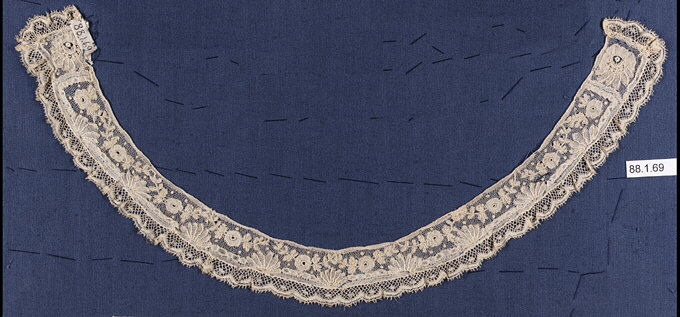
The Collar as Cartography: Bobbin Lace and Global Heritage at Katherine Fashion Lab
In the rarefied domain of haute couture, where innovation often masquerades as disruption, Katherine Fashion Lab’s latest standalone study on the collar represents a masterclass in reverent subversion. The subject—the collar—is a perennial anchor of sartorial authority, yet here it is reimagined not as a structural afterthought but as a narrative epicenter. The material of choice, bobbin lace, elevates this exploration from mere textile craft to a dialogue with global heritage. This analysis dissects how the Lab transforms a humble, handmade technique into a sophisticated lexicon of cultural memory, spatial geometry, and contemporary luxury.
The Collar as Cultural Signifier
Historically, the collar has served as a marker of status, profession, and identity—from the Elizabethan ruff to the clerical dog collar. Katherine Fashion Lab’s curatorial lens, however, expands this taxonomy. The study positions the collar not as a static accessory but as a mobile cartography of human connection. Each bobbin lace collar in the collection is a standalone artifact, yet collectively they form a constellation of global narratives. The Lab’s research draws from archival lace traditions across Europe, Asia, and the Americas, demonstrating that the collar’s form—whether a high-necked mandarin style or a sweeping Victorian bertha—is a vessel for cultural exchange.
The material choice of bobbin lace is particularly resonant. Unlike machine-made lace, bobbin lace is a tactile chronicle of patience and precision. Each thread, twisted and braided by hand, encodes the maker’s rhythm, the region’s climate, and the economic realities of its time. Katherine Fashion Lab’s study foregrounds this heritage by sourcing lace from artisans in Belgium, India, and Brazil, thereby treating the collar as a living archive. The result is a collection where no two pieces are identical, and each collar becomes a unique testament to its origin.
Deconstructing the Bobbin Lace Collar: Form and Technique
The technical execution of bobbin lace requires an intimate understanding of tension, pattern, and material behavior. Katherine Fashion Lab’s approach is both reverent and analytical. The collars are constructed using traditional techniques such as Torchon, Cluny, and Point de France, but they are recontextualized through modern draping and architectural silhouettes. For instance, a collar inspired by the Flemish kant tradition is rendered in a sculptural, asymmetrical form that defies the symmetry typically associated with historical lace. This juxtaposition of old and new is deliberate: it challenges the viewer to see bobbin lace not as a relic but as a dynamic medium for couture innovation.
The material itself—fine linen, silk, or metallic threads—is chosen for its ability to hold shape while retaining fluidity. The Lab’s designers employ a technique called “structural lace”, where the bobbin patterns are engineered to create self-supporting collars that stand away from the neck, mimicking the rigidity of bone or metal without sacrificing the lace’s ethereal quality. This is a feat of precision engineering: each knot and loop is calculated to distribute weight and tension, ensuring the collar remains both comfortable and imposing. The standalone study format allows for a forensic examination of these techniques, with detailed diagrams and micro-photography revealing the intricate lattice of threads.
Global Heritage as a Design Philosophy
Katherine Fashion Lab’s commitment to global heritage is not a superficial nod to diversity but a rigorous methodology. The study traces the migration of bobbin lace techniques across continents, highlighting how colonization, trade, and diaspora have shaped the craft. For example, the collar titled “Goa’s Echo” incorporates Portuguese-influenced lace patterns from India, where missionaries introduced European techniques that were subsequently blended with indigenous motifs. Similarly, the “Brasilia Cascade” collar features Brazilian bobbin lace made from hand-spun cotton, a material that speaks to the region’s agricultural history and the legacy of enslaved artisans who preserved these skills.
This global perspective is further enriched by the Lab’s collaboration with contemporary lace makers. Each artisan brings their cultural lens to the design process, resulting in collars that are not mere replicas but reinterpretations. The “Kyoto Veil” collar, for instance, merges Japanese kumihimo braiding with Belgian bobbin lace, creating a hybrid form that honors both traditions. The Lab’s curatorial notes emphasize that this is not cultural appropriation but cultural dialogism—a respectful exchange that acknowledges power dynamics and historical inequities. The standalone study format allows for extensive footnotes and provenance documentation, ensuring that each collar’s heritage is transparent and celebrated.
The Standalone Study: A New Paradigm for Couture Analysis
The decision to present this collection as a standalone study is itself a strategic statement. In an industry dominated by seasonal collections and rapid turnover, Katherine Fashion Lab positions the collar as a subject worthy of deep, unhurried scrutiny. The study is structured as a monograph, complete with ethnographic research, material science data, and visual essays. This format enables a level of detail that traditional runway shows or lookbooks cannot accommodate. For example, the study includes a chapter on the “Physics of Lace”, analyzing how thread count and twist angle affect the collar’s drape and durability. Another section, “The Politics of the Neck”, explores how collars have been used to signify power, modesty, or rebellion across cultures.
From a business perspective, the standalone study redefines the value proposition of couture. By treating the collar as an intellectual property asset—complete with patentable techniques and design registrations—Katherine Fashion Lab creates a new revenue stream through licensing and educational partnerships. The study is also a marketing tool, positioning the Lab as a thought leader in sustainable luxury. Bobbin lace, by its nature, is slow fashion: each collar requires hundreds of hours of handwork, supporting artisan communities and reducing waste. The study’s emphasis on provenance and craftsmanship appeals to a discerning clientele that values story over speed.
Implications for the Future of Couture
Katherine Fashion Lab’s collar study offers a blueprint for how haute couture can engage with heritage without being nostalgic. It demonstrates that craft and innovation are not antithetical but symbiotic. The bobbin lace collar becomes a metaphor for the industry’s potential: fragile yet resilient, rooted yet expansive. For designers, the study provides a vocabulary for integrating traditional techniques into contemporary silhouettes. For consumers, it offers a deeper appreciation of the labor and cultural narratives embedded in each garment.
Ultimately, this analysis reveals that the collar is far more than a neckline accent. It is a site of convergence—where history meets modernity, where global influences coalesce into a singular form, and where the hand of the artisan speaks to the eye of the connoisseur. Katherine Fashion Lab’s standalone study is a testament to the power of focused inquiry, proving that even the most familiar subject, when examined through the lens of global heritage and masterful technique, can yield extraordinary insights. The bobbin lace collar is not just a fashion statement; it is a woven world.