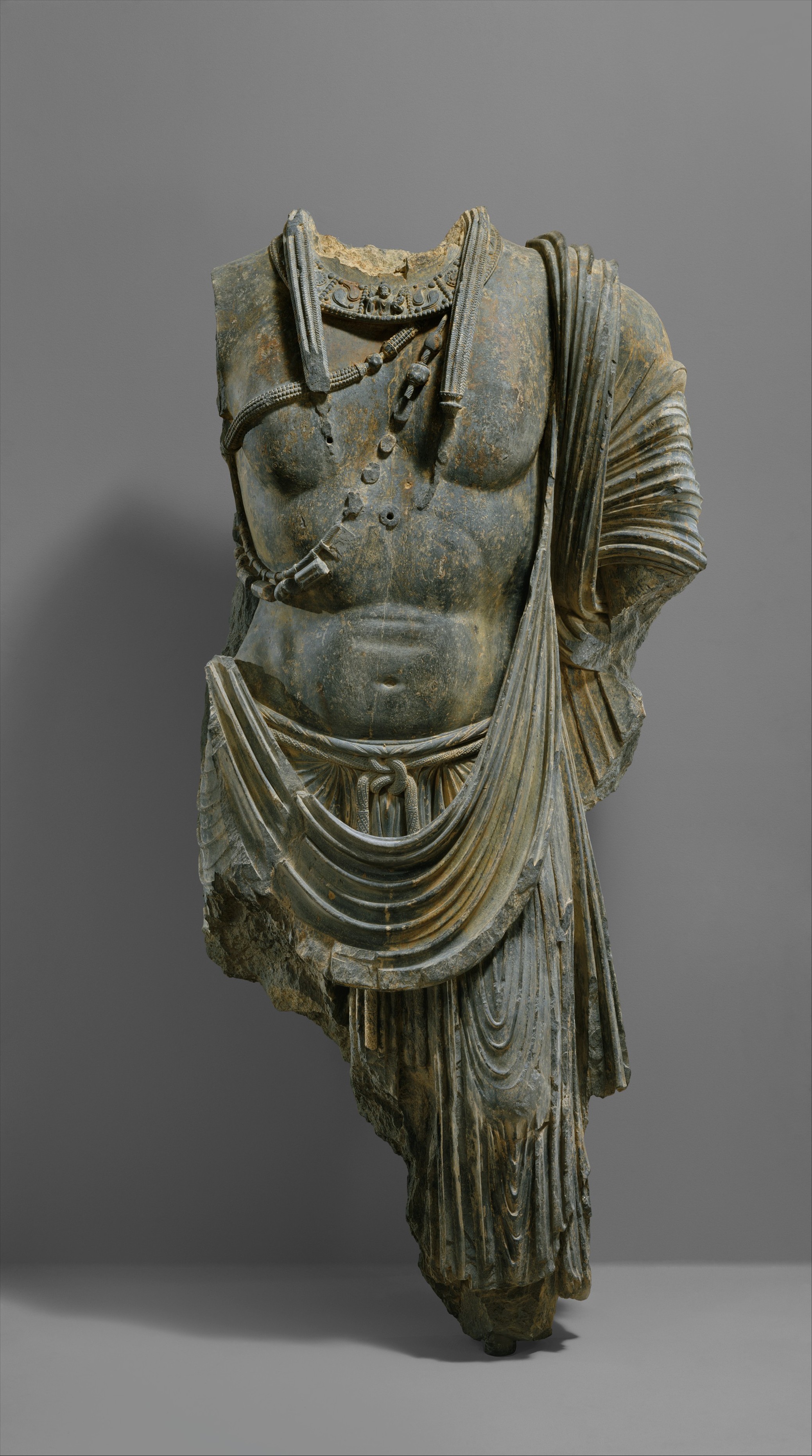
The Ethereal in Stone: Deconstructing the Torso of a Bodhisattva
Artifact as Artefact: A Couture Lens on Gandharan Sculpture
In the rarefied world of haute couture, a garment is never merely fabric; it is a narrative, a philosophy, a dialogue between the ephemeral and the eternal. The Torso of a Bodhisattva, a fragmentary yet profoundly eloquent sculpture from the ancient Gandharan region of modern-day Pakistan, offers a parallel lexicon for the fashion analyst. Carved from dark, metamorphic schist in the Peshawar basin between the 2nd and 4th centuries CE, this piece is not a complete figure—it is a masterclass in the power of the partial, the suggestive, and the transcendent. For Katherine Fashion Lab, this artifact is not a historical relic to be preserved behind glass; it is a living design brief, a study in volume, drape, and the architecture of spiritual aspiration.
Gandhara, a crossroads of Hellenistic, Persian, and indigenous Indian cultures, produced a syncretic art form that reimagined the Buddha and Bodhisattvas with a distinctly Western-inflected naturalism. The Torso embodies this fusion. The garment—a monastic robe (sanghati) worn over a dhoti—is rendered with a realism that rivals the finest draping in a Parisian atelier. Yet, the materiality of schist, with its dense, layered grain and somber grey-green patina, introduces a tension: the softness of cloth is eternalized in stone, the fluidity of the human form is arrested in a medium of immense gravity. This is the first couture lesson: the medium is the message. A silk charmeuse gown and a carved granite bodice communicate radically different temporalities, yet both can achieve the same goal—the elevation of the wearer beyond the mundane.
The Anatomy of Drape: Volume, Weight, and the Illusion of Movement
The most arresting feature of the Gandharan Torso is its treatment of fabric. The sanghati, worn diagonally across the left shoulder, cascades in a series of deep, rhythmic folds that gather at the chest and fall in a controlled cascade down the torso. This is not the static, geometric pleating of archaic Greek kouroi; it is a baroque, almost rococo, manipulation of mass. The sculptor understood that fabric has a life of its own—a weight that pulls, a texture that catches light, a volume that defines the space between the body and the world.
From a couture perspective, this is a study in negative space and structural tension. The folds are not merely decorative; they create a series of interlocking planes that guide the eye from the missing head down to the severed waist. The left side of the torso, where the robe is gathered, is dense with vertical striations that suggest a heavy, woolen-like material. The right side, where the fabric is pulled taut over the chest and abdomen, reveals the underlying anatomy with startling precision. The navel is subtly indicated, the pectoral muscles are softly modeled, and the slight rotation of the torso—a contrapposto stance inherited from Hellenistic sculpture—imbues the figure with a latent dynamism.
For Katherine Fashion Lab, this interplay between concealment and revelation is the essence of sophisticated design. A couture gown that hides the body entirely can be as powerful as one that reveals it; the key is intentionality. The Gandharan sculptor chose exactly where to let the stone become skin, and where to let it remain cloth. This is a lesson in strategic opacity. The fabric is not a cover; it is a second skin that amplifies the spiritual presence of the Bodhisattva, a being who has transcended desire yet remains compassionately embodied. In modern terms, this is the power of a well-constructed jacket that sculpts the silhouette or a bias-cut gown that clings and releases with each step.
Materiality and Patina: Schist as a Couture Fabric
The choice of schist is itself a bold design decision. Unlike the white marble of Hellenistic originals, which suggests purity and light, Gandharan schist is dark, dense, and almost foreboding. Its surface, when polished, takes on a subtle sheen that resembles wet stone, while its natural cleavage planes create a layered, almost sedimentary texture. This is not a material that forgives error; it demands precision. The sculptor’s chisel marks, visible in the deep undercutting of the folds, become a kind of textural calligraphy—a signature of the hand that is as intimate as a seamstress’s stitch.
In the context of a couture analysis, the patina of age—the chips, the abrasions, the partial loss of the left arm and head—is not a flaw but an accumulated narrative. This Torso has survived centuries of conquest, climate, and neglect. Each mark is a witness to history, a trace of the journey from a monastic sanctuary in the Peshawar valley to a climate-controlled gallery. A garment that bears the patina of wear—a faded dye, a mended tear, a softened collar—carries a similar power. It speaks of a life lived, of rituals performed, of the body that once inhabited it. The fashion industry’s obsession with the pristine is a modern construct; the Gandharan Torso reminds us that imperfection is the ultimate luxury. It is the evidence of authenticity, the proof that the object has been in the world.
The Missing Head: The Power of the Incomplete
Perhaps the most provocative element of this sculpture for the fashion analyst is its fragmentation. The head is gone; the arms are missing below the shoulders; the legs are severed at the hips. What remains is a pure, concentrated study of the torso—the core, the center of gravity, the seat of breath and being. In a world of complete, often cluttered, visual stimuli, the Torso demands a different kind of attention. It forces the viewer to complete the figure in the mind’s eye, to imagine the serene face, the intricate ushnisha (cranial protuberance), the lotus pedestal. This act of imaginative co-creation is the same dynamic that occurs when a woman slips into a couture gown: she does not merely wear the garment; she inhabits it, animates it, and completes its narrative.
For Katherine Fashion Lab, the Torso of a Bodhisattva is a manifesto for minimalism with maximum intention. It proves that a fragment can be more powerful than a whole. A dress that reveals the back while covering the front, a jacket that ends at the ribcage, a skirt that is asymmetrically hemmed—these are not failures of design but deliberate choices to engage the viewer’s imagination. The missing head of the Bodhisattva is a reminder that the most compelling fashion often leaves something unsaid, something to be discovered, something that remains in the realm of the sacred.
Conclusion: The Drape of the Divine
The Torso of a Bodhisattva from Gandhara is not a static artifact; it is a dynamic text on the art of dressing the spirit. Its mastery of drape, its dialogue between stone and flesh, its embrace of fragmentation, and its synthesis of cultural influences offer a timeless vocabulary for the couturier. In the hands of Katherine Fashion Lab, the lessons of this ancient sculpture translate into garments that are not worn but inhabited. They are robes that speak of transcendence, volume that honors the body, and textures that bear the weight of history. To study this Torso is to understand that true couture is never about the fabric alone—it is about the space between the fabric and the soul, the breath that animates the form, and the eternal echo of a hand that once carved stone into grace.