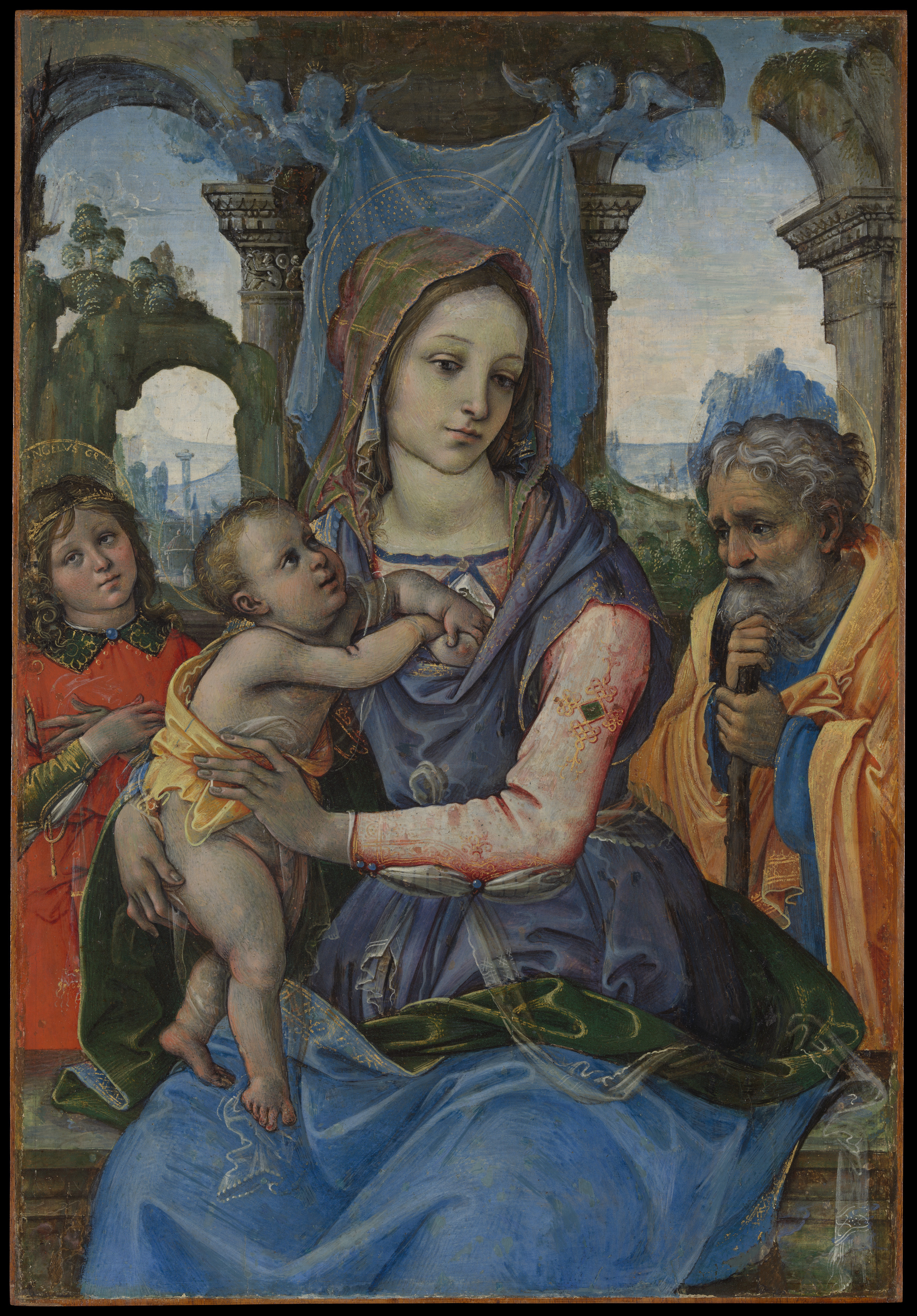
The Divine Thread: A Couture Analysis of “Holy Family with an Angel”
Introduction: The Sacred as Sartorial Muse
In the rarefied echelons of haute couture, the intersection of art history and textile innovation often yields collections that transcend mere clothing to become cultural commentary. At Katherine Fashion Lab, the analysis of “Holy Family with an Angel”—a tempera-on-canvas masterpiece transferred from wood, bearing a Global Heritage provenance—serves as a profound case study in how sacred iconography can inform modern design ethos. This standalone work, originally conceived as a devotional study, offers a rich tapestry of symbolic, chromatic, and textural elements that resonate with couture’s highest aspirations: the elevation of the human form through narrative and craft.
I. Materiality and Craft: Tempera’s Lesson in Precision
The medium of tempera on canvas, transferred from its original wood support, is a testament to meticulous restoration and artistic intent. Tempera, a paint bound with egg yolk, demands rapid, deliberate application—each stroke is permanent, unforgiving. This technique mirrors the discipline of couture draping, where every pleat and seam must be executed with unwavering precision. For Katherine Fashion Lab, this materiality inspires a collection rooted in structural integrity and translucency. The canvas’s weave, now visible after transfer, suggests a base fabric for a gown: a raw silk or organza that catches light while retaining form. The tempera’s matte finish, devoid of gloss, translates to matte satins and velvets that absorb rather than reflect, inviting tactile engagement. The “transfer” itself—a delicate process of moving the painting from wood to canvas—parallels the couturier’s challenge of shifting a design from sketch to three-dimensional form, preserving essence while adapting to a new substrate.
II. Chromatic Palette: The Theology of Color
The color scheme of “Holy Family with an Angel” is a masterclass in divine harmony. The Virgin Mary’s lapis lazuli blue—historically sourced from Afghanistan and more precious than gold—dominates the composition. This ultramarine hue, symbolizing heaven and truth, becomes a signature tone for a couture evening gown: a deep, saturated indigo velvet, hand-dyed to evoke the pigment’s luminosity. The Christ Child’s pale, warm flesh tones, rendered in ochre and lead white, suggest a nude silk charmeuse slip dress, layered under the blue for a subtle, skin-like glow. Joseph’s earthy brown cloak, grounded in umber and sienna, translates to a tailored wool coat in burnt umber, its weight and texture evoking protection and humility. The angel’s wings, painted in gold leaf and white lead, inspire metallic brocade or gold-thread embroidery on a sheer tulle overlay—an ethereal accent that catches light like a halo. The interplay of these colors—cool blues against warm earths, punctuated by gold—creates a chromatic narrative of the sacred and the terrestrial, a balance that Katherine Fashion Lab’s design team can replicate through strategic color blocking and tonal gradients.
III. Composition and Silhouette: The Geometry of Devotion
The painting’s composition, a triangular arrangement of the Holy Family with an angel, offers a blueprint for silhouette. The central group—Mary, Joseph, and the infant Jesus—forms a stable pyramid, suggesting a structured gown with a defined bodice and full A-line skirt. The angel, positioned slightly above and to the side, introduces an asymmetrical element, akin to a dramatic shoulder drape or a single cape sleeve. The figures’ gestures—Mary’s protective embrace, Joseph’s contemplative stance, the angel’s pointing hand—translate to draping techniques that guide the eye. For instance, a gown’s neckline could echo the angel’s gesture with a bias-cut cowl that sweeps from one shoulder, while the bodice’s boning mimics the rigid, vertical folds of Joseph’s cloak. The infant’s reclining pose suggests a draped overlay, like a silk sash that cascades from the waist. This geometric approach ensures that the garment is not merely decorative but architectural—each line and fold serving a narrative purpose.
IV. Textural Dialogue: From Tempera to Textile
The surface of the tempera painting—smooth yet subtly textured from brushstrokes and the canvas weave—inspires a textural vocabulary for couture. The Virgin’s veil, painted with fine, parallel lines, suggests a pleated organza or micro-pleated silk, its ridges catching shadow and light. The angel’s feathers, rendered in layered gold strokes, translate to hand-embroidered sequins or metallic threadwork on a sheer base. Joseph’s rough cloak, with its visible brushwork, evokes a bouclé wool or raw linen, intentionally nubby and tactile. The transfer process, which may have left faint craquelure or surface irregularities, inspires a distressed finish on certain fabrics—a deliberate “aged” effect achieved through sanding or chemical treatment, adding depth and history. This textural dialogue ensures that the garment engages multiple senses, inviting the wearer and observer to explore its surface as one might study a painting up close.
V. Symbolic Embellishment: Narrative Details
Beyond color and texture, the painting’s iconography offers rich opportunities for embellishment. The angel’s halo, a gold disc, can be reinterpreted as a circular train or a metallic appliqué at the back of a gown, symbolizing divine presence. The infant Jesus’s hand, raised in blessing, inspires a single embroidered hand motif on a glove or sleeve cuff. The Virgin’s star—a common attribute in Marian iconography—could be rendered as a crystal-encrusted brooch or a constellation of tiny beads on the bodice. Joseph’s staff, a symbol of his role as protector, becomes a structural element—a boned seam or a metallic rod inserted into the gown’s hem for shape. These symbolic details transform the garment into a wearable narrative, where each element invites contemplation and conversation, much like the painting itself.
VI. Global Heritage: A Universal Language
The painting’s designation as “Global Heritage” underscores its transcendence of a single cultural origin. While rooted in Christian iconography, its themes of family, protection, and divine love are universal. For Katherine Fashion Lab, this demands a collection that respects the original context while embracing cross-cultural fusion. The tempera technique, with roots in Byzantine and Italian Renaissance traditions, can be paired with textiles from India (handwoven silk), Japan (shibori dyeing), or West Africa (indigo resist-dye). The angel’s wings, reminiscent of Persian miniature painting, might incorporate metallic thread from Uzbekistan. The Virgin’s blue, historically sourced from Afghanistan, could be matched with a naturally dyed indigo from the Americas. This global approach ensures that the couture line is not a mere reproduction but a dialogue—a respectful conversation between cultures, epochs, and techniques.
VII. Standalone Study: The Power of Singularity
As a standalone study, this painting exists outside a larger narrative, inviting the viewer to focus entirely on its composition and detail. For couture, this translates to a signature piece—a single gown or ensemble that embodies the entire collection’s ethos. Such a garment might be shown alone on a runway, with minimal accessories, allowing its structure, color, and symbolism to speak. The standalone nature also suggests a modular design: a dress that can be worn in multiple ways (e.g., a detachable train, interchangeable sleeves), echoing the painting’s ability to be studied from different angles. This approach aligns with modern couture’s shift toward versatility and personalization, where the wearer becomes a co-creator of the narrative.
Conclusion: Weaving the Sacred into the Secular
“Holy Family with an Angel” is not merely a painting to be admired but a blueprint for couture innovation. Through its materiality, chromatic depth, geometric composition, textural richness, symbolic embellishment, global resonance, and standalone power, it offers Katherine Fashion Lab a template for creating garments that are both visually stunning and intellectually profound. In an era where fashion often prioritizes speed over substance, this analysis reminds us that true couture is a slow, deliberate art—one that, like tempera painting, demands precision, patience, and a deep reverence for the story it tells. The result is not just clothing but a wearable heritage, a thread connecting the divine to the everyday, the past to the present, and the artist to the artisan.