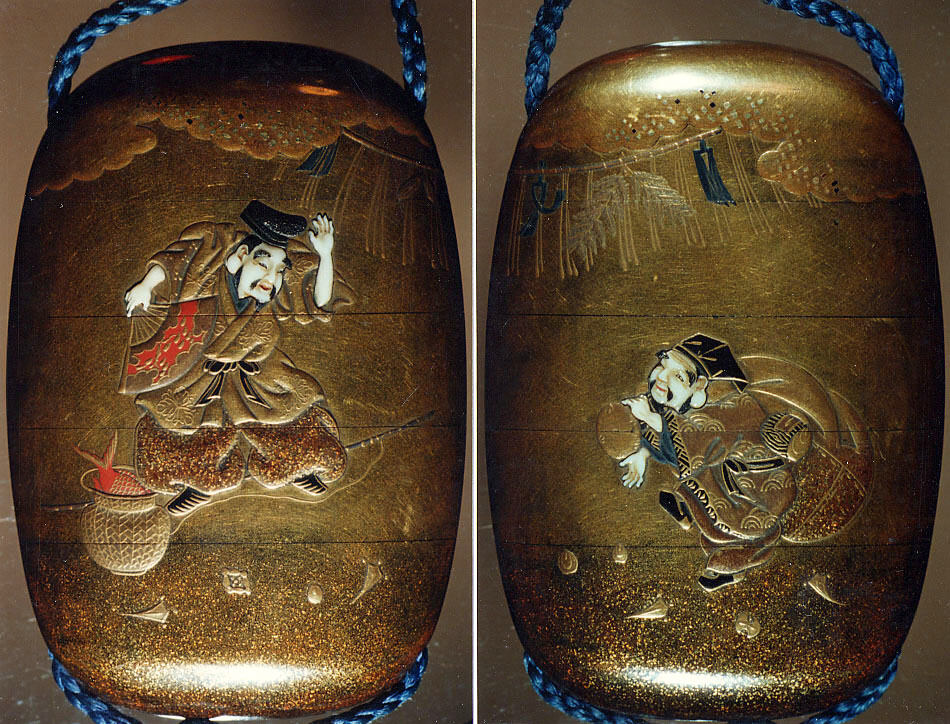
Heritage Analysis: Case (Inrō) with Design of Ebisu and Daikoku Dancing beneath New Year's Decorations
Introduction: The Object as Cultural Archive
The Case (Inrō) with Design of Ebisu and Daikoku Dancing beneath New Year's Decorations represents a pinnacle of Japanese Edo-period craftsmanship, embodying a confluence of spiritual symbolism, social status, and aesthetic mastery. As a portable accessory worn by samurai and wealthy merchants, the inrō served both utilitarian and decorative functions. This particular piece, executed in gold lacquer with gold and colored hiramakie sprinkled and polished lacquer, complemented by ivory inlay, a polished wood netsuke, and a red lacquer ojime, offers a rich narrative of prosperity, renewal, and divine favor. For Katherine Fashion Lab, this artifact provides a strategic blueprint for infusing high-end luxury with deep cultural resonance, particularly as we approach the 2026 market landscape.
Symbolic Power: Ebisu, Daikoku, and the Iconography of Fortune
At the heart of this inrō lies the depiction of Ebisu and Daikoku, two of Japan’s Seven Lucky Gods (Shichifukujin). Ebisu, the god of fishermen and honest labor, is traditionally shown with a fishing rod and sea bream (tai), symbolizing abundance and good luck. Daikoku, the god of wealth and agriculture, carries a mallet (uchide no kozuchi) that, when shaken, grants wishes and produces riches. Their dancing posture beneath New Year’s decorations—likely shimenawa (sacred straw ropes) and kadomatsu (pine and bamboo arrangements)—elevates the scene from mere ornamentation to a ritual invocation of renewal and prosperity.
The New Year context is critical: in Japanese culture, the turn of the year is a liminal period when deities descend to bless households. By capturing Ebisu and Daikoku in mid-dance, the artisan freezes a moment of auspicious energy, transforming the inrō into a portable talisman. For Katherine Fashion Lab, this symbolic power can be translated into a 2026 luxury strategy that emphasizes “fortune as a wearable experience.” Limited-edition collections could feature motifs of paired deities or celebratory patterns, aligning with consumer desires for meaning and protection in uncertain times.
Historical Adornment: Inrō as Status and Identity
The inrō emerged during the Muromachi period (1336–1573) and reached its zenith in the Edo period (1603–1868), when sumptuary laws regulated dress but allowed for subtle displays of wealth through accessories. Worn suspended from the obi (sash) via a silk cord, the netsuke (toggle) and ojime (bead) were not merely functional but also signifiers of taste and social standing. This particular piece, with its gold lacquer and ivory inlay, would have been commissioned by a high-ranking samurai or affluent merchant seeking to project sophistication and piety.
The materials themselves carry historical weight: gold lacquer (kinji) was labor-intensive and costly, requiring dozens of layers and months of drying time. The use of hiramakie (flat sprinkled gold) and nashiji (pear-skin ground) interiors reflects the artisan’s mastery of maki-e techniques, while the ivory inlay adds a tactile dimension. The netsuke, a simple polished wood button, contrasts with the opulence of the inrō, suggesting a deliberate restraint. For modern luxury, this balance between opulence and understatement is a lesson in exclusivity. Katherine Fashion Lab can adopt a “quiet luxury” approach for 2026, using precious materials in subtle, artisanal ways—such as micro-embroidery or hand-painted motifs—that reward close inspection.
Spiritual Meaning: The Inrō as a Vessel for Blessings
Beyond its aesthetic and social functions, this inrō embodies Shinto and Buddhist syncretism. The New Year decorations reference Shinto purification rituals, while the Seven Lucky Gods derive from Buddhist and Taoist traditions. The act of carrying the inrō was itself a spiritual practice: the wearer would handle the netsuke and ojime throughout the day, each touch reinforcing the connection to divine blessings. The interior, finished in fundame (matte gold) and nashiji, suggests a hidden sanctum, mirroring the idea of inner wealth and spiritual cultivation.
This spiritual dimension is increasingly relevant for high-end consumers in 2026, who seek meaning over materialism. Katherine Fashion Lab can integrate this by designing “ritual accessories” that encourage mindfulness—such as a modern inrō-inspired pouch for carrying talismans or a necklace with interchangeable charms representing luck, health, or prosperity. The red lacquer ojime, in particular, evokes the protective color in Japanese culture, which can be echoed in signature red accents across the collection.
2026 High-End Luxury Strategy: Lessons from the Inrō
As we look toward 2026, the luxury market is shifting toward cultural authenticity, craftsmanship, and narrative depth. The inrō offers a three-pillar strategy:
1. Artisanal Heritage as Brand Equity: The inrō’s production involved multiple specialists—lacquerers, carvers, and metalworkers. Katherine Fashion Lab should commission limited-edition pieces in collaboration with master artisans from Japan, India, or Italy, emphasizing the human touch in an age of AI. Each piece could be numbered and accompanied by a “maker’s story,” much like the inrō’s historical context.
2. Symbolic Storytelling: The Ebisu-Daikoku motif is a narrative of joy and abundance. For 2026, launch a “Fortune Dance” capsule collection, where each garment or accessory features hidden symbols—embroidered sea bream, mallet-shaped clasps, or New Year knot patterns. The storytelling extends to packaging: a box designed like a traditional inrō case, with a silk cord and ojime-style closure.
3. Spiritual and Emotional Resonance: The inrō’s role as a protective amulet aligns with the growing trend of “wellness luxury.” Katherine Fashion Lab can develop a “Blessings” line that incorporates gemstones, auspicious colors, and ritualistic design. For instance, a handbag with an interior compartment for a small charm, or a scarf printed with Ebisu and Daikoku in a contemporary, abstract style. The red lacquer ojime inspires a signature red bead closure for bags or bracelets, serving as a brand hallmark.
Conclusion: Weaving the Past into the Future
The Case (Inrō) with Design of Ebisu and Daikoku Dancing beneath New Year's Decorations is more than a historical artifact; it is a strategic template for luxury in 2026. Its synthesis of symbolic power, historical adornment, and spiritual meaning offers Katherine Fashion Lab a roadmap to create objects that are not just consumed but cherished. By honoring the craftsmanship, narrative, and ritual of this inrō, we can position the brand as a curator of cultural heritage—a purveyor of luxury that uplifts, protects, and inspires. As the New Year decorations in the design suggest, every season is an opportunity for renewal, and every accessory can be a dance of fortune.