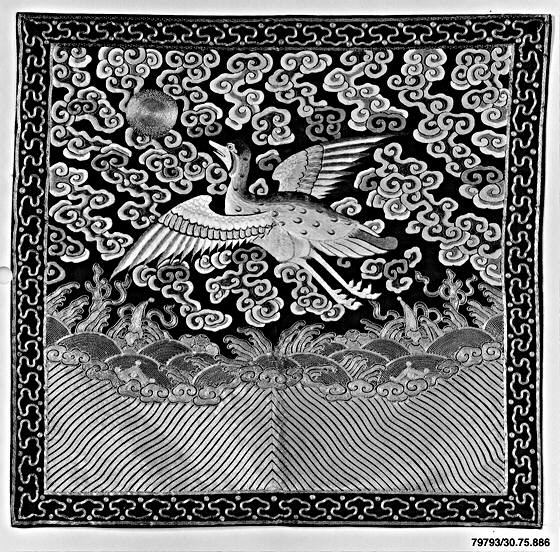
Decoding Distinction: A Connoisseur's Analysis of the Rank Badge with Wild Goose
Within the rarefied world of historical textiles, few artifacts communicate status as precisely and poetically as the Chinese rank badge. This particular specimen, a Rank Badge with Wild Goose, is not merely an embroidered silk square; it is a compact, wearable manifesto of imperial bureaucracy, cosmological order, and exquisite craftsmanship. As a standalone study, it offers Katherine Fashion Lab a profound case study in how material, motif, and technique converge to create an unambiguous language of power within a sartorial system. Its value lies in its explicit codification—a stark contrast to the often-subtle semiotics of Western aristocratic dress—presenting a masterclass in regulated luxury.
The Grammar of Governance: Symbolism and the Mandate of Heaven
The badge’s primary function was administrative semaphore. During the Ming (1368–1644) and Qing (1644–1912) dynasties, a rigidly hierarchical civil service was the empire’s backbone. To visually articulate this complex hierarchy at a glance, the court instituted a system of büzi (Mandarin squares) for official robes. Each of the nine civil ranks was assigned a specific bird, while military officials wore beasts. The wild goose, depicted here in majestic profile amidst clouds and waves, unequivocally denotes a civil official of the fourth rank.
This was no arbitrary assignment. The wild goose is a potent symbol in Chinese culture, revered for its migratory precision, disciplined flight formations, and loyalty to its mate. As such, it embodied the ideal Confucian virtues expected of a senior bureaucrat: order, punctuality, fidelity to the state, and a harmonious journey through the administrative heavens. The badge thus transforms the wearer into a living emblem of these qualities, his personal identity subsumed by the virtues of his office. The surrounding motifs—stylized clouds representing the celestial realm and rolling waves symbolizing the earthly domain—further contextualize the official’s role as an intermediary between heaven and earth, a key concept in the Chinese imperial worldview known as the Mandate of Heaven.
Material Alchemy: Silk and Metallic Thread as Mediums of Message
The chosen materials—silk ground with embroidery in silk and metallic thread—are as semantically loaded as the imagery. Silk was, for millennia, a state-controlled commodity and a de facto currency in China, its production a closely guarded secret. Its use here immediately signals privilege and access. The luxurious hand of the fabric, its sheen, and its capacity to hold vibrant color were tangible proofs of the empire’s wealth and the wearer’s sanctioned participation in it.
The deployment of metallic thread, likely fine strips of gold or silver leaf wound around a silk core, elevates the badge from mere insignia to a object of luminous power. This technique, known as gold couching, involved laying the metal threads across the surface and securing them with tiny, invisible stitches. The effect is one of radiant, low-relief sculpture. The metallic threads catch the light dynamically, ensuring the badge was visually legible and imposing in both the dim halls of the imperial court and in procession. This material choice transcends decoration; it creates a halo of authority, literally illuminating the wearer’s rank with a precious, light-reflective medium that paralleled the perceived luminosity of the emperor himself.
Technical Mastery: The Embroidery as Strategic Execution
As a standalone study, the badge demands an analysis of its technical execution as a strategic component of its authority. The embroidery is a virtuosic display of multiple stitches, each selected for specific aesthetic and functional outcomes. The wild goose’s body likely employs satin stitch to create smooth, expansive planes of color, mimicking the sleekness of feathers. Its intricate plumage, the delicate clouds, and the curling waves would utilize finer techniques like seed stitch or Peking knot to build texture and detail.
This technical complexity served two crucial purposes. First, it acted as a deterrent to forgery. The labor-intensive, highly specialized skill required to produce such a badge made unauthorized replication extremely difficult, protecting the integrity of the rank system. Second, the quality of the needlework was a direct reflection of the state’s patronage and the artisan’s allegiance. Every minute stitch was a testament to the empire’s control over supreme craftsmanship. The badge is, therefore, a nexus of artisanal intelligence, where technical skill is mobilized in the service of political control and symbolic communication.
Contemporary Resonance: From Regulated Insignia to Inspired Motif
For a modern fashion laboratory like Katherine Fashion Lab, this artifact is a rich repository of conceptual challenges and inspirations. It presents a starkly different paradigm from contemporary, individuality-driven fashion: here, the garment strictly defines the man. This raises provocative questions about uniform, identity, and the sartorial projection of systemic values. The design challenge encoded within the badge—to communicate a specific, complex message instantly and beautifully—is one that resonates with branding and iconic design today.
Materially, the interplay of matte silk and luminous metal offers a timeless lesson in textural contrast and dignified opulence. The symbolic depth of the wild goose motif transcends its bureaucratic origin, speaking to themes of journey, discipline, and collective order. A contemporary reinterpretation might abstract the goose’s graceful form, translate the couching technique into innovative material hybrids, or deconstruct the square format while retaining its emblematic gravitas. The badge teaches that decoration, when underpinned by a powerful narrative code, ceases to be ornament and becomes a compelling, non-verbal language.
In conclusion, this Rank Badge with Wild Goose is a masterpiece of sartorial semiotics. It exemplifies how fashion, at its most institutionalized, can be a primary technology of statecraft. Through its unwavering symbolism, luxurious materials, and impeccable technique, it performed the vital cultural work of making abstract rank visible, tangible, and awe-inspiring. For the modern analyst and creator, it stands as a testament to the profound power of clothing to organize society and embody an entire worldview in a single, exquisite square of silk and thread.