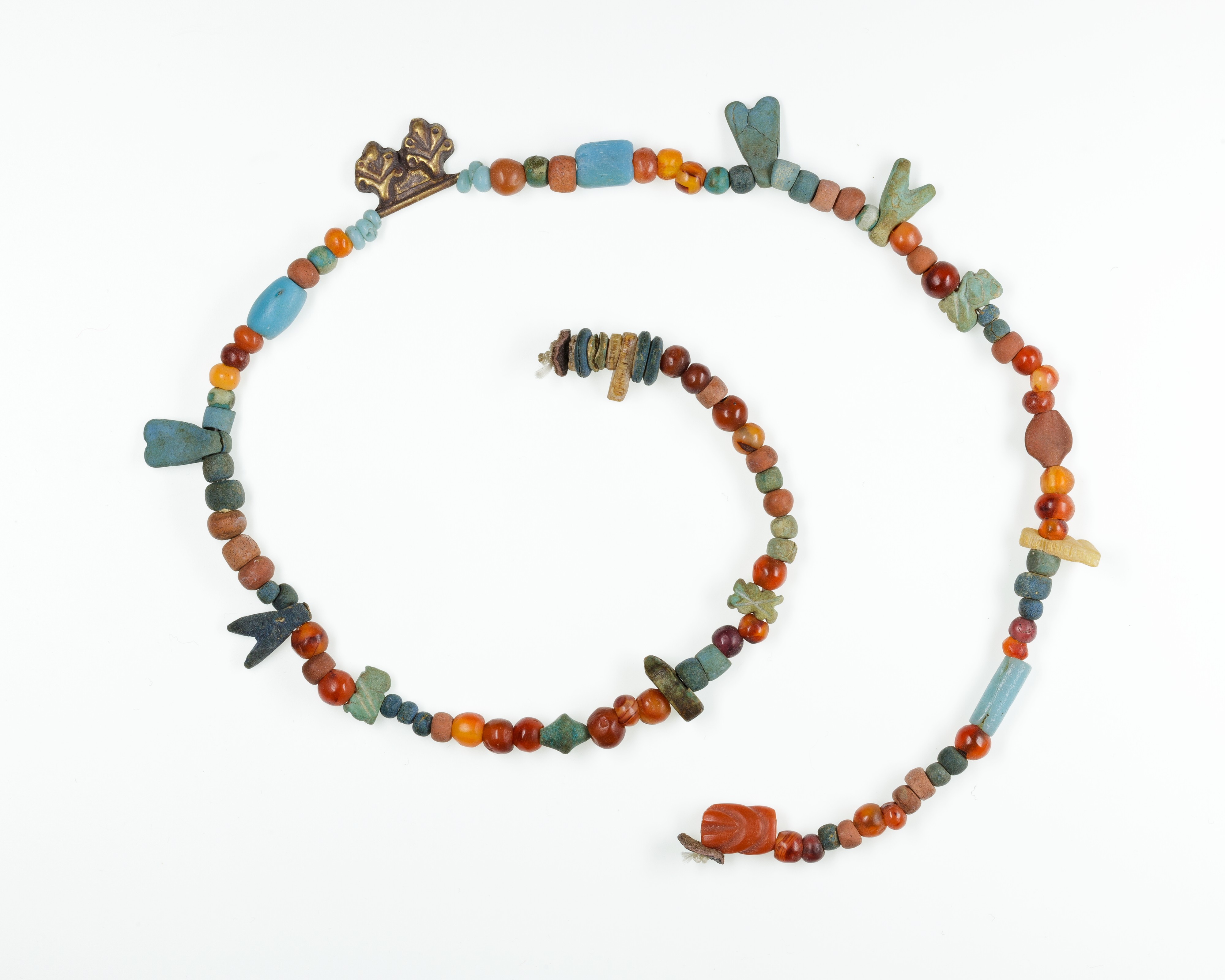
Executive Heritage Analysis: The Fly Amulet Necklace
This report presents a curated heritage analysis of an ancient necklace featuring fly amulets, rendered in yellow, green, and blue faience with gold accents. As a strategic standalone research document for Katherine Fashion Lab, the following sections explore the symbolic power, historical adornment practices, and spiritual meaning of this artifact. The analysis concludes with a forward-looking 2026 high-end luxury strategy, positioning this object as a potent source of inspiration for a new collection that merges ancestral gravitas with contemporary desirability.
Symbolic Power: The Fly as a Talisman of Persistence and Protection
In the context of ancient civilizations, particularly within the Nile Valley cultures, the fly was not an insect of nuisance but a potent emblem of persistence, courage, and divine protection. The fly amulet, often crafted from faience or precious metals, was believed to imbue its wearer with the unyielding tenacity of the insect—its ability to survive and thrive in hostile environments. The choice of yellow, green, and blue faience is not arbitrary; these colors held profound symbolic resonance. Yellow evoked the eternal sun and the gold of the gods, signifying immortality and royal power. Green represented rebirth, regeneration, and the lush fertility of the Nile. Blue symbolized the heavens, the primordial waters of creation, and protection against evil forces.
The gold accents further elevate the necklace’s symbolic capital. Gold, considered the flesh of the gods, was a material of supreme spiritual and temporal authority. By combining faience—a material associated with the masses and ritual purity—with gold, the necklace bridges the mortal and the divine. The fly amulet, therefore, operates as a multidimensional talisman: it is a warrior’s charm for relentless pursuit, a funerary object for safe passage into the afterlife, and a status marker for those who possessed the resilience of the fly. For Katherine Fashion Lab, this symbolic density offers a rich narrative foundation. The fly can be repositioned as an icon of unbreakable will and adaptive elegance—qualities highly resonant with the modern luxury consumer seeking meaning beyond aesthetics.
Historical Adornment: The Necklace as a Social and Ritual Artifact
Historically, this necklace would have been worn by individuals of elevated status—priests, warriors, or members of the royal court—during both life and death. The arrangement of multiple fly amulets on a single strand suggests a cumulative protective effect, where each amulet amplified the wearer’s spiritual armor. Adornment was not merely decorative; it was a functional interface between the human and the supernatural. The use of faience, a self-glazing ceramic, indicates a sophisticated understanding of material science and aesthetic permanence. The yellow, green, and blue glazes would have shimmered under sunlight or torchlight, creating a visual spectacle that communicated wealth, piety, and supernatural favor.
The necklace’s design—a series of suspended amulets—also speaks to the ancient practice of layered protection. Each fly, with its wings spread or body elongated, would have been meticulously crafted to catch light and movement, transforming the wearer into a living talisman. The gold elements, likely used for spacers or clasps, added auditory and tactile dimensions, producing a soft clinking sound that further announced the wearer’s presence. For Katherine Fashion Lab, this historical context provides a blueprint for experiential luxury. The modern reinterpretation should not merely replicate the form but evoke the ritualistic weight of wearing a protective, power-laden object.
Spiritual Meaning: The Amulet as a Conduit for Transcendence
At its core, the fly amulet necklace is a spiritual technology. In ancient belief systems, amulets were charged with protective and transformative energy through specific rituals, often involving incantations and consecration by priests. The fly’s association with persistence is deeply spiritual: it represents the soul’s ability to navigate the perilous journey of the afterlife, to persist through trials, and to emerge victorious. The combination of faience (earthly materials transformed by fire) and gold (divine metal) creates a dialectic between mortality and immortality.
The color palette further deepens the spiritual narrative. Yellow, green, and blue together form a trinity of cosmic forces: the sun’s life-giving energy, the earth’s regenerative cycles, and the sky’s protective expanse. This necklace was likely worn during funerary rites or significant life transitions, serving as a guide and guardian. For the modern wearer, the spiritual meaning can be translated into a personal mantra of resilience and transcendence. Katherine Fashion Lab can leverage this by positioning the collection as a tool for contemporary empowerment—a wearable reminder of one’s inner strength and capacity for renewal.
2026 High-End Luxury Strategy: From Artifact to Icon
To translate this ancient artifact into a 2026 high-end luxury strategy, Katherine Fashion Lab must adopt a three-pillar approach: narrative authority, material innovation, and experiential exclusivity.
Pillar One: Narrative Authority
The fly amulet necklace must be positioned as a symbol of defiant elegance. In a luxury market saturated with derivative motifs, the fly offers a unique, intellectually provocative icon. The brand should craft a compelling origin story that emphasizes the amulet’s historical role as a protector of warriors and seekers. This narrative can be disseminated through limited-edition lookbooks, immersive digital content, and collaborations with historians or cultural institutions. The target consumer—the culturally literate, status-conscious individual—will be drawn to the artifact’s authenticity and the brand’s scholarly rigor.
Pillar Two: Material Innovation
While faience and gold are historically accurate, a 2026 luxury collection demands contemporary material alchemy. Katherine Fashion Lab should explore high-tech ceramics with iridescent glazes that mimic the ancient faience’s luster, combined with recycled 18-karat gold or lab-grown precious stones. The colors can be reinterpreted as signature brand hues: a deep Nile green, a celestial lapis blue, and a sunlit amber yellow. The fly motif can be rendered in three-dimensional, sculptural forms using 3D printing or hand-carved resin, creating a tactile and visual experience that honors the original while feeling resolutely modern.
Pillar Three: Experiential Exclusivity
To achieve true high-end status, the collection must be ritualized. Each piece could be sold with a certificate of authenticity that includes a digital archive of the historical artifact, a personal narrative card, and an invitation to a private exhibition or virtual reality experience of the ancient workshop. Limited drops, numbered editions, and bespoke customization (e.g., choice of gemstone accents or gold finish) will create scarcity and personal connection. The necklace should be marketed as an heirloom of the future—a piece that carries the spiritual weight of its ancient predecessor while embodying the pinnacle of contemporary craftsmanship.
Conclusion: The Fly as a Luxury Archetype
The fly amulet necklace, with its layered symbolism of persistence, protection, and transcendence, offers Katherine Fashion Lab a strategically potent archetype for 2026. By honoring the artifact’s historical and spiritual depth while reimagining it through innovative materials and exclusive experiences, the brand can create a collection that resonates with the modern luxury consumer’s desire for meaning, authenticity, and status. The fly, once a humble insect, becomes a luxury icon of resilience—a timeless talisman for those who refuse to yield.