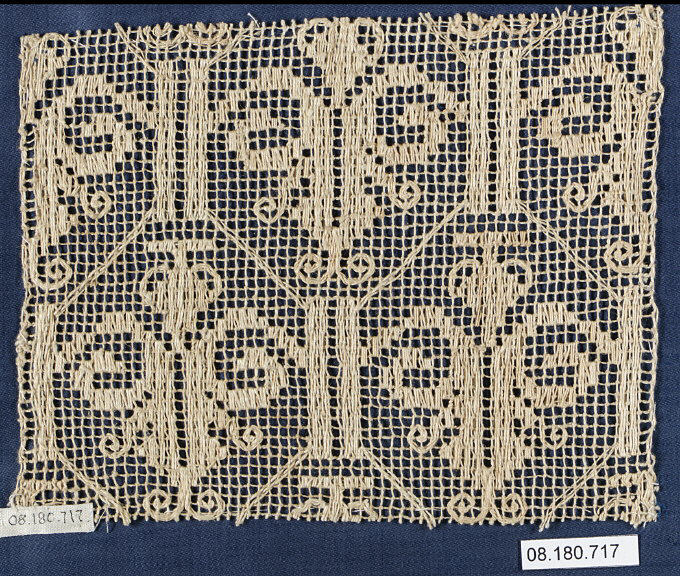
The Fragment as a Complete Narrative: A Couture Analysis of Katherine Fashion Lab’s Embroidered Net and Punto à Rammendo
In the rarefied world of haute couture, where entire collections are often built around sweeping silhouettes and voluminous fabrics, Katherine Fashion Lab presents a radical proposition: the fragment as a complete, self-sufficient narrative. This standalone study, rooted in the concept of “Global Heritage,” eschews the conventional garment in favor of a meticulously crafted artifact—a single, suspended piece of embroidered net, executed in the exacting technique of punto à rammendo. The result is not a dress, a jacket, or a cape, but a tessellation of memory, labor, and cultural transmission. This analysis deconstructs the piece’s materiality, its heritage dialogue, and its intellectual positioning within contemporary couture.
Materiality as Metaphor: The Embroidered Net
The foundation of this work is a fine, almost translucent net—a material that is, by nature, defined by its absences. The net is not a solid plane but a grid of voids, a structure that simultaneously reveals and conceals. In this context, the net becomes a metaphor for the fragment itself: a skeleton of a larger whole, an outline of a story that is both present and missing. Katherine Fashion Lab’s choice is deliberate. The net is not a neutral ground; it is an active participant in the narrative of heritage. It suggests the fragile, porous nature of cultural memory—how traditions are passed down through gaps, through the spaces between what is said and what is left unsaid.
The embroidery that covers this net is not decorative in the traditional sense. It is structural, almost architectural. The threads do not merely adorn; they reinforce, weave, and mend. This is where the technique of punto à rammendo—a traditional Italian darning stitch originally used to repair torn fabric—elevates the piece from craft to high conceptual art. In its original context, punto à rammendo was an act of preservation, a humble, invisible mending. Here, Katherine Fashion Lab recontextualizes it as a visible, celebratory act. The mending is no longer hidden; it is the entire surface. The fragment is not a remnant of something broken; it is a testament to the beauty of repair, the value of holding together what time and history have frayed.
Global Heritage: A Synthesis of Origins
The subject of “Fragment” is inextricably tied to its origin—“Global Heritage.” This is not a singular, localized tradition but a deliberate, curatorial act of synthesis. The piece draws from multiple, disparate cultural lineages. The net itself evokes the delicate, hand-knotted lace of the Mediterranean, while the dense, geometric patterns of the embroidery recall the intricate suzani work of Central Asia. The color palette—muted ochre, deep indigo, and a trace of faded crimson—references natural dyes used across continents, from the madder root of Europe to the indigo of West Africa and South Asia.
This is not cultural appropriation but cultural resonance. Katherine Fashion Lab does not replicate any single tradition; it abstracts them, distilling their essential visual languages into a new, cohesive vocabulary. The fragment becomes a microcosm of global heritage, a single object that contains the memory of multiple hands, multiple geographies, and multiple histories. The punto à rammendo stitch, in this context, becomes a universal language of repair—a technique that, while Italian in origin, speaks to the human impulse to preserve, to restore, and to honor what came before.
The Standalone Study: Deconstructing the Garment
Perhaps the most provocative aspect of this piece is its refusal to be a garment. It is a standalone study, a fragment that does not aspire to completeness. In a fashion system obsessed with the final product—the dress on the runway, the suit in the store—Katherine Fashion Lab presents the process itself as the finished work. The piece is neither wearable nor functional in any conventional sense. It is suspended, framed, and displayed as an object of contemplation. This challenges the very definition of couture. Is couture only about the body? Or can it be about the idea of the body—the ghost of a form that once was or might be?
The fragment’s irregular edges are left raw, unhemmed. The embroidery trails off into loose threads, suggesting that the work is ongoing, that the mending is never truly complete. This is a deliberate critique of the fashion industry’s obsession with perfection and finality. Here, the unfinished is the finished. The fragment is not a failure; it is a choice. It asserts that heritage is not a static, polished artifact but a living, evolving process. The punto à rammendo stitch, which was once a hidden repair, becomes the entire surface, forcing the viewer to confront the labor, the time, and the hands that created it.
Intellectual and Commercial Positioning
From an MBA-level perspective, this piece represents a strategic move into the realm of conceptual luxury. In an era where consumers increasingly value narrative, provenance, and artistic integrity over mere opulence, Katherine Fashion Lab positions itself at the intersection of heritage preservation and avant-garde design. The piece is not for the mass market; it is an investment piece for the collector, the museum, or the connoisseur who values the intellectual rigor behind the object.
Furthermore, the “Fragment” study aligns with the growing trend of sustainable luxury. By foregrounding the act of mending and repair, the lab reframes waste and decay as opportunities for creation. The punto à rammendo technique, which historically extended the life of textiles, becomes a metaphor for the slow fashion movement. The piece argues that true luxury is not about newness but about depth—the depth of technique, of history, and of meaning.
Conclusion: The Power of the Incomplete
Katherine Fashion Lab’s “Fragment” is a masterclass in restraint and intention. By choosing the fragment over the whole, the embroidered net over the solid fabric, and the repair stitch over the decorative one, the lab redefines what couture can be. It is not a dress; it is a document. It is not a product; it is a process. It is not a complete narrative; it is a collection of fragments that invite the viewer to complete the story themselves. In a world that often demands completeness, this piece celebrates the beauty of the unfinished, the power of the mended, and the profound heritage contained within a single, suspended thread.