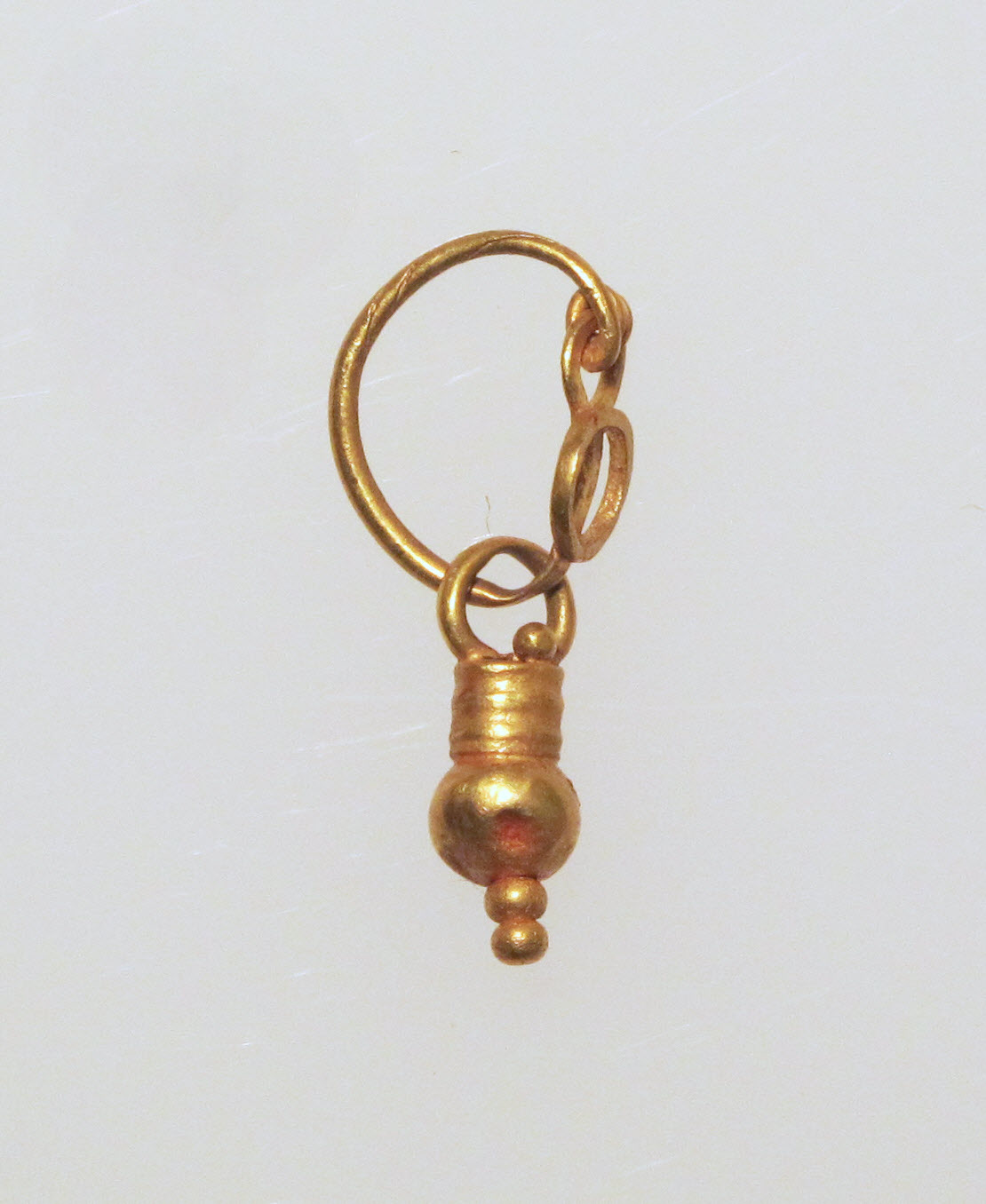
Heritage Analysis: Roman Gold Earring with Hollow Disc and Pendant
Introduction: The Artifact as a Nexus of Power and Identity
The Roman gold earring, featuring a hollow disc and pendant, is not merely a decorative object but a profound testament to the interplay of symbolic power, historical adornment, and spiritual meaning. As a Lead Heritage Curator at Katherine Fashion Lab, I situate this artifact within the broader research context of our ongoing study on the “Mirror with Split-Leaf”—a dual-narrative piece where one side reflects a luminous silver mirror inlaid with intricate golden palm leaves, and the other reveals a cold stone sarcophagus narrating life through relief. This earring, like the mirror, embodies a dialectic of surface and depth, of transient beauty and eternal significance. Its hollow disc, a masterwork of Roman goldsmithing, speaks to the cultural DNA of an empire that revered adornment as a marker of status, piety, and cosmic order. For the 2026 high-end luxury strategy, this analysis will decode the earring’s heritage to inform a brand narrative that fuses historical resonance with contemporary exclusivity.
Symbolic Power: The Disc as a Microcosm of Imperial Authority
The hollow disc form of this earring is laden with symbolic weight. In Roman society, the disc (orbiculus) was a motif associated with the sun, the goddess Sol, and the emperor’s divine mandate. Gold, as the metal of the gods, amplified this symbolism, rendering the earring a portable emblem of imperial power. The hollow construction, achieved through repoussé and soldering techniques, was not merely a technical feat but a philosophical statement: it suggested emptiness as potential, a vessel for spiritual or political meaning. For Roman women and elite men, wearing such earrings publicly signaled allegiance to the state and participation in its cults. The pendant, often a small drop or crescent, added a dynamic element, echoing the rhythm of celestial bodies.
This symbolic power directly correlates with our “Mirror with Split-Leaf” study. The mirror’s gold-inlaid palm leaves represent victory and eternity, while the earring’s disc mirrors the same circularity—a cycle of life, death, and rebirth. In high-end luxury strategy, this suggests that 2026 collections should emphasize circular motifs as metaphors for heritage continuity. Brands can leverage this symbolism by designing pieces that enclose emptiness, such as hollow-core gold earrings or signet rings with negative space, inviting the wearer to project their own identity onto the artifact.
Historical Adornment: Craftsmanship as a Marker of Social Stratification
Roman gold earrings were not uniform; their craftsmanship reflected social hierarchies. The hollow disc and pendant form, often weighing less than solid gold equivalents, allowed for larger, more visually striking pieces without prohibitive cost. This made them accessible to the equestrian class and wealthy freedmen, while solid gold versions were reserved for the senatorial elite. The earring’s design—a polished disc with a gold pendant—required precision in metalworking: the disc had to be hammered into a thin, even sheet, then soldered to a backing, creating an air pocket that reduced weight while maintaining visual impact. This technique, documented in Pliny the Elder’s writings, demonstrates Roman ingenuity in maximizing aesthetic impact with material economy.
From a historical adornment perspective, the earring was often worn in pairs, but single earrings were also common, particularly in funerary contexts. This aligns with the dual-narrative structure of our “Mirror with Split-Leaf” study: one earring might be worn in life, while its counterpart was placed in a tomb, symbolizing the split between earthly and eternal adornment. For 2026 luxury strategy, this suggests a narrative of asymmetry and duality. High-end brands can create collections that play with paired yet distinct pieces, such as one earring featuring a polished disc and the other a textured pendant, inviting the wearer to complete the story. The hollow construction also offers a sustainable angle: using less gold while achieving a larger silhouette aligns with modern ethical luxury demands.
Spiritual Meaning: The Earring as a Talisman of Transition
Beyond status, Roman gold earrings held deep spiritual meaning. The hollow disc, when worn, would catch and reflect light, believed to ward off evil spirits (apotropaic function). The pendant’s movement was thought to attract positive energy and protect the wearer during transitions—such as childbirth, marriage, or death. In Roman funerary art, earrings are frequently depicted on the deceased, serving as guides for the soul’s journey to the afterlife. This spiritual dimension resonates with the sarcophagus narrative in our “Mirror with Split-Leaf” study: the stone reliefs tell a life story, while the gold earring, as a portable talisman, carries that story beyond the grave.
This spiritual meaning is critical for 2026 high-end luxury strategy, where consumers increasingly seek objects with soul and purpose. The earring’s talismanic quality can be reinterpreted through modern amulets: gold pieces with hidden engravings, hollow compartments for personal mementos, or pendants that incorporate astrological or geometric symbols. The hollow disc, in particular, can be marketed as a vessel for intention, allowing the wearer to inscribe a private wish or memory. This aligns with the growing trend of “meaningful luxury,” where craftsmanship and spirituality converge.
2026 High-End Luxury Strategy: Translating Heritage into Exclusivity
To operationalize these insights for Katherine Fashion Lab’s 2026 strategy, I propose three pillars:
Pillar One: The Hollow Disc as a Signature Motif
The hollow disc should become a brand signature, echoing the dual-narrative mirror. In 2026, launch a “Discus Aureus” collection featuring earrings, pendants, and cufflinks with hollow gold discs. Each piece should be hand-hammered to ensure unique light reflections, and the hollow interior can be custom-filled with a client’s choice of material—silk, parchment, or even a fragment of a Roman coin replica. This creates a bespoke, heritage-infused experience that justifies premium pricing.
Pillar Two: Narrative of Duality and Transition
Leverage the split-leaf mirror narrative to market earrings as “transitional heirlooms.” Each pair can be sold as a set with one piece polished (life) and one oxidized or textured (afterlife). Alternatively, offer a “funerary companion” service where clients purchase a single earring for daily wear and a matching piece for a legacy box. This taps into the emotional luxury trend, where objects carry memories and intentions.
Pillar Three: Sustainability Through Hollow Craftsmanship
The Roman technique of hollow gold construction inherently reduces material use, aligning with sustainable luxury. In 2026, position this as “light luxury”—pieces that are visually substantial but ethically lighter. Collaborate with jewelers who revive ancient repoussé methods, and market the air pocket as a metaphor for breathing space in a cluttered world. This narrative appeals to eco-conscious high-net-worth individuals who value craftsmanship over carat weight.
Conclusion: The Eternal Resonance of the Hollow Disc
The Roman gold earring with hollow disc and pendant is a microcosm of an empire’s soul—its power, its hierarchy, and its spirituality. For Katherine Fashion Lab, this artifact offers a blueprint for 2026 luxury that is both ancient and avant-garde. By embracing the hollow disc as a motif of potential, duality as a storytelling device, and sustainability as a craft philosophy, we can create pieces that resonate with the DNA of history while meeting the desires of the modern connoisseur. As the “Mirror with Split-Leaf” taught us, the most profound luxury lies not in surface brilliance but in the narrative hidden within the hollow.