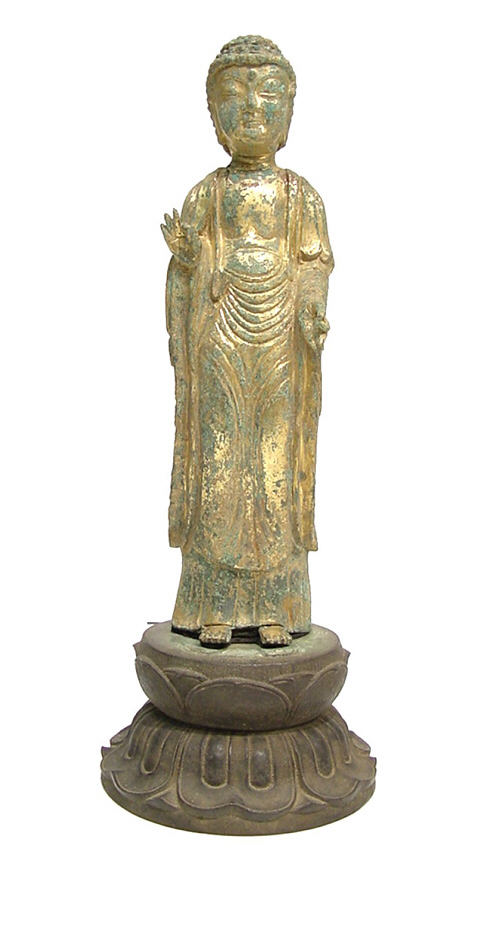
Heritage Analysis: The Standing Buddha of Korea
Introduction: The Object as a Repository of Cultural and Spiritual Capital
This analysis examines a Korean Standing Buddha, rendered in gilt bronze, as a strategic artifact for Katherine Fashion Lab’s 2026 high-end luxury strategy. Within the context of heritage curation, this object transcends its religious origins to function as a symbol of refined power, historical adornment, and spiritual transcendence. For a luxury brand seeking to differentiate through cultural depth, the Standing Buddha offers a lexicon of forms, materials, and meanings that can be translated into a collection of exceptional narrative weight. This paper will deconstruct the object’s symbolic power, its historical adornment techniques, its spiritual significance, and propose a strategic framework for its integration into a 2026 luxury narrative.
Symbolic Power: Authority, Serenity, and the Gilded Gaze
The symbolic power of the Korean Standing Buddha is multifaceted, rooted in both its iconography and its materiality. The standing posture (samapada) itself is a statement of active, benevolent presence—a deity not in repose but ready to engage with the world. This contrasts with seated meditative forms, offering a dynamic yet composed authority. The abhaya mudra (hand gesture of fearlessness) and the varada mudra (gesture of granting wishes) are common in Korean standing figures, projecting a dual message of protection and generosity. For a luxury brand, this translates into a design language that communicates assurance, generosity of spirit, and unwavering confidence.
The gilt bronze medium is the primary vector of symbolic power. Gold, in Buddhist and Korean contexts, is not mere ornamentation; it represents the radiant, incorruptible nature of enlightenment. The application of gold leaf or gilding to bronze—a base metal of strength and durability—creates a luminous surface that appears to emit light from within. This is a direct metaphor for the inner illumination of the enlightened mind. In a 2026 luxury strategy, this translates to a material philosophy: using precious metals and finishes not for ostentation, but to signify an inner, unassailable value. The gilt surface becomes a symbol of refined transcendence, a material that speaks of both earthly power and spiritual attainment. The subtle patina of age on such a piece—where the gold has worn slightly to reveal the bronze beneath—adds a layer of historical authenticity and the beauty of impermanence, a powerful narrative for a heritage-driven brand.
Historical Adornment: The Aesthetics of Korean Buddhist Sculpture
The historical adornment of the Korean Standing Buddha is characterized by a distinct aesthetic that merges indigenous sensibilities with imported Buddhist iconography. Unlike the more ornate, heavily bejeweled forms of Indian or Tibetan Buddhist art, Korean standing Buddhas from the Three Kingdoms (57 BCE–668 CE) and Unified Silla (668–935 CE) periods exhibit a restrained elegance. The ushnisha (cranial protuberance) is often rendered as a smooth, rounded dome, and the urna (third eye) is frequently a simple, raised dot or a small jewel. The monastic robe (kasaya) is depicted with flowing, rhythmic folds that cling to the body, revealing the form beneath without overt sensuality. This is an adornment of subtlety and grace.
The gilt bronze technique itself is a form of historical adornment that required immense skill. The process involved casting the bronze core, then applying a thin layer of gold amalgam (mercury and gold) which was heated to vaporize the mercury, leaving a permanent, brilliant gold surface. This mercury gilding was a labor-intensive, high-risk process reserved for objects of supreme importance. For a luxury strategy, this translates to a commitment to artisanal mastery and material integrity. The historical adornment of the Korean Standing Buddha is not about adding external decoration; it is about revealing an inherent luminosity. This principle can guide a 2026 collection: using exquisite, hand-finished materials—such as 23-karat gold leaf on oxidized silver or lacquer with gold powder—to create finishes that appear to glow from within, rather than simply shine on the surface.
Spiritual Meaning: Enlightenment, Compassion, and the Path
The spiritual meaning of the Korean Standing Buddha is deeply embedded in the Mahayana Buddhist tradition, which emphasizes the bodhisattva ideal—a being who delays their own enlightenment to help all sentient beings. The standing posture is often associated with the Buddha of the Future (Maitreya) or the Buddha of Compassion (Amitabha), figures who are actively engaged in the world. The gilt bronze medium is a physical manifestation of the Dharmakaya—the truth body of the Buddha—which is formless, luminous, and omnipresent.
For a high-end luxury brand, this spiritual dimension offers a profound narrative of purpose beyond product. The Standing Buddha is not merely a decorative object; it is a symbol of a path. The spiritual meaning can be translated into a brand ethos that emphasizes mindfulness, compassion, and enlightened leadership. The gilt bronze becomes a metaphor for the refinement of the self—a process of polishing one’s actions, thoughts, and creations until they radiate with inner clarity. This is a powerful counter-narrative to the excesses of contemporary luxury, offering a model of conscious opulence that is grounded in spiritual depth. The standing posture itself can inspire a collection that is about movement, purpose, and engagement—not static perfection, but dynamic grace.
Strategic Framework for 2026 High-End Luxury Integration
To leverage the heritage of the Korean Standing Buddha for a 2026 luxury strategy, Katherine Fashion Lab must move beyond mere visual quotation. The integration must be conceptual, material, and narrative. Three strategic pillars are proposed:
1. The ‘Gilt Core’ Material Philosophy: The 2026 collection should introduce a signature material system inspired by gilt bronze. This could involve hand-applied gold leaf on structured, sculptural fabrics or bronze-toned hardware with a warm, luminous finish. The key is to replicate the effect of a luminous core—materials that appear to have an inner light. This is not about gold-plating everything, but about selective, meaningful gilding that highlights key structural elements, just as the Buddha’s gilding highlights the sacred form. A new finish, tentatively named ‘Silla Luster,’ could be developed, combining polished and matte gold tones to mimic the patina of ancient gilt bronze.
2. The ‘Standing Grace’ Silhouette: The standing posture of the Buddha, with its balanced, elongated proportions and flowing drapery, should inform the silhouette of the collection. Garments could feature asymmetrical draping that mimics the rhythmic folds of the kasaya, or structured, columnar forms that convey stability and presence. Accessories could include elongated pendants or sculptural belts that echo the Buddha’s hand gestures. The design language should prioritize verticality, grace, and a sense of composed movement.
3. The ‘Enlightened Narrative’ Campaign: The 2026 campaign should not simply sell products; it should tell a story of inner transformation. The narrative should center on the concept of ‘Refined Light’—a journey from raw material to luminous form, from chaos to clarity. Collaborations with Korean Buddhist cultural institutions, such as the National Museum of Korea or Jogyesa Temple, could add authenticity. The campaign imagery should evoke the serene, contemplative atmosphere of a temple hall, where light plays across a gilt bronze surface. The spiritual meaning of the Buddha should be presented not as religious dogma, but as a universal philosophy of mindful excellence. This positions Katherine Fashion Lab as a brand that offers not just luxury goods, but a path to a more enlightened state of being.
Conclusion: The Luminous Legacy
The Korean Standing Buddha in gilt bronze is a masterclass in the fusion of symbolic power, historical adornment, and spiritual meaning. For Katherine Fashion Lab’s 2026 high-end luxury strategy, this object offers a blueprint for creating a collection that is not only aesthetically exquisite but also deeply resonant. By translating the gilt core material philosophy, the standing grace silhouette, and the enlightened narrative, the brand can differentiate itself in a crowded market. The result is a luxury that is not about accumulation, but about illumination—a heritage-driven strategy that honors the past while forging a luminous future. This is the ultimate expression of strategic luxury: where every material, every line, and every story is a reflection of an enduring, enlightened legacy.