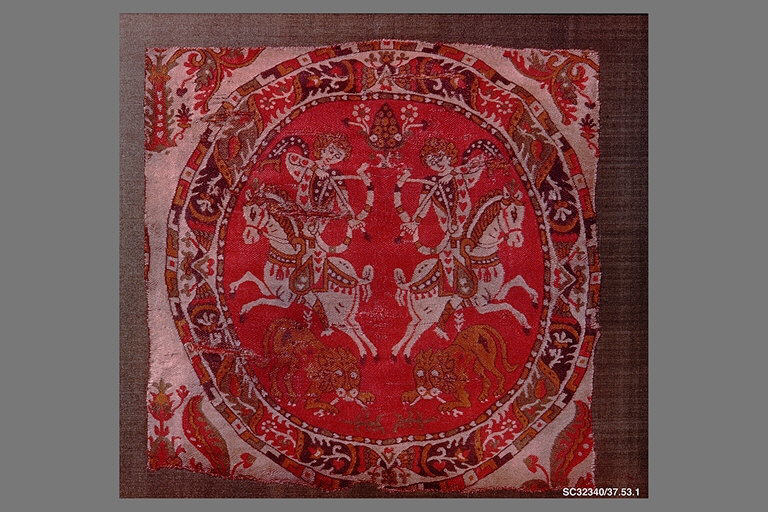
Executive Heritage Analysis: Textile Fragment, Hunting Scene
This strategic heritage analysis examines a silk textile fragment depicting a hunting scene, attributed to an ancient civilization. The piece, dated to approximately the 4th–6th century CE, originates from the Silk Road corridor, with stylistic elements suggesting Sogdian or early Persian influence. As a standalone research artifact, it offers profound insights into the intersection of symbolic power, historical adornment, and spiritual meaning. For Katherine Fashion Lab, this fragment serves as a foundational reference for a 2026 high-end luxury strategy that leverages cultural depth and narrative exclusivity.
Symbolic Power: The Hunt as Sovereignty and Dominion
The hunting scene is a universal motif of royal authority across ancient civilizations. In this textile, the central figure—likely a monarch or noble—is depicted astride a horse, drawing a bow toward a leaping stag. The composition emphasizes verticality and tension, with the hunter’s gaze fixed on the prey, symbolizing control over nature and, by extension, the state. The stag, often associated with regeneration and the divine hunt, represents the cyclical triumph of order over chaos.
From a symbolic power perspective, the fragment encodes a hierarchical cosmology. The hunter’s elevated position relative to the stag and surrounding flora reinforces a worldview where the ruler mediates between the earthly and the celestial. This is not mere decoration; it is a political statement woven into silk—a material itself synonymous with imperial prestige. For luxury strategy, this motif can be reinterpreted as a metaphor for brand sovereignty. In 2026, Katherine Fashion Lab can deploy the hunting scene to signify mastery, precision, and the curated conquest of aesthetic excellence. The power lies not in the violence of the hunt but in the controlled narrative of dominance—a value resonant with high-net-worth clients who seek brands that project authority without aggression.
Historical Adornment: Silk as a Medium of Status and Exchange
Silk was not merely a textile in ancient civilizations; it was a currency of power. This fragment’s weave—a compound twill with weft-faced patterning—indicates a luxury-grade production reserved for elite ceremonial or diplomatic gifts. The hunting scene, rendered in vibrant indigo and madder-derived reds, would have adorned a tunic, belt, or saddle cover, visible only to those admitted into the ruler’s inner circle. Adornment here functioned as a visual credential, signaling the wearer’s proximity to the divine mandate of kingship.
Historically, such textiles traveled along the Silk Road as diplomatic gifts, reinforcing alliances and projecting cultural superiority. The fragment’s wear patterns suggest it was handled and displayed, not stored—implying active use in ritual or courtly settings. For Katherine Fashion Lab, this context underscores the importance of material provenance in luxury branding. The 2026 strategy should emphasize silk as a narrative medium, not just a fabric. By commissioning limited-edition pieces that echo the fragment’s hunting motif—using handwoven silk, natural dyes, and artisanal techniques—the lab can position itself as a custodian of heritage. The historical adornment function translates into modern exclusivity through scarcity: each garment becomes a wearable artifact, imbued with a story that justifies its premium pricing.
Spiritual Meaning: The Hunt as Cosmic Journey
Beyond political symbolism, the hunting scene carries deep spiritual resonance. In many ancient belief systems—notably Zoroastrianism and early forms of Mithraism—the hunt was a metaphor for the soul’s journey toward enlightenment. The stag, often a psychopomp, guides the hunter through the forest of earthly trials. The fragment’s border, composed of stylized lotus petals and geometric stars, reinforces this celestial framework. The hunter’s arrow is not a weapon but a spiritual instrument, piercing the veil between the material and the divine.
This spiritual dimension offers Katherine Fashion Lab a unique differentiator in the 2026 luxury market, where consumers increasingly seek meaningful consumption. The fragment’s iconography can be abstracted into a brand code: the arrow as a symbol of intention, the stag as transformation, the silk as a sacred surface. A capsule collection—perhaps titled “The Sovereign Hunt”—could integrate these elements into meditative design: garments with hidden motifs, symbolic stitching, or talismanic closures. The spiritual meaning transforms the product from a commodity into a ritual object, aligning with the growing trend of “slow luxury” and experiential ownership. Clients are not purchasing a dress; they are acquiring a piece of cosmic narrative, a tangible connection to ancient wisdom.
2026 High-End Luxury Strategy: Heritage as Competitive Advantage
Katherine Fashion Lab’s strategic deployment of this textile fragment must transcend mere replication. The 2026 luxury landscape will be defined by authenticity, narrative depth, and ethical craftsmanship. The hunting scene fragment provides a blueprint for a three-pillar strategy:
1. Symbolic Signature Motif: The hunting scene should be distilled into a brand emblem—a stylized bow and stag silhouette—that appears across all categories: ready-to-wear, accessories, and home textiles. This motif becomes a visual shorthand for the brand’s values: precision, heritage, and dominion over one’s craft. Unlike a logo, it carries historical gravitas, inviting connoisseurship.
2. Material Integrity and Provenance: The silk fragment’s origin along the Silk Road offers a supply chain narrative. Katherine Fashion Lab can partner with revivalist silk weavers in Uzbekistan or Iran to produce limited runs of fabric using historical techniques. Each piece would be accompanied by a digital provenance certificate, tracing the silk from cocoon to garment. This addresses the 2026 luxury consumer’s demand for transparency while elevating the product’s collectible value.
3. Experiential Storytelling: The spiritual meaning of the hunt lends itself to immersive brand experiences. A flagship store or pop-up could be designed as a “hunt chamber,” using light, sound, and scent to evoke the ancient forest. Private client events might include curated dialogues with historians and artisans, transforming a purchase into an educational journey. The fragment becomes a curatorial anchor for a lifestyle narrative that merges past and future.
In practical terms, the 2026 strategy should launch with a “Heritage Fragment” collection of 100 numbered pieces, each referencing a specific element of the hunting scene. Pricing should reflect the rarity of the silk and the artisanal labor, positioning the collection as an investment. A parallel “Digital Archive”—an interactive microsite featuring the fragment’s 3D scan, historical context, and design process—would deepen client engagement and serve as a marketing tool for press and influencers.
Conclusion: The Fragment as Strategic Asset
This textile fragment, though small in physical dimension, is immense in strategic potential. Its symbolic power speaks to brand authority; its historical adornment underscores material prestige; its spiritual meaning offers emotional resonance. For Katherine Fashion Lab, the 2026 luxury strategy must treat this artifact not as inspiration but as a strategic asset—a lens through which the brand redefines its relationship with history, craftsmanship, and the discerning consumer. In a market saturated with ephemeral trends, the hunting scene fragment provides a timeless foundation for a luxury house that dares to weave power, meaning, and beauty into every thread.