The Art of Containment: Deconstructing the Japanese Writing Box as a Masterclass in Narrative Couture
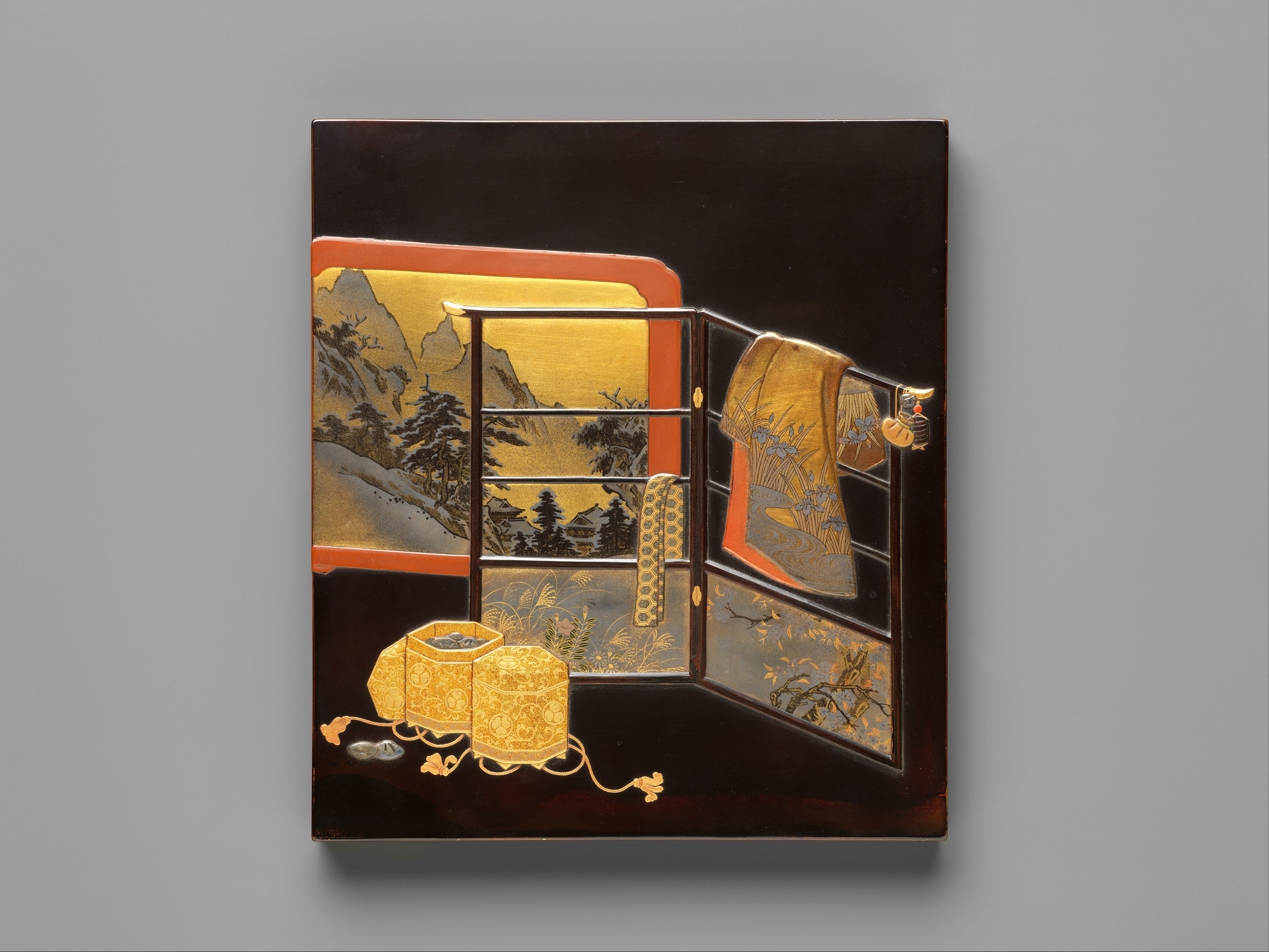
At Katherine Fashion Lab, we do not merely observe fashion; we deconstruct its foundational principles from every conceivable cultural artifact. The subject of this analysis—a Japanese Suzuribako (writing box) from the Edo period, complete with a screen, robe rack, and shell-matching game set—is not a garment. Yet, it is a profound study in the very essence of haute couture: the interplay of surface, structure, and story. This lacquered treasure, rendered in gold, silver, and red takamaki-e, hiramaki-e, and togidashimaki-e on a black ground, transcends its functional origins to become a standalone thesis on luxury, temporality, and the architecture of desire.
The Lacquer as a Textile: Materiality and the Language of Luxury
In couture, fabric is the primary vocabulary. Here, the fabric is lacquer—a material that demands an almost monastic patience and an obsessive pursuit of perfection. The black ground, polished to a mirror-like depth, serves as the void upon which narrative is inscribed. This is the equivalent of a master tailor’s finest wool or silk: a foundation that is both stark and infinitely receptive.
The takamaki-e (high-relief sprinkled picture) technique introduces a sculptural dimension, akin to embroidery or appliqué in three dimensions. The gold and silver particles are not merely painted; they are built up layer by layer, creating a topography that invites touch. This is the couture equivalent of a Schiaparelli shoulder or a Gaultier cone bra—a deliberate disruption of the flat plane. The hiramaki-e (flat sprinkled picture) offers a counterpoint of delicate line work, much like fine beading or sequin work that catches light without overwhelming the silhouette. Meanwhile, togidashimaki-e (polished-out sprinkled picture) creates a seamless, glass-like finish, where the image appears to float within the lacquer itself. This is the ultimate luxury: the illusion of effortlessness, the disappearance of the hand.
The red lacquer accents are the strategic pop of color—a crimson lining in a black coat, a vermillion heel on a monochrome pump. They are not decorative; they are structural, guiding the eye and creating visual tension. In the context of the writing box, this red is the blood of the narrative, the passion that animates the otherwise austere black.
Architecture of the Ensemble: The Screen, Robe Rack, and Shell Game as Layered Silhouettes
A couture collection is never a single piece; it is a system of relationships. The Suzuribako is not a box; it is a stage set. The inclusion of a screen, a robe rack, and a shell-matching game set transforms the object from a container into a narrative ecosystem.
The screen functions as the backdrop, the architectural silhouette of the composition. In fashion, a screen is analogous to a dramatic train or a voluminous cape—it defines the space around the wearer. The lacquered screen, likely depicting a seasonal scene or poetic landscape, creates a framing device for the other elements. It is the atmosphere, the mood board made tangible. The robe rack, by contrast, is the skeleton—the structural armature upon which garments are hung. In this context, it speaks to the tension between the body and its absence. The rack is empty, yet it implies the robe, the gesture, the ritual of dressing and undressing. This is the negative space of couture, the power of what is not shown.
The shell-matching game set (kaiawase) is the most intimate component. These small, paired shells, often painted with scenes from classical literature, are the accessories—the jewelry, the buttons, the hidden details that only the wearer knows. They represent memory and pairing, a game of recognition and connection. In a couture context, this is the secret pocket, the embroidered monogram, the invisible stitch that holds the garment together. The shells are the micro-narratives within the grand story.
Red Lacquer on Black Ground: The Chromatic Dialogue of Power and Restraint
Color in couture is never arbitrary. The black ground is the ultimate signifier of authority, mystery, and timelessness. It is the color of the little black dress, of a Chanel suit, of a Yohji Yamamoto silhouette. It absorbs all light, demanding that the viewer look deeper. The red lacquer is its antagonist and partner. Red is the color of life, blood, and celebration in Japanese culture. It is the accent that breaks the monochrome, the strategic slit in a skirt, the bold lipstick that completes a minimalist face.
The placement of red is critical. It appears in the inner compartments, the edges of the screen, the rims of the shells. It is never the dominant field; it is the exclamation point. This is a masterclass in restraint. The designer of this box understood that true luxury does not shout; it whispers. The red is a controlled release of energy, much like a single red thread in a black tapestry or a vermillion lining in a charcoal coat.
Standalone Study: The Deconstruction of Function into Pure Aura
The prompt specifies that this is a standalone study, not a functional writing set. This is the critical distinction. In fashion, we often speak of wearable art, but the ultimate luxury is the object that has shed its utility entirely. This Suzuribako is no longer a box for writing implements; it is a sculpture of process. The screen no longer blocks wind; it frames emptiness. The robe rack no longer holds silk; it holds the memory of silk. The shell game is no longer played; it is frozen in a state of potentiality.
This is the deconstruction of function that couturiers like Rei Kawakubo and Martin Margiela have made their signature. The writing box becomes a meta-object, a commentary on the act of creation itself. The gold and silver takamaki-e are not just decoration; they are the traces of the artisan’s hand, the calligraphy of labor. The black ground is the void of the blank page, the silence before the poem. The red lacquer is the heartbeat of the maker.
Conclusion: The Box as a Couture Manifesto
For Katherine Fashion Lab, this Suzuribako is a primary text. It teaches us that couture is not about covering the body but about constructing worlds. It demonstrates that the most powerful materials are those that hold light and shadow in equal measure. It proves that a single object can contain an entire system of gestures, rituals, and silences.
The writing box is a wardrobe for the mind. The screen is its cape, the robe rack its foundation, the shell game its jewels. And the lacquer—this incredible, laborious, luminous lacquer—is the fabric of eternity. In a world of fast fashion and disposable trends, this object stands as a manifesto for slowness, for depth, for the irreducible value of the handmade. It is not simply a box; it is a lesson in how to contain the infinite.