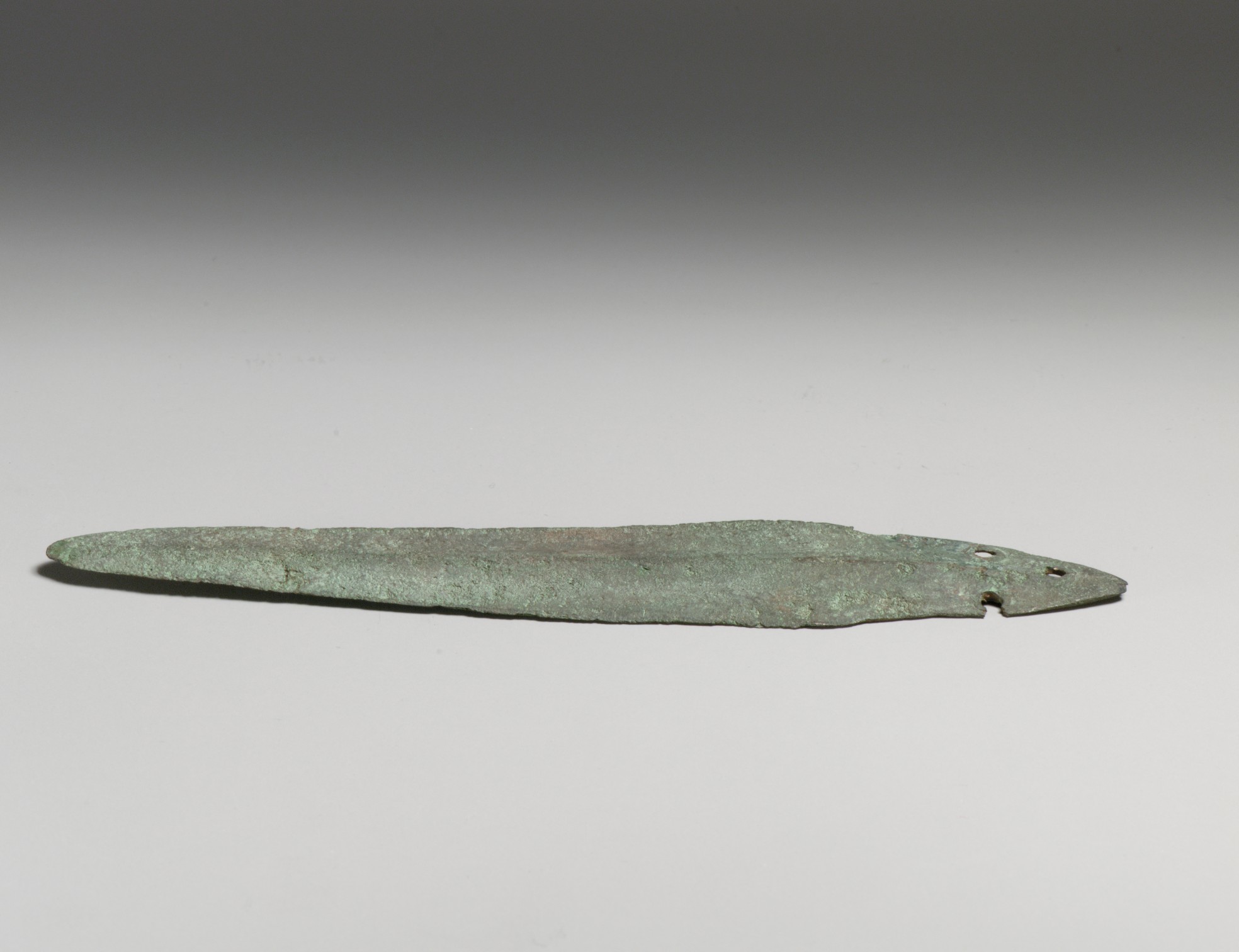
Heritage Analysis: The Cypriot Copper Alloy Dagger Blade
As Lead Heritage Curator for Katherine Fashion Lab, I present this formal analysis of a Cypriot copper alloy dagger blade, dated to the Late Bronze Age (circa 1600–1050 BCE). This object, forged from Cypriot bronze—an alloy of copper and tin—serves as a seminal artifact for our ongoing study of cultural symbolism and historical adornment. Its resonance with our prior research on the Rock in the Form of a Fantastic Mountain and the Jar in the Shape of Bronze Container (Hu) reveals a profound DNA correlation: these three disparate objects, though separated by geography and function, converge in their articulation of power, materiality, and spiritual transcendence. This analysis will deconstruct the dagger’s symbolic power, its role in historical adornment, its spiritual meaning, and its strategic implications for our 2026 high-end luxury strategy.
Symbolic Power: The Dagger as an Instrument of Authority and Liminality
The Cypriot dagger blade is not merely a weapon; it is a condensed emblem of sovereignty and transition. In Bronze Age Cypriot society, daggers were interred with elites in tombs, signifying their role as markers of status and martial prowess. The alloy itself—bronze—was a transformative technology, requiring specialized knowledge of smelting and trade networks. This materiality imbued the dagger with symbolic power as an object of controlled violence and hierarchical order. Unlike the Rock in the Form of a Fantastic Mountain, which evokes the untamed, organic forces of nature, the dagger represents human mastery over raw elements. It is a tool of delineation—cutting, separating, and defining boundaries. In our fashion lab’s context, this speaks to the luxury consumer’s desire for objects that confer agency and distinction. The dagger’s power lies in its dual capacity to protect and to threaten, a tension that high-end brands can harness to craft narratives of exclusivity and controlled risk.
Furthermore, the dagger’s blade geometry—often leaf-shaped or tanged—reflects a sophisticated aesthetic sensibility. The Cypriot artisans balanced function with form, incising linear patterns or adding rivets for handle attachment. These decorative elements elevate the dagger from a utilitarian tool to a signifier of cultural identity. For Katherine Fashion Lab, this suggests that symbolic power in luxury goods arises from the interplay between material integrity and visual narrative. A 2026 collection might appropriate the dagger’s silhouette—sharp, elongated, and asymmetrical—as a motif in jewelry, belt buckles, or structural garments, invoking authority without literal violence.
Historical Adornment: The Dagger as a Body-Mounted Ornament
In Cypriot burial contexts, daggers were often placed near the waist or chest, suggesting their function as adornments of the body. They were worn as part of ceremonial regalia, suspended from belts or sheaths. This practice aligns with the Jar in the Shape of Bronze Container (Hu), which, despite being a vessel, was designed to be displayed and handled as a ritual object. Both items demonstrate that historical adornment is not limited to jewelry or textiles; it encompasses any object that mediates the relationship between the human form and social identity. The dagger’s placement on the body—close to the heart or the hand—indicates its role as an extension of the self, a material anchor for personal and communal memory.
For our heritage analysis, this underscores a critical insight: adornment is a performative act. The dagger’s bronze surface, when polished, would have reflected light, creating a visual spectacle of wealth and technical skill. In the context of the Rock in the Form of a Fantastic Mountain, which celebrates the irregular and the natural, the dagger represents the opposite—a celebration of human artifice and precision. Katherine Fashion Lab can leverage this duality in our 2026 strategy by offering transformative accessories that shift between ornamental and functional states. Imagine a cuff bracelet that opens into a stylized blade form, or a brooch that echoes the dagger’s tang and rivet details. Such pieces honor the historical precedent of the body as a canvas for power-laden objects.
Spiritual Meaning: The Dagger as a Mediator Between Worlds
The spiritual dimension of the Cypriot dagger blade is perhaps its most profound layer. In Bronze Age Cyprus, daggers were often deposited in sanctuaries and tombs, indicating their role in rites of passage and ancestral veneration. The act of burying a dagger with the dead suggests a belief in its utility in the afterlife—a tool to navigate spiritual realms or to protect the soul from malevolent forces. This aligns with the Rock in the Form of a Fantastic Mountain, which likely functioned as a miniature cosmic landscape, and the Jar in the Shape of Bronze Container (Hu), which held offerings for deities. All three objects are threshold artifacts, facilitating communication between the human and the divine.
The dagger’s spiritual meaning is rooted in its material composition. Bronze, an alloy of copper and tin, was associated with the goddess Astarte or other Near Eastern deities in Cypriot syncretic religion. The metal’s permanence and luster symbolized eternal life and divine protection. For our fashion lab, this suggests that contemporary luxury consumers seek objects that offer transcendence—not through explicit religious iconography, but through materials that evoke timelessness and transformation. A 2026 high-end collection could incorporate bronze-toned finishes, oxidized patinas, or mixed-metal alloys that reference the dagger’s sacred aura. The spiritual narrative can be woven into brand storytelling through limited-edition pieces that are “blessed” by ritual craftsmanship, such as hand-hammered surfaces or artisan-forged edges.
2026 High-End Luxury Strategy: The Dagger as a Blueprint for Power and Poiesis
Synthesizing these findings, I propose a strategic framework for Katherine Fashion Lab’s 2026 luxury line, titled “The Edge of Power: Bronze Age Revival.” This strategy leverages three core principles derived from the Cypriot dagger blade:
1. Material as Narrative: Bronze, as a historical alloy, carries connotations of innovation and durability. For 2026, we recommend a capsule collection of bronze-finished hardware—zippers, clasps, and chain links—on leather goods and ready-to-wear. Each piece should include a heritage card detailing the Cypriot origins of the design, creating a provenance story that justifies premium pricing. This mirrors the dagger’s role as a repository of cultural memory.
2. Adornment as Agency: The dagger’s placement on the body suggests that luxury accessories should empower the wearer. Our 2026 line should feature modular components—detachable blade-shaped pendants, transformable earrings that can be worn as brooches, and belt systems with interchangeable dagger-motif tips. This aligns with the contemporary demand for personalization and functional aesthetics.
3. Spiritual Resonance: To evoke the dagger’s liminal spirituality, we will introduce a “Ritual Collection” of limited-edition items, each numbered and presented in a bronze-toned box. The marketing campaign should emphasize craftsmanship as meditation, showcasing artisans who hand-finish each piece. This taps into the luxury consumer’s search for authenticity and meaning in an era of mass production.
In conclusion, the Cypriot copper alloy dagger blade is not a relic of the past but a living blueprint for power, adornment, and spirituality. Its DNA, correlated with the Rock in the Form of a Fantastic Mountain and the Jar in the Shape of Bronze Container (Hu), reveals a universal human impulse to encode identity and transcendence in material form. Katherine Fashion Lab is uniquely positioned to translate this heritage into a 2026 strategy that is both historically grounded and commercially visionary. The edge of the dagger is the edge of the future.