Deconstructing the Dantesca: A Couture Analysis of Form, Fabric, and Feminine Power
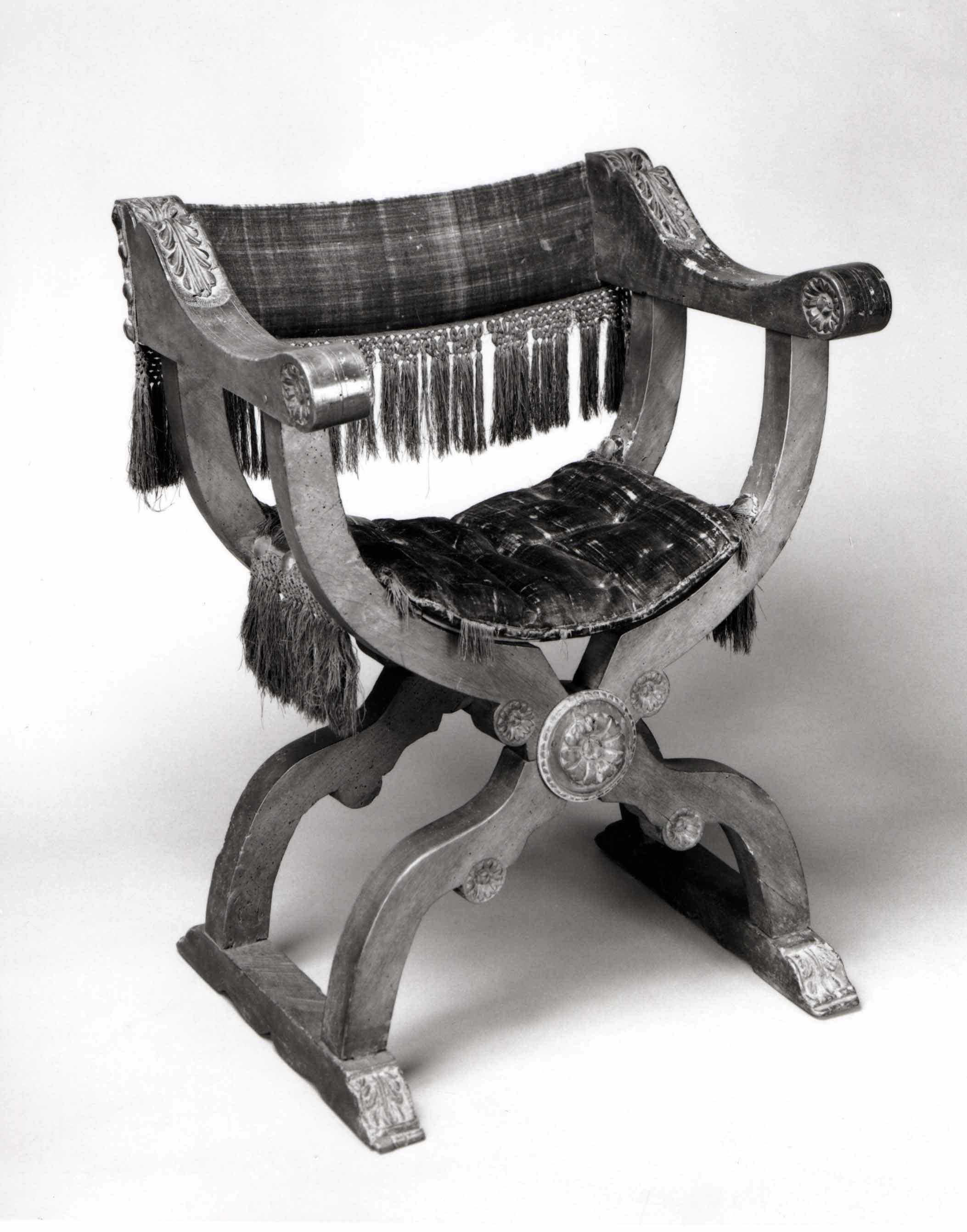
Within the hallowed halls of Katherine Fashion Lab, we engage not only with garments but with the total architecture of presence. Our curatorial lens often turns to objects of design that embody the same principles of structure, embellishment, and symbolic communication as haute couture. The Hip-Joint Armchair of the Dantesca type presents a formidable subject for such an analysis. Of probable Italian Renaissance origin, crafted from carved walnut and adorned with silk cut velvet and metal, this piece is not mere furniture; it is a wearable throne, a exoskeleton of authority and artistry. This analysis will deconstruct its elements through the paradigms of couture: its structural boning is the carved frame, its textile is the luxurious velvet, and its embellishments are the metal accents, together composing a narrative of restrained power and tectonic beauty.
The Structural Frame: Architectural Silhouette and Skeletal Integrity
In couture, the foundational silhouette is paramount, often achieved through internal structures like boning, horsehair, or complex seaming. The Dantesca armchair operates on an identical principle. Its defining feature—the hip-joint—is a masterclass in articulated structure. This ingenious mechanism allows the sitter to recline without altering the chair's fundamental, upright posture. We interpret this as the couture equivalent of a transformative garment, one that accommodates dynamic movement while maintaining its iconic silhouette. The carved walnut frame serves as the garment’s "skeleton." The robust, turned legs and the arched stretchers provide a base of stability, much like the rigid waistline of a corseted gown or the broad shoulders of a power suit. The high, straight back and the armrests create a defined spatial envelope for the body, sculpting the sitter's posture and presence. This is not a chair for languishing; it is a chair for presiding. The woodcarving—likely featuring classical motifs like acanthus leaves, gadrooning, or geometric fluting—adds a layer of textual detail, analogous to the subtle, structural embroidery on a garment’s inner layers that informs its external drape.
The Textile Skin: Velvet as the Language of Luxury and Light
If the walnut frame is the bone, the silk cut velvet is the flesh and skin. In couture, fabric selection is the primary sensory dialogue between the wearer and the world. Silk cut velvet, one of the most prestigious textiles of the Renaissance, is a fabric of profound depth and narrative. The "cut" technique involves shearing loops of silk pile to create a pattern in contrasting textures—a luminous, reflective design against a matte, shadowy ground. This play of light is deliberate and symbolic. The velvet does not merely cover; it articulates. It translates the chair’s structural authority into a language of tactile opulence. The pattern chosen—perhaps a pomegranate (symbol of fertility and unity), a palmette (stylized palm leaf denoting victory), or an intricate geometric—would have been a direct communication of status, learning, or familial identity. In our Lab, we see this as the direct precursor to the couture house’s signature jacquard or the meticulous, narrative-driven prints of designers like Dries Van Noten. The velvet’s rich, absorbing color (a deep crimson, a somber black, or a regal gold) would further define the chair’s character, much as a specific shade of burgundy or emerald defines a collection’s mood. It is a second skin that is both protective and performative.
The Metallic Embellishment: Hardware as Final Accentuation
No couture ensemble is complete without its definitive accents—the buttons, the closures, the jewelled brooch that pivots a look from beautiful to iconic. On the Dantesca chair, metal fulfills this role. These are not merely functional reinforcements; they are the punctuation marks in the object’s visual sentence. Nailheads (often of polished brass or silver) would trace the edges of the velvet upholstery, creating a sharp, gleaming contour that highlights the fabric’s shape and secures it with visible deliberation. This is analogous to the meticulous piping or beaded edging on a couture jacket. More substantial metal plates or caps might protect the joints of the hip mechanism or the ends of the armrests. These elements serve as a reminder of the chair’s ingenious mechanics and its durability, much like the exposed zippers or harness details in the work of designers like Rick Owens or Thomas Hauser of A-COLD-WALL*, which celebrate industrial integrity as aesthetic. The metal provides a moment of cold, hard contrast against the organic warmth of the wood and the plush depth of the velvet, creating a compelling tension of materials.
Synthesis: The Body Enthroned and the Couture of Context
Analyzed in its intended context—the standalone study, or studiolo—the Dantesca chair completes its couture narrative. This was the private domain of the Renaissance man or woman of power, a room dedicated to intellectual pursuit, correspondence, and contemplation. Here, the chair was not part of a set; it was a singular statement piece. The sitter, enveloped in its structured embrace and luxurious textures, would have been elevated—both physically and symbolically. The chair performed a sartorial function, composing the occupant’s posture and framing their presence for the few granted an audience. It communicated erudition, stability, and a command of both the classical past (through its motifs) and cutting-edge craftsmanship (through its hip-joint mechanism).
For Katherine Fashion Lab, the Dantesca Hip-Joint Armchair stands as a canonical object in the history of designed presence. Its lessons are direct: true luxury lies in the intelligent marriage of innovative structure and sublime materiality. Its articulated joint whispers of movement and adaptability within a rigid form, a principle seen in the transformative designs of Iris van Herpen or the architectural pleating of Issey Miyake. Its combination of sturdy walnut, sumptuous velvet, and precise metalwork is a masterful exercise in material juxtaposition, a core tenet of modern couture. To study this chair is to understand that the environment we create around ourselves is the ultimate garment—a constructed identity that speaks before we utter a word.