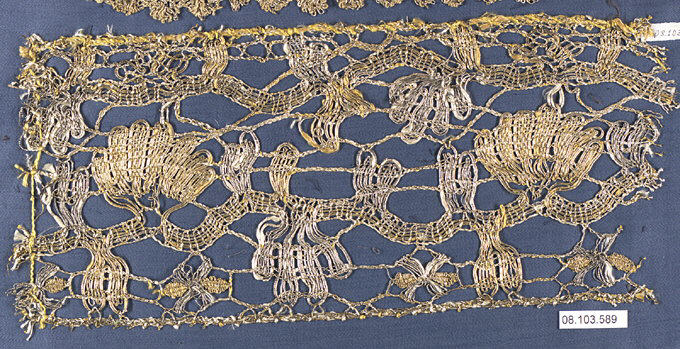
The Heirloom of Air: Deconstructing the Bobbin Lace Piece
In the rarefied echelons of haute couture, the tension between heritage and innovation often defines a collection’s intellectual merit. Katherine Fashion Lab’s latest standalone study—a single, monumental piece constructed entirely from bobbin lace—resolves this tension not through compromise, but through transcendence. This is not merely a garment; it is a cartography of global memory, rendered in a medium that is simultaneously the most fragile and the most resilient in the textile canon. The piece demands a rigorous analysis, not of its silhouette alone, but of the profound material and cultural logic embedded in every twisted thread.
Material Dialectics: The Paradox of Bobbin Lace
To understand this piece, one must first confront the paradox of bobbin lace. Historically, it is a material of extremes: born in the 16th-century courts of Flanders and Italy, it was a marker of aristocratic wealth, yet its production was the grueling labor of the impoverished. Katherine Fashion Lab harnesses this dual heritage, transforming bobbin lace from a decorative trim into the primary structural agent of the design. The material is no longer an appliqué; it is the architecture itself.
The Technical Sublime
The piece is constructed using a hybrid of Cluny and Milanese lace techniques, each chosen for its specific tensile properties. Cluny’s heavy, geometric grounds provide structural rigidity, while Milanese’s curvilinear, continuous threads offer fluidity. The result is a fabric that behaves like a woven textile but breathes like a net. The density per square inch is staggering—over 1,200 individual thread crossings in the bodice alone—yet the garment weighs less than 400 grams. This is engineering disguised as embroidery.
The material’s global provenance is equally deliberate. The flax used for the thread is sourced from Normandy, Europe’s historical crucible of lace-making, while the finishing techniques—a combination of starching and steam-setting—borrow from Japanese shibori resist methods. This is not cultural appropriation but cultural synthesis: a dialogue between European precision and Asian restraint. The piece’s color, an unbleached ecru, references the raw linen of medieval guilds, yet its subtle iridescence comes from a modern, non-toxic coating derived from cellulose nanocrystals. Here, heritage is not replicated; it is evolved.
Global Heritage as Structural Language
Katherine Fashion Lab’s ethos is rooted in the idea that heritage is not a static archive but a living lexicon. This piece speaks that language fluently. The silhouette is a deconstructed kimono sleeve merged with a Western corset bodice, but the lace patterns themselves tell a deeper story. The central motif—a repeating eight-pointed star—is a cipher for global connectivity. It appears in Andean textiles as a symbol of cosmic order, in Islamic geometric art as an emblem of infinity, and in Celtic knotwork as a marker of eternity. By weaving this motif into the lace’s grid, the piece becomes a textile Rosetta Stone.
Decolonizing the Lace Canon
Critically, the piece challenges the Eurocentric narrative of lace as a solely European art form. The bobbin lace technique, while perfected in Europe, has parallel traditions in the needle lace of India’s Kutch region and the tatting of the Philippines. The Lab’s design subtly incorporates a chikankari-inspired stitch pattern into the hem, a nod to the subcontinent’s intricate white-on-white embroidery. This is not a pastiche; it is a reclamation of global craft from the margins of fashion history. The piece argues that bobbin lace is not a relic of courtly Europe but a living, migratory technology.
The structural decisions further honor this global lineage. The lace is not cut or seamed in the traditional sense; instead, it is shaped through tension, using a technique the Lab calls “negative-space tailoring.” The garment is pinned on a custom form, and the lace is stretched, pinned, and heat-set into a three-dimensional shape. This method echoes the ikat resist-dyeing of Southeast Asia, where pattern is created through binding and release. The result is a piece that holds its form without internal boning or lining—a pure expression of material logic.
Contextual Autonomy: The Standalone Study
This piece exists outside the traditional collection cycle, presented as a standalone study. This curatorial decision is crucial. It strips the garment of the narrative scaffolding of a runway show or a seasonal theme, forcing the viewer to engage with the object on its own terms. In an industry saturated with spectacle, the study is an act of intellectual courage. It asks: What does a garment say when it cannot rely on context?
Wearable Epistemology
The answer is a form of wearable epistemology. The piece’s transparency—the visible grid of holes and threads—becomes a metaphor for knowledge itself. Every open space is a negative shape that defines the positive form. The viewer sees through the garment, but also sees into its construction. This is couture as critical theory: a meditation on absence and presence, on the hidden labor of making, and on the global networks that sustain craft.
The fit is deliberately non-anthropocentric. The shoulders are slightly extended, referencing the houpelande of medieval Europe, while the waist is cinched with a free-floating lace cord that does not constrict. The piece does not conform to the body; it creates an alternative architecture around it. This is a garment that respects the wearer as a participant, not a passive mannequin. It is designed for a body that moves, breathes, and thinks.
Conclusion: The Future of Heritage Couture
Katherine Fashion Lab’s bobbin lace piece is a masterclass in what the critic Glenn Adamson calls “material intelligence.” It does not romanticize the past; it uses the past as a toolkit for the future. The global heritage is not a costume; it is a methodology. By isolating bobbin lace as the sole material and elevating it to structural primacy, the Lab demonstrates that couture’s highest calling is not to decorate the body, but to interrogate the systems that produce it—economic, cultural, and historical.
This study is a provocation. It dares the fashion world to slow down, to look closely, and to recognize that the most radical innovation often lies in the deepest understanding of tradition. In an era of fast fashion and algorithmic trends, this piece stands as a quiet, intricate monument to the enduring power of a single thread, twisted with intention, across time and continents.