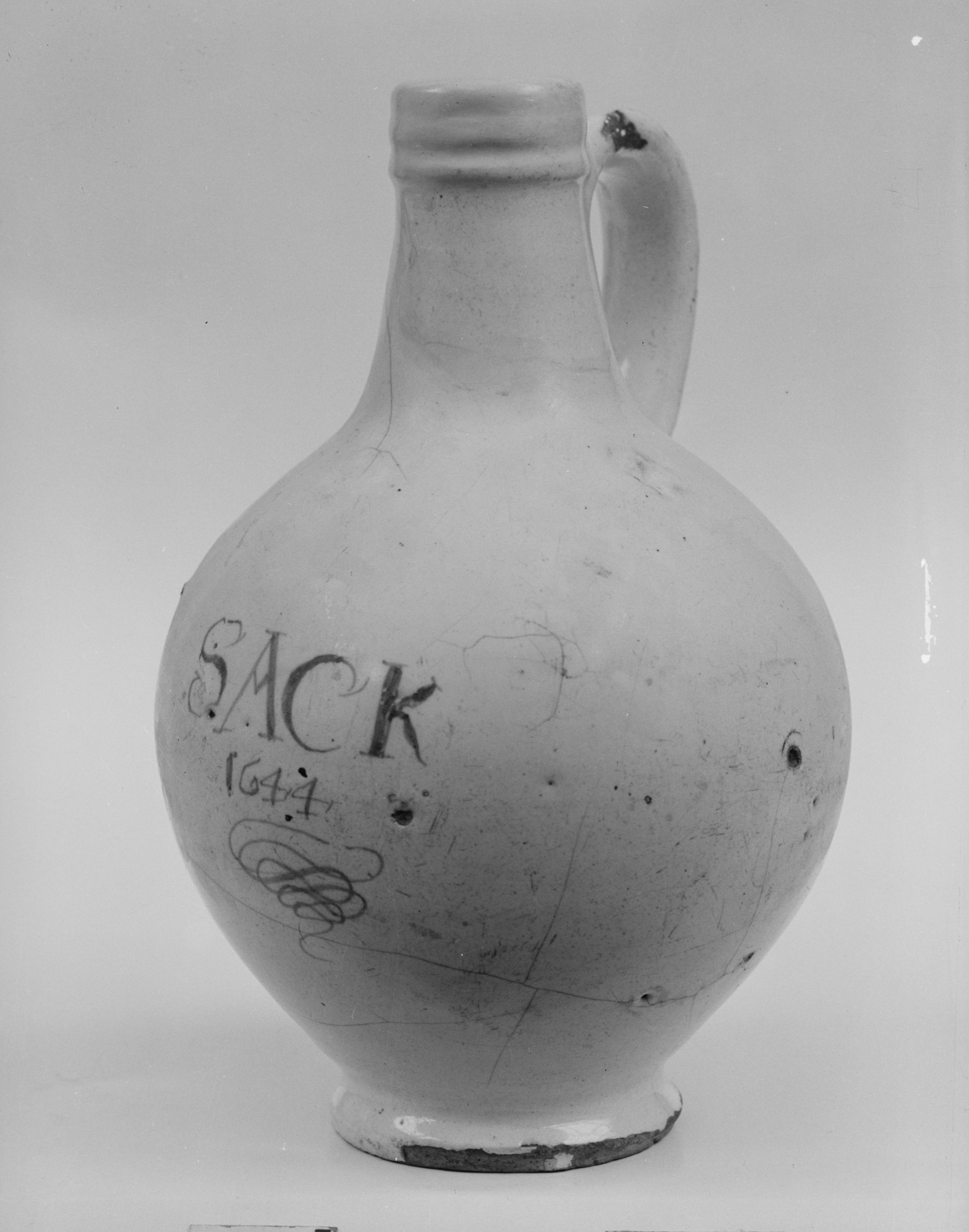
The Sack Bottle: An Object of Structural Elegance and Industrial Heritage
In the rarefied world of couture analysis, where fabric and form typically dominate discourse, the study of a seemingly utilitarian object such as the British sack bottle offers a profound lesson in structural integrity, material alchemy, and the quiet luxury of functional design. At Katherine Fashion Lab, we approach this 18th-century artifact—crafted from tin-enameled earthenware—not merely as a vessel for spirits, but as a standalone study in the principles that underpin high fashion: silhouette, volume, surface treatment, and the tension between fragility and endurance.
The Anatomy of the Silhouette
The sack bottle’s form is deceptively simple, yet its proportions are a masterclass in balance. Typically characterized by a broad, bulbous body that narrows into a short, cylindrical neck, the bottle’s silhouette mirrors the classic peplum or bell-shaped skirt found in couture evening wear. The generous girth of the base provides a stable foundation, while the tapered neck introduces a vertical line that draws the eye upward. This interplay of expansion and contraction is a foundational technique in garment construction, where a fitted bodice may flare into a voluminous skirt, creating a dynamic visual rhythm.
For the couturier, the sack bottle’s volume-to-void ratio is instructive. The body’s curvature is not arbitrary; it is engineered to contain liquid while resisting the internal pressure of fermentation. In fashion, this translates to the careful draping of fabric around the human form, where excess material must be managed without compromising movement or aesthetic. The bottle’s rounded shoulders, for instance, evoke the padded sleeves of a tailored jacket, offering both protection and a sculpted line. The neck, often finished with a simple lip, functions like a clean collar or neckline—an unadorned edge that frames the entirety of the composition.
Materiality: Tin-Enameled Earthenware as a Textile Analog
The choice of tin-enameled earthenware—a composite of clay, glaze, and metallic oxides—is a testament to the British artisan’s pursuit of durability and refinement. This material is analogous to structured couture fabrics such as duchesse satin, brocade, or gazar, which combine stiffness with a luminous surface. The earthenware body provides the underlying heft, much like a heavy silk lining or a horsehair canvas interlining, while the tin glaze offers a smooth, impermeable finish that mimics the sheen of a high-quality taffeta or a lacquered cotton.
What elevates this object within a couture context is the tactile and visual tension between the coarse clay and the glossy enamel. The glaze, often white or cream with a subtle crackle pattern, creates a surface that is both reflective and absorbent of light. This dual quality is reminiscent of pleated silk organza, which catches highlights and shadows depending on the angle of observation. The bottle’s surface may also bear hand-painted cobalt blue decorations—a common feature of British delftware—which introduce a graphic element akin to embroidery or appliqué. These motifs, whether floral scrolls or geometric bands, serve as a narrative layer, transforming a functional object into a canvas for artistic expression.
Structural Integrity: The Couture of Containment
In fashion, structure is often invisible; it is the boning, the interfacing, the underlining that gives a garment its shape. The sack bottle externalizes this principle. Its thick walls and robust foot ring are not decorative but essential, ensuring the bottle can withstand the rigors of transport and use. This functionalist aesthetic resonates with the work of designers like Cristóbal Balenciaga or Madame Grès, who prioritized architectural form over ornamentation. The bottle’s neck, for instance, is reinforced with a rolled rim, a detail that parallels the reinforced buttonholes or bound seams in a bespoke suit—small but critical elements that speak to craftsmanship and longevity.
The bottle’s handle, when present, is a study in ergonomic design. Often a simple strap or loop, it is attached at the shoulder and lower body, distributing weight evenly. In couture, this is analogous to the strategic placement of straps, ties, or closures that allow a garment to drape naturally on the body. The handle’s curve echoes the line of a dolman sleeve or a dropped shoulder, emphasizing ease of movement without sacrificing fit.
Cultural and Historical Context: The British Sensibility
The sack bottle emerged during the 17th and 18th centuries, a period when British trade and industry were flourishing. Tin-enameled earthenware, often called delftware, was a domestic alternative to imported Chinese porcelain, reflecting a national desire for self-sufficiency and understated elegance. This British sensibility—pragmatic, reserved, yet technically ambitious—is mirrored in the couture traditions of Savile Row and the work of designers like Alexander McQueen and Vivienne Westwood, who blend traditional methods with avant-garde vision.
The bottle’s name, “sack,” refers to a fortified wine or sherry, a beverage associated with social rituals and the leisurely class. In fashion, this context invites a parallel to the cocktail dress or the ceremonial robe—garments designed for specific occasions that demand both formality and comfort. The bottle’s presence on a sideboard or in a cabinet is a statement of taste, much like a couture gown displayed in a gallery or worn to a gala. It is an object that exists within a system of value, where material, craft, and purpose converge.
Lessons for Contemporary Couture
For Katherine Fashion Lab, the sack bottle serves as a reminder that couture is not limited to fabric. The principles of volume, surface, and structure are universal, applicable to any medium. In designing a collection inspired by this artifact, one might explore:
- Volume manipulation: Using stiffened tulle or horsehair to recreate the bottle’s rounded, generous shape in a skirt or sleeve.
- Surface treatment: Applying a glossy finish to a garment through resin-coated lace or patent leather, mimicking the tin enamel’s reflective quality.
- Graphic decoration: Incorporating hand-painted or embroidered motifs that echo the cobalt blue designs of British delftware, adding a narrative layer to an otherwise minimalist silhouette.
- Structural detailing: Emphasizing seams, darts, and reinforcements as visible design elements, celebrating the engineering that supports form.
Ultimately, the sack bottle is a testament to the beauty of constraint. Its form is dictated by function, yet it achieves an elegance that transcends utility. In the hands of a couturier, such an object becomes a source of endless inspiration—a study in how to contain, shape, and adorn the human experience.