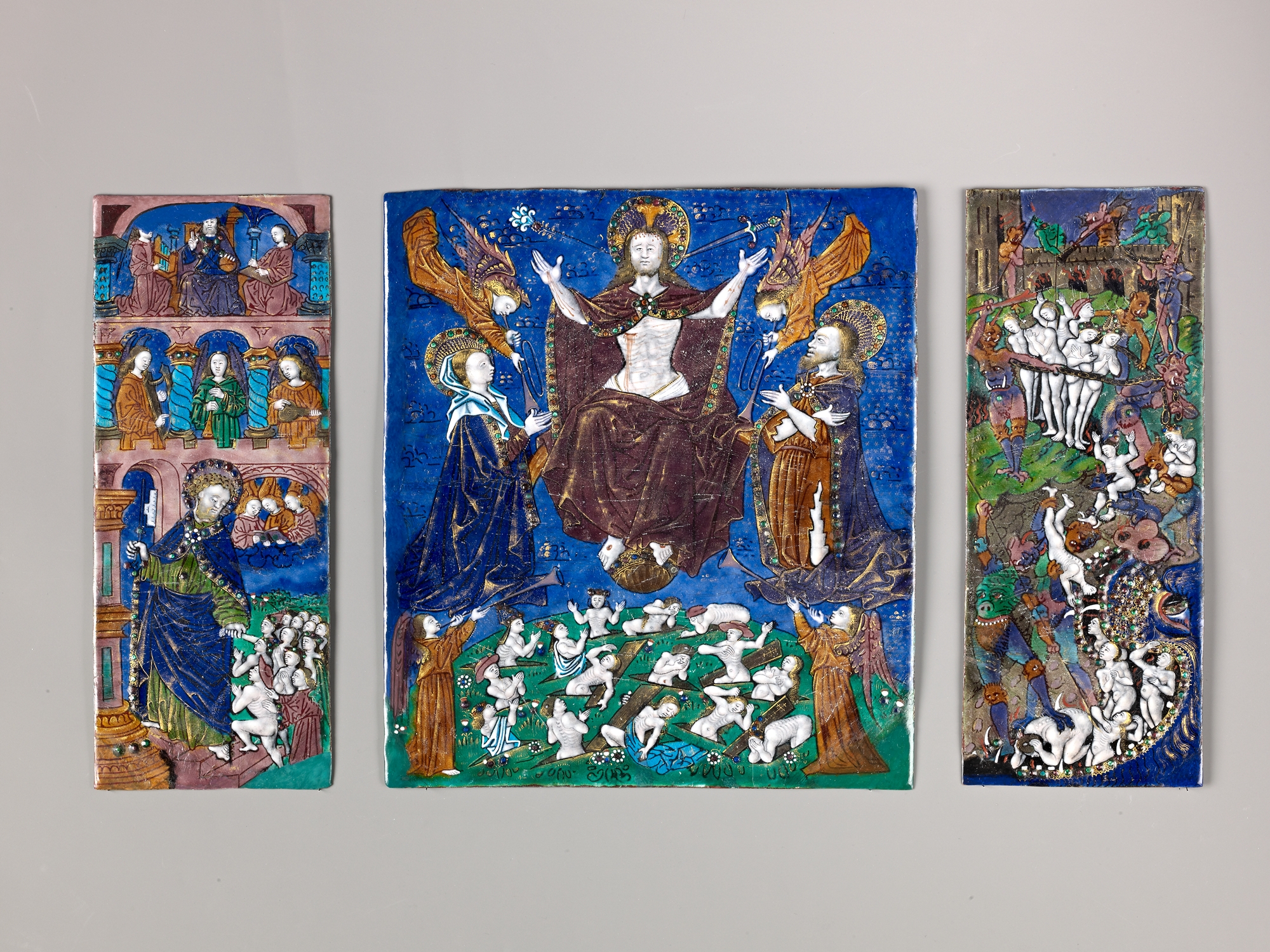
Heritage Analysis: Triptych: The Last Judgment
Subject Overview and Cultural Provenance
The Triptych: The Last Judgment, crafted in painted enamels on copper with partial gilding, originates from mid-16th century France, specifically the renowned Limoges workshops. This piece exemplifies the pinnacle of Renaissance enamel artistry, where religious iconography served both devotional and didactic purposes. For Katherine Fashion Lab, this artifact represents a profound intersection of symbolic power, historical adornment, and spiritual meaning—elements that can strategically inform a 2026 high-end luxury strategy rooted in narrative depth and material mastery.
Symbolic Power and Theological Architecture
The triptych format itself is a symbolic structure: the central panel depicts Christ as Judge, flanked by the saved on the left and the damned on the right. This tripartite division mirrors the hierarchical order of medieval and Renaissance cosmology, where salvation and damnation are juxtaposed as ultimate binaries. For a luxury brand, this symbolic power can be reinterpreted as a narrative of dichotomy and transformation—the tension between light and shadow, virtue and vice, ascension and descent. In a 2026 context, where consumers seek authenticity and moral clarity, the Last Judgment motif offers a potent allegory for ethical luxury: the idea that every creation carries a judgment of quality, intention, and legacy.
Historical Adornment and Material Semiotics
The medium—painted enamels on copper, partly gilded—is a testament to Limoges’ technical virtuosity. Enamel, a vitreous substance fused to metal at high temperatures, requires extreme precision and risk; a single flaw can destroy the piece. This material fragility and permanence parallels the luxury industry’s pursuit of perfection through craft. The partial gilding, applied to halos, thrones, and divine light, elevates the copper base to a celestial plane, creating a luminous hierarchy of surfaces. Historically, such adornment was not merely decorative but hierophanic—it revealed the sacred through material splendor. For Katherine Fashion Lab, this suggests a strategy where adornment is not accessory but essence. In 2026, high-end luxury can draw from this by emphasizing material storytelling: copper as the earthly ground, enamel as the transformative fire, and gold as the divine finality.
Spiritual Meaning and the Luxury Consumer’s Quest
The Last Judgment triptych served a spiritual function within private chapels and cathedrals, prompting reflection on mortality, morality, and transcendence. Its intimate scale (typical of Limoges enamels) allowed for personal contemplation, making the divine accessible through portable sacrality. In the 2026 luxury landscape, consumers increasingly seek meaning over materialism. The spiritual meaning of this artifact—judgment as a moment of truth—can be translated into a brand ethos of curated conviction. A luxury strategy might position each garment or accessory as a moral artifact, inviting the wearer to consider their own legacy. The triptych’s narrative of salvation and damnation, when abstracted, becomes a metaphor for inclusion and exclusivity: the saved represent the brand’s loyal clientele, while the damned symbolize the rejection of mass production and ethical compromise.
2026 High-End Luxury Strategy: The Last Judgment Collection
Based on this heritage analysis, Katherine Fashion Lab can develop a 2026 haute couture or accessories collection titled “The Final Verdict.” The strategy integrates the following pillars:
Narrative Architecture: The collection is structured as a triptych—three distinct capsules: “Ascension” (light, salvation, purity), “Descent” (shadow, damnation, rebellion), and “The Throne” (judgment, power, neutrality). Each capsule uses color, texture, and silhouette to evoke its archetype. Ascension employs ivory, gold, and ethereal organza; Descent uses blackened copper, charred silks, and asymmetric draping; The Throne features rigid, architectural forms in gilded leather and enamel-like finishes.
Material Mastery as Spiritual Practice: The collection foregrounds enamel-inspired techniques—vitreous finishes on metal hardware, fused glass accents on jewelry, and high-gloss lacquers on leather goods. Partial gilding, applied selectively to closures, zippers, and embroidery, creates a hierarchy of light. This mirrors the original triptych’s use of gold to denote the sacred. Clients are invited to “commission their own judgment” through bespoke services, choosing which elements are gilded or darkened, thereby participating in the moral narrative.
Symbolic Marketing and Ritual Experience: The launch is staged as a private exhibition in a cathedral-like space, where each garment is displayed on a copper pedestal under dramatic lighting. The triptych’s original function—personal contemplation—is revived through one-on-one appointments with a “curator-judge,” who guides clients through the collection’s symbolism. Digital companion content includes a “Judgment Journal” app, where users reflect on their own style legacy, reinforcing the brand’s spiritual and ethical positioning.
Exclusivity and Moral Capital: The collection is limited to 333 pieces—a number symbolizing spiritual completeness (3 for the Trinity, 33 for Christ’s age at crucifixion). Each piece is serialized and accompanied by a “certificate of moral provenance” detailing the artisan’s name, the enamel firing temperature, and the ethical sourcing of materials. This transforms the purchase into a collectible artifact, aligning with the 2026 trend toward investment-worthy, narrative-driven luxury.
Conclusion: The Last Judgment as Brand Parable
The Triptych: The Last Judgment is far more than a religious relic; it is a strategic parable for high-end luxury in 2026. Its symbolic power teaches the value of narrative dichotomy; its historical adornment underscores the importance of material truth; its spiritual meaning addresses the consumer’s longing for transcendence. By translating these elements into a cohesive collection and brand experience, Katherine Fashion Lab can position itself at the vanguard of meaningful luxury—where every creation is a judgment, and every client is a participant in their own legacy.