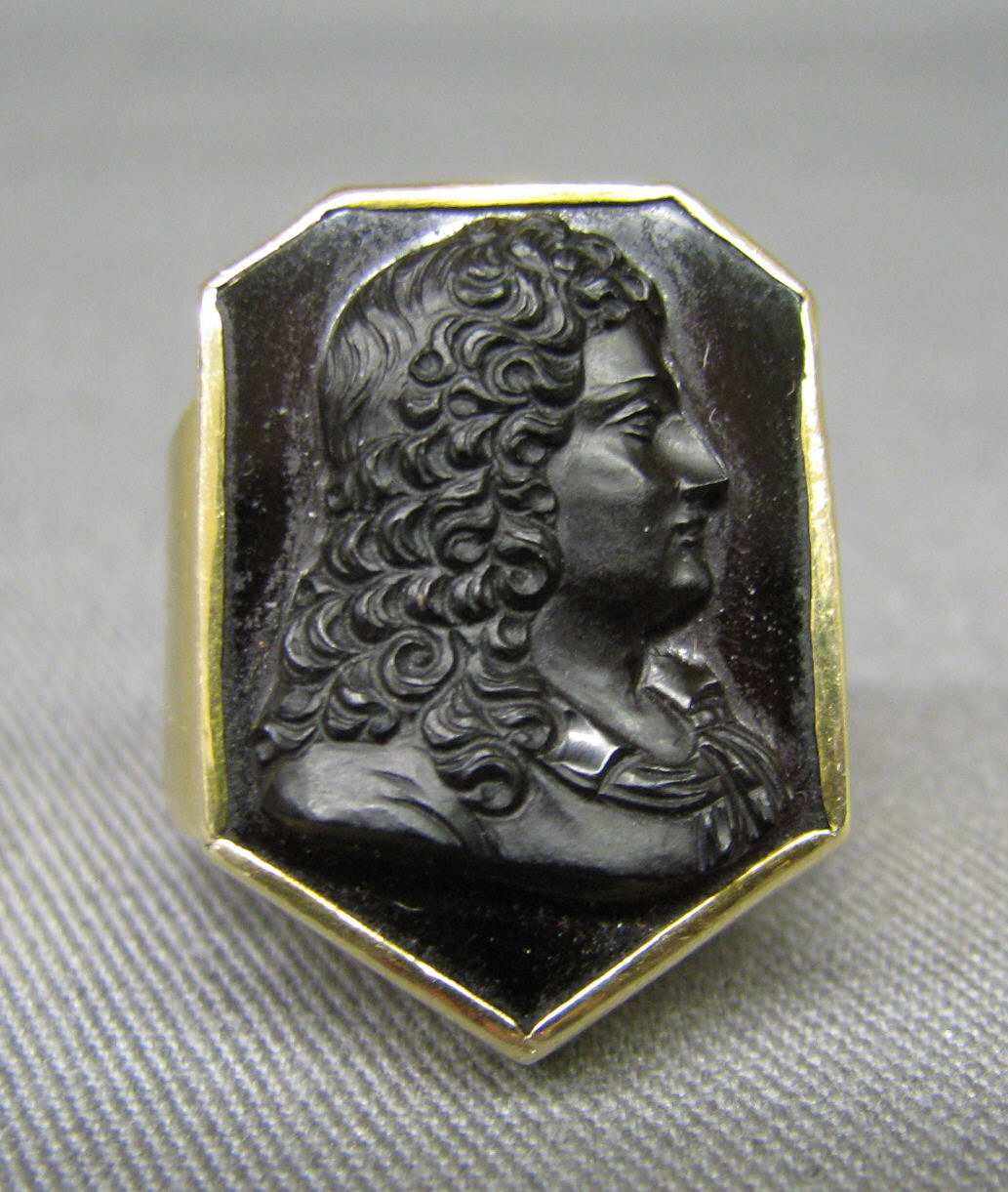
Heritage Analysis: The Sardonyx Bust Ring
This strategic research paper examines a singular artifact: a bust of a man in a wig, possibly a writer, carved from sardonyx and mounted in gold as a ring. Originating from an ancient civilization, this object represents a confluence of symbolic power, historical adornment, and spiritual meaning. For Katherine Fashion Lab, understanding this piece is not merely an academic exercise; it is a blueprint for a 2026 high-end luxury strategy that leverages deep cultural resonance to command authority in a saturated market.
Symbolic Power: The Writer as Sovereign
The choice of a writer—a figure of intellectual and creative authority—is deliberate. In ancient societies, the writer was often a priest, scribe, or philosopher who mediated between the divine and the mortal. The bust, rendered in sardonyx, elevates this figure to a status of permanence. Sardonyx, a layered chalcedony, was prized for its hardness and its ability to hold intricate carvings without fracture. This material choice communicates immutability—the writer’s words, like the stone, endure across millennia.
The wig, a stylized headpiece, is equally potent. In ancient Egypt, Mesopotamia, and Rome, wigs signified rank, ritual purity, and social hierarchy. A wig on a writer suggests that his intellectual labor was not merely personal but institutional. He was a custodian of knowledge, a figure whose thoughts shaped law, religion, and governance. When mounted as a ring, this bust becomes a talisman of intellectual sovereignty—a reminder that the wearer possesses the power to define reality through language and narrative.
For Katherine Fashion Lab, this symbolism translates directly into luxury positioning. The 2026 consumer is not just buying a product; they are buying a narrative of influence. A ring bearing the bust of a writer suggests that the wearer is a creator, a thought leader, or a patron of culture. It is a quiet declaration of power that does not rely on overt wealth but on intellectual and historical gravitas.
Historical Adornment: The Ring as Micro-Architecture
The ring format itself is a study in historical adornment. Ancient signet rings were functional—they sealed documents and authenticated authority. The sardonyx bust ring, however, transcends utility. It is micro-architecture in miniature: a three-dimensional portrait carved with precision, then set in gold. The gold mount is not merely a setting; it is a frame that elevates the stone to a sacred object.
Historical records from the Hellenistic and Roman periods indicate that such rings were often worn by patricians and scholars. They were not mass-produced; each was a bespoke commission, reflecting the owner’s personal lineage, profession, or philosophical allegiance. The ring’s portability allowed it to function as a portable shrine—a constant companion for meditation, inspiration, or ritual.
In the context of Katherine Fashion Lab’s 2026 strategy, this historical precedent is invaluable. The luxury market is shifting toward personalization and narrative. A ring that tells a story—of a writer, a civilization, a stone—offers a depth that mass-produced jewelry cannot replicate. The Lab should consider offering limited-edition rings that pair ancient gemstones with contemporary narratives, allowing clients to commission pieces that reflect their own intellectual or spiritual identities.
Spiritual Meaning: The Stone as a Vessel
Sardonyx held profound spiritual meaning in antiquity. It was believed to protect the wearer from negative energies, enhance eloquence, and promote marital harmony. The stone’s layered bands—often white, red, and brown—were seen as a metaphor for the layers of consciousness: the mortal, the heroic, and the divine. Carving a writer’s bust into this stone fuses the spiritual with the intellectual: the writer’s thoughts become a conduit for divine wisdom.
The ring’s placement on the finger—typically the index or middle finger—was also symbolic. The index finger was associated with authority and direction, while the middle finger with balance. Wearing a writer’s bust on these fingers suggests that the wearer is guided by wisdom, not impulse. This aligns with ancient Stoic and Platonic ideals, where the philosopher-king ruled through reason.
For Katherine Fashion Lab, this spiritual dimension offers a powerful marketing angle. In 2026, consumers are increasingly seeking meaningful consumption. A ring that is not just beautiful but also spiritually protective and intellectually ennobling can command premium positioning. The Lab should emphasize the ritualistic aspects of wearing such a piece—perhaps offering a certificate of provenance that details the stone’s historical and metaphysical properties, or hosting private events where clients learn about the ancient traditions of gemstone carving.
2026 High-End Luxury Strategy: Heritage as Currency
Katherine Fashion Lab’s strategy for 2026 must pivot on heritage as currency. In a market flooded with logo-driven luxury, the true connoisseur seeks cultural capital. The sardonyx bust ring is a prime example of how an object can embody multiple layers of value: material (sardonyx, gold), historical (ancient civilization), symbolic (writer as sovereign), and spiritual (protective stone).
The Lab should develop a Heritage Collection that reinterprets such artifacts for the modern elite. Each piece should be accompanied by a curatorial dossier—a research paper, like this one—that explains its symbolic, historical, and spiritual significance. This transforms the ring from a commodity into an artifact of personal mythology.
Furthermore, the Lab should leverage exclusivity through scarcity. Sardonyx of this quality is rare; the carvings require master artisans. By limiting production to a small number of pieces per year, the Lab creates collectible value. Clients are not just buying a ring; they are acquiring a piece of history that appreciates in cultural and monetary worth over time.
Finally, the Lab must engage in narrative marketing. Instead of traditional advertising, the Lab should partner with museums, archaeologists, and philosophers to create content that educates and inspires. A short film on the carving process, a podcast on the spiritual meaning of sardonyx, or a private exhibition at a gallery—these strategies build a community of informed patrons who value depth over display.
Conclusion
The bust of a man in a wig, possibly a writer, carved in sardonyx and mounted as a ring, is far more than an ancient adornment. It is a convergence of power, identity, and spirituality. For Katherine Fashion Lab, this artifact provides a clear roadmap for 2026: luxury that is rooted in heritage, rich in symbolism, and resonant with spiritual meaning. By translating these ancient values into modern form, the Lab can offer not just products, but legacies.