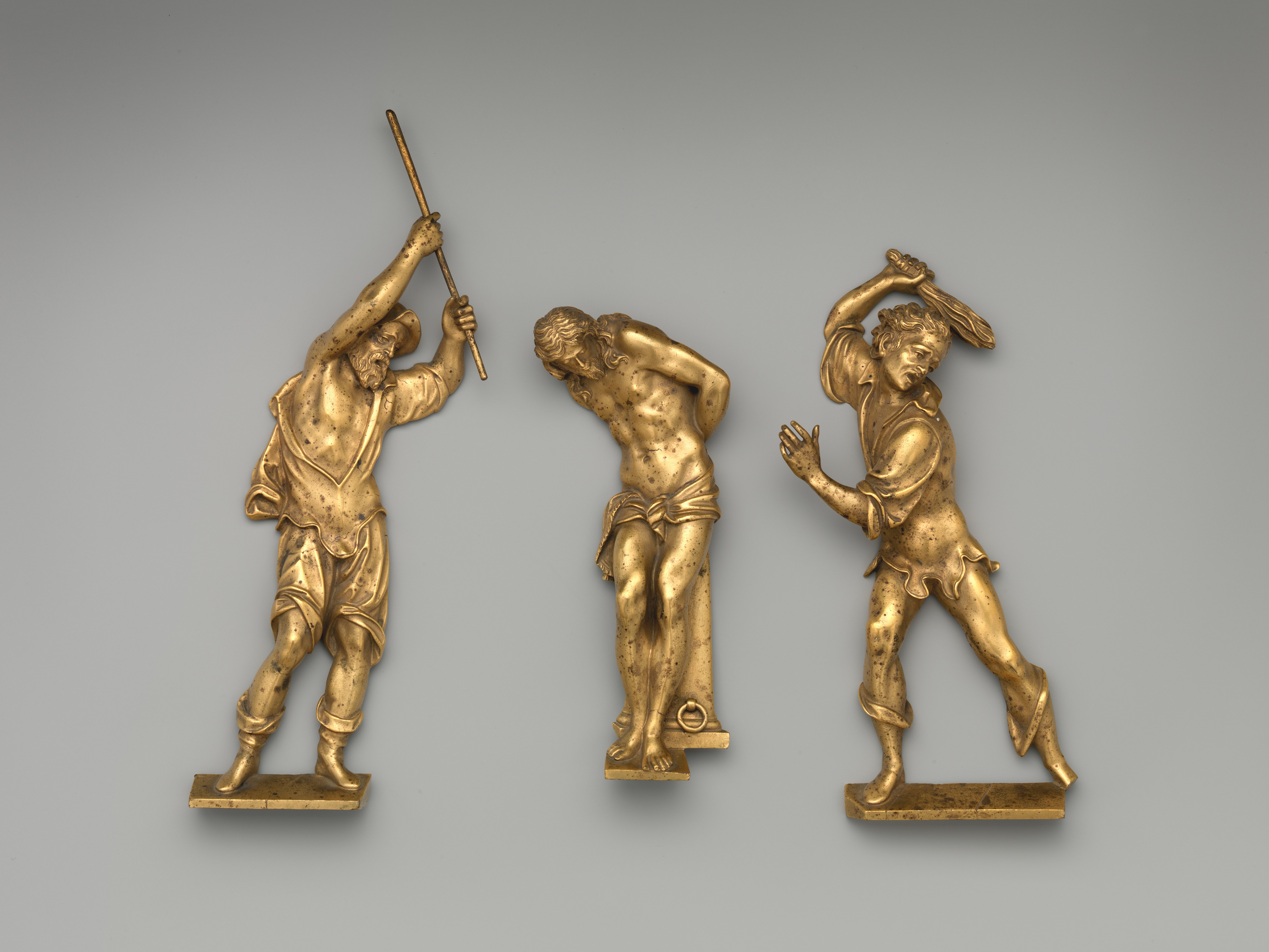
Divine Wounds: A Couture Analysis of The Flagellation of Christ in Bronze Gilt
In the hallowed halls of Katherine Fashion Lab, where the ephemeral art of couture meets the permanence of global heritage, we encounter a singular artifact: a bronze gilt study of The Flagellation of Christ. This piece, stripped of its liturgical context and presented as a standalone object, demands a reading that transcends its religious origins. As a lead curator, I propose we analyze this work not as a devotional icon, but as a masterclass in the couture of suffering—a dialogue between material, form, and the human condition. The bronze gilt, with its luminous surface and weighty substance, transforms a moment of profound violence into an artifact of transcendent beauty, much like the finest haute couture elevates fabric into art.
The Materiality of Pain: Bronze Gilt as a Couture Fabric
Bronze gilt is not a passive medium. It is a statement of durability and opulence, a material that demands reverence. In this study, the gold leaf or gilding applied to the bronze surface creates a paradoxical tension: the luminous sheen of the gold contradicts the visceral agony of the subject. The flagellation—a scene of raw, physical torment—is rendered in a material that catches light, reflecting it in a way that softens the brutality while amplifying its sacredness. This is the couture paradox: to clothe pain in beauty, to make the unbearable bearable through craftsmanship.
The surface texture is critical. The bronze is not smooth; it is worked with a patina of hammer marks and subtle indentations, mimicking the lash marks on Christ’s flesh. The gilding highlights these contours, creating a play of shadow and light that evokes the tactile memory of fabric—the way a silk faille catches the light on a pleat, or how a metallic thread in a brocade emphasizes a fold. Here, the metal becomes a textile of the soul, each mark a stitch in the narrative of suffering. The gilding, often associated with royalty and divinity, paradoxically elevates the figure of Christ into a couture garment of martyrdom, where every wound is a jewel.
The Silhouette of Suffering: Form and Composition
Standing alone, the study presents Christ in a moment of arrested motion. The pose is not static; it is a frozen gesture of endurance. The figure is slightly contorted, the spine arched as if to receive the blows, the hands bound above the head. This silhouette—elongated, vulnerable, yet dignified—mirrors the architectural lines of a couture gown. The verticality of the form draws the eye upward, suggesting a transcendence beyond the physical. The asymmetry of the body, with one shoulder dropped and the other raised, evokes the drape of a bias-cut dress, where fabric follows the body’s curves in a dance of tension and release.
The absence of the flagellators and the pillar—traditional elements in the scene—forces the viewer to focus solely on the figure. This isolation is a curatorial choice that parallels the minimalist aesthetic of modern couture, where a single, powerful silhouette can convey an entire narrative. The bronze gilt, with its reflective quality, becomes a second skin—a metal sheath that both protects and exposes. It is the ultimate couture garment: one that reveals the form beneath while shielding it from the world, much like the armor of a knight or the corset of a Victorian lady, both designed to sculpt and constrain.
Global Heritage: The Cross-Cultural Threads of the Flagellation
Though rooted in Christian iconography, this study of the Flagellation draws from a global heritage of artistic representations of suffering. The bronze gilt technique itself has echoes in ancient Chinese bronzes, Indian temple sculptures, and Renaissance European masterworks. The golden surface is not merely decorative; it is a universal symbol of the divine, the unattainable, and the eternal. In many cultures, gold is the material of gods and kings, a metal that does not tarnish, much like the soul that endures beyond the body.
This piece, as a standalone study, invites a dialogue with other traditions of martyrdom and sacrifice. The contorted pose recalls the yogic discipline of a meditating ascetic in Hindu or Buddhist art, where physical endurance is a path to enlightenment. The gilding, with its luminous quality, suggests the nimbus of a saint in Byzantine icons, or the halo of a bodhisattva in East Asian art. By stripping the narrative context, Katherine Fashion Lab positions this work as a global artifact of human resilience, a testament to the universal language of pain and beauty.
The Standalone Study: Decontextualization as a Couture Statement
Presenting this study without its traditional setting—without the column, the soldiers, the architectural backdrop—is a radical act of decontextualization. In the world of couture, this is akin to presenting a single garment on a bare mannequin, without accessories or a runway. The focus shifts entirely to the craftsmanship and the emotional resonance of the form. The bronze gilt study becomes a wearable artifact of the mind, a piece of jewelry that adorns the space it inhabits.
This isolation allows for a deeper exploration of the materiality of suffering. The bronze gilt is not just a metal; it is a memory of fire, casting, and polishing—a process that mirrors the purification of the soul through trial. The flagellation, in this reading, is not a historical event but a metaphor for the trials of creation itself. Every couture garment undergoes a similar process: the cutting, the stitching, the pressing, the fitting—each step a small violence that transforms raw material into art. The study, then, is a meditation on the cost of beauty, the price of perfection that both the artisan and the subject must pay.
Conclusion: The Couture of the Sacred
In The Flagellation of Christ as rendered in bronze gilt, Katherine Fashion Lab presents a work that challenges the boundaries between art, couture, and heritage. It is a piece that asks us to see suffering as a form of adornment, and metal as a fabric of the divine. The luminous surface, the contorted silhouette, and the global echoes of its technique all converge to create a study that is at once brutal and beautiful, ancient and contemporary. As a standalone artifact, it invites us to consider the couture of the sacred—the way we dress our most profound experiences in materials that transcend time. This is not merely a study of a biblical scene; it is a garment of the soul, stitched in gold and forged in fire, a testament to the enduring power of human creativity to transform pain into grace.