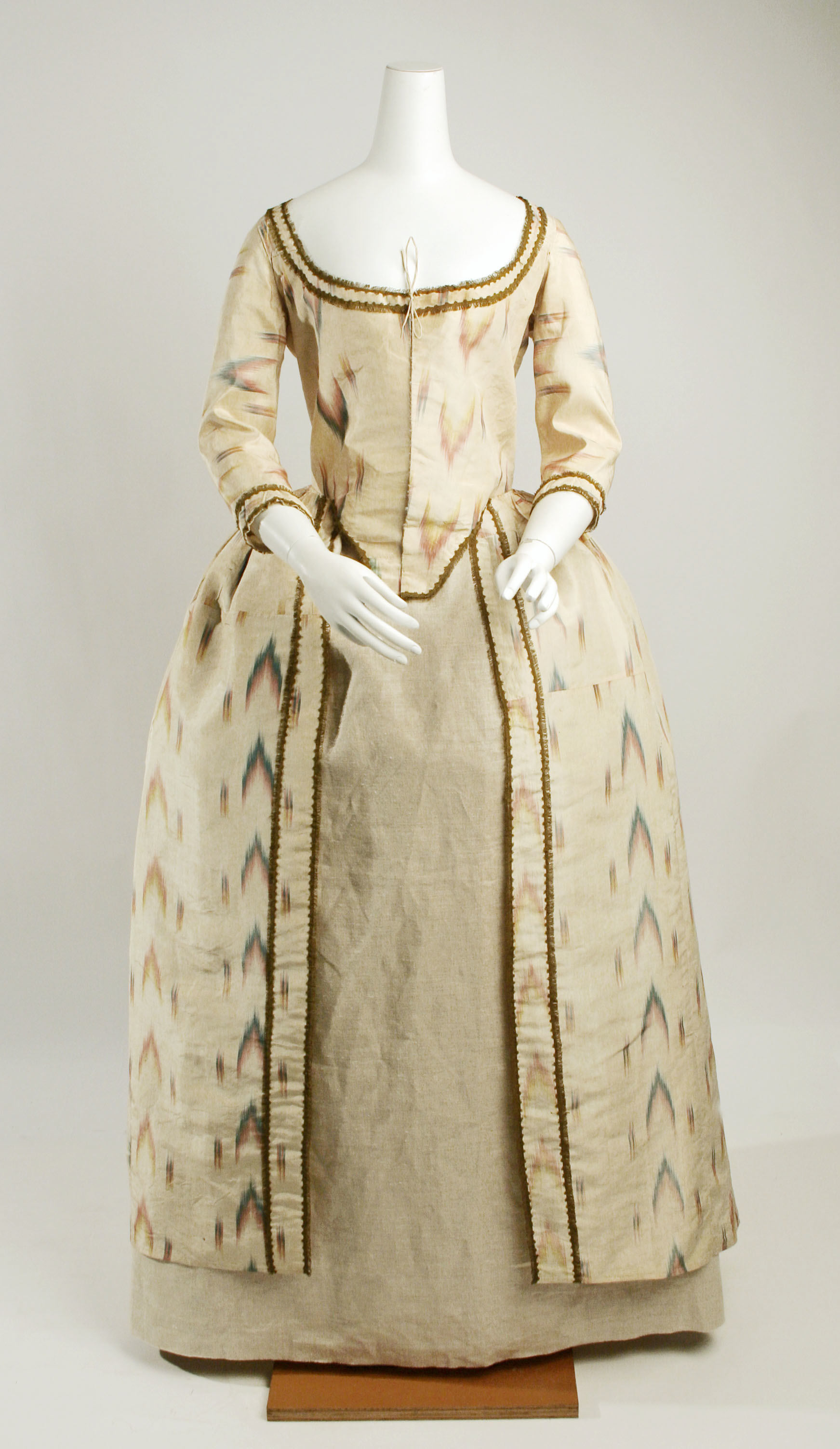
The Robe à l'Anglaise: A British Silken Masterpiece in the Katherine Fashion Lab Archive
Within the hallowed collections of Katherine Fashion Lab, few garments command as much scholarly reverence as the Robe à l’Anglaise—a quintessentially British interpretation of 18th-century aristocratic dress. This standalone study examines a singular example, crafted from lustrous silk, which exemplifies the convergence of technical innovation, social signaling, and aesthetic restraint that defined the English haute couture of its era. As Lead Curator, I invite you to consider this piece not merely as a garment, but as a document of cultural identity, economic ambition, and the subtle art of self-presentation.
Historical Context: The Anglophile Silhouette
The Robe à l’Anglaise emerged in the 1760s as a deliberate counterpoint to the French robe à la française, with its ostentatious, wide panniers and profuse trimmings. British aristocrats, influenced by Enlightenment ideals of simplicity and naturalism, sought a silhouette that conveyed rational elegance rather than courtly excess. This gown, dating from approximately 1770–1780, embodies that shift. The silk—a sumptuous, self-striped taffeta in a muted celadon green—speaks to a preference for refined understatement. The fabric’s subtle moiré effect, achieved through a heat-pressing technique, adds depth without overt ornamentation, aligning with the British valorization of craftsmanship over decoration.
In contrast to the French court’s rigid formality, the Anglais dress was designed for domestic and social mobility. Its fitted bodice, which hugs the torso without boning, allowed for natural movement, while the skirt fell in gentle, unbroken folds from the waist—a deliberate rejection of the artificial hip extensions favored across the Channel. This was a garment for the English country house, the assembly room in Bath, or the promenade in St. James’s Park. It signaled a woman’s participation in a culture that prized polite sociability and moral sincerity over performative grandeur.
Material and Construction: The Silk as Narrative
The silk itself is a protagonist in this story. Sourced from the Spitalfields silk-weaving district of London, this taffeta was a product of the British silk industry’s golden age. The warp and weft threads, dyed with madder root and weld, produce a color that shifts from sage to silver under different light—a deliberate choice to mimic the organic hues of the English landscape. The weave is tight, with a subtle ribbed texture that catches light like water on polished stone. This material was not cheap; a gown of this quality could cost the equivalent of a year’s wages for a skilled artisan. Its presence in a wardrobe was a declaration of economic solvency and cultural literacy.
Construction techniques reveal the garment’s dual identity as both luxury object and functional attire. The bodice is cut in four pieces, with darts at the bust and a center-back seam that allows for a snug fit without lacing. The sleeves, set into the armhole with minute pleats, terminate in double-layered cuffs that could be turned back to reveal a contrasting lining—a subtle flirtation with the erotic, as the wrist was one of the few acceptable areas of bare skin. The skirt, cut in a full circle from three widths of silk, is pleated into the waistband with meticulous precision, creating a bell shape that moves with the wearer’s steps. Every seam is finished with a hand-rolled hem, and the interior is lined with a coarse linen that absorbed perspiration and protected the delicate silk from body oils.
The Aesthetic of Restraint: Design Details
What distinguishes this Robe à l’Anglaise from its French counterparts is the strategic use of negative space. The bodice is devoid of lace, ribbons, or floral appliqués. Instead, the gown relies on the play of light across the silk’s surface and the architectural lines of the cut. The only ornamentation is a self-fabric rouleau that traces the neckline and descends in a gentle V to the waist, echoing the shape of a stomacher without the need for a separate piece. This minimalism was radical for its time—a visual manifesto of British anti-Gallican sentiment. While French fashion was synonymous with artifice, the Anglais dress claimed authenticity and virtue through its unadorned elegance.
Yet restraint did not mean simplicity. The gown’s back, visible only when the wearer turned, features a complex arrangement of pleats that fan out from the shoulder blades—a technique known as “à la Watteau” after the painter. These pleats, secured at the waist but free-flowing below, create a waterfall of silk that moves with kinetic grace. This was a deliberate engineering feat: the pleats had to be deep enough to drape elegantly but shallow enough to avoid bulk. The effect is a garment that appears effortless but required hours of labor and a master’s understanding of fabric behavior.
Cultural Significance: The Gown as Social Currency
In the context of British society, this Robe à l’Anglaise functioned as a tool of social negotiation. Worn to afternoon teas, musical performances, and informal gatherings, it signaled that the wearer belonged to the landed gentry or the upper merchant class—those with enough leisure to appreciate culture but not so much as to be idle. The gown’s cut allowed for easy conversation and movement, facilitating the polite exchange of ideas that defined Enlightenment sociability. It was a garment for the woman who read novels, discussed politics, and managed her estate—a far cry from the decorative, almost static figure of the French court.
Moreover, the choice of silk over wool or cotton was a political statement. The British silk industry, protected by tariffs on imported French goods, was a source of national pride. Wearing Spitalfields silk was an act of economic patriotism, a quiet rebellion against the dominance of French luxury. This gown, then, is not just a garment but a commercial artifact—a testament to the interconnectedness of fashion, industry, and national identity in the late 18th century.
Conclusion: A Legacy of Elegance and Ideology
As we study this Robe à l’Anglaise within the Katherine Fashion Lab, we uncover layers of meaning that transcend its physical beauty. It is a document of British cultural resistance, a showcase of technical mastery, and a mirror of the Enlightenment’s ideals. The silk, now fragile with age, still whispers of the hands that wove it, the needles that sewed it, and the woman who wore it with quiet confidence. In its restrained lines and subtle shimmer, we find not just a fashion, but a philosophy—one that valued substance over spectacle, and found elegance in the art of omission. This garment remains a masterclass in how clothing can articulate identity, ideology, and aspiration without a single spoken word.