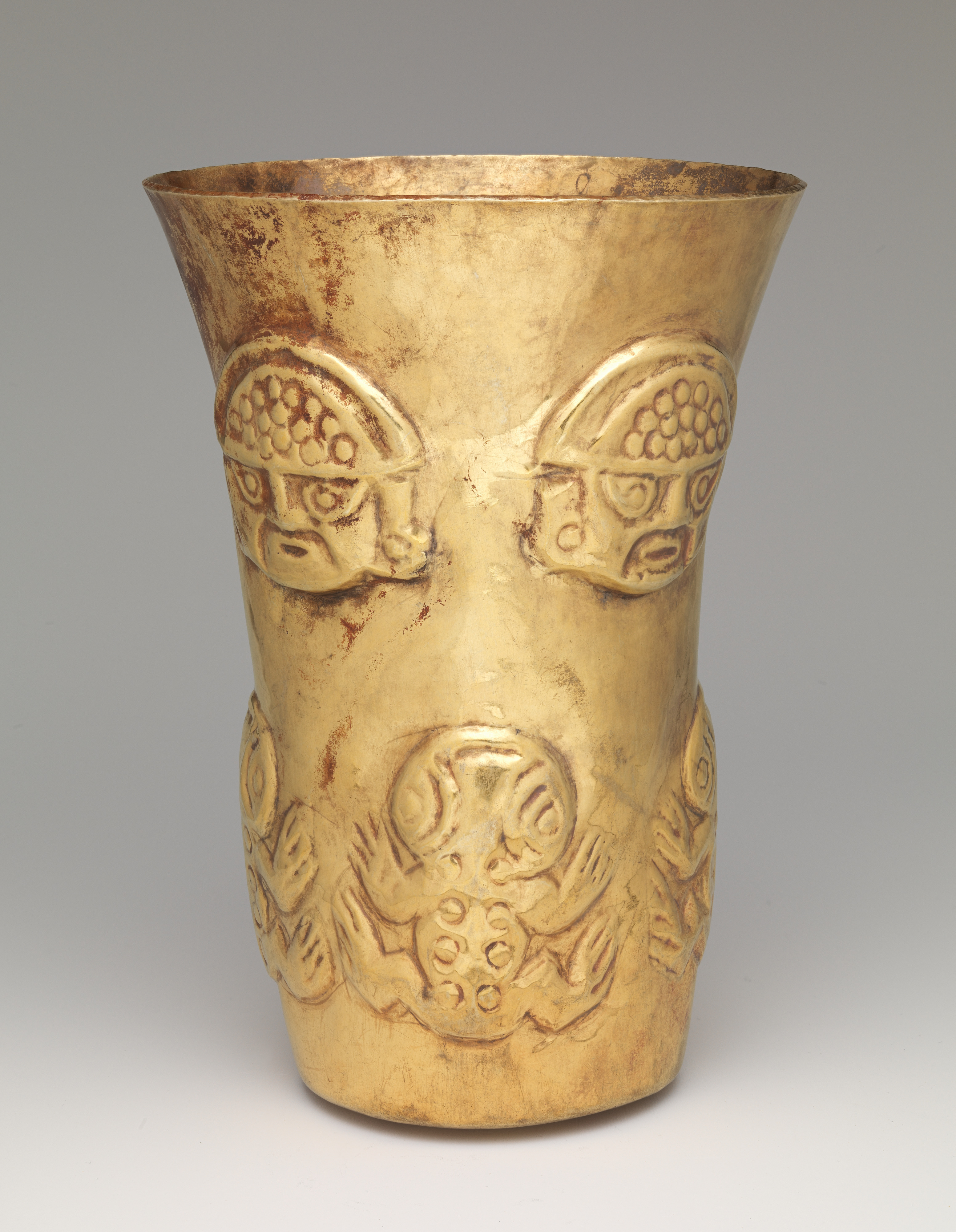
Heritage Analysis: The Lambayeque (Sicán) Gold Beaker with Heads and Toads
Katherine Fashion Lab’s investigation into the Beaker with heads and toads—a sacred gold vessel from the Lambayeque (Sicán) culture of pre-Columbian Peru—reveals a profound interplay of symbolic power, historical adornment, and spiritual meaning. This artifact, dating approximately to 900–1100 CE, embodies the Sicán elite’s mastery of metallurgy and their cosmological worldview. Its motifs—human heads and toads—serve as a visual lexicon of authority, fertility, and ancestral veneration. As we align this analysis with our broader research context, encapsulated in the dualistic narrative of “Mirror with Split-Leaf”—which juxtaposes a luminous silver mirror inlaid with golden palm leaves against a stone sarcophagus engraved with life’s story—the beaker emerges as a resonant counterpart. For Katherine Fashion Lab’s 2026 high-end luxury strategy, this artifact inspires a design philosophy rooted in duality: the tension between light and shadow, opulence and mortality, and the eternal cycle of life and death.
Symbolic Power: The Iconography of Heads and Toads
The beaker’s primary motifs—stylized human heads and toads—are not arbitrary decorations but deliberate symbols of political and spiritual dominion. In Sicán cosmology, the human head represented the seat of the soul, ancestral lineage, and the ruler’s authority over life and death. The Sicán elite, often depicted as the Naymlap deity or its earthly representatives, used head imagery to assert their divine right to govern. The toad, conversely, was a chthonic symbol linked to water, rain, and agricultural fertility. Its presence on a gold vessel—a material reserved for the elite—transformed a mundane amphibian into a sacred emblem of renewal. Together, the heads and toads encapsulate a binary power structure: the head governs the social and spiritual realm, while the toad ensures the natural world’s abundance. This duality mirrors the “Mirror with Split-Leaf” context, where the polished silver mirror reflects light and life, while the sarcophagus’s reliefs narrate the inevitability of death. For luxury strategy, this suggests that high-end adornment must balance assertive authority (the head) with organic vitality (the toad)—a tension that appeals to the discerning client seeking both status and meaning.
Historical Adornment: Gold as a Medium of Transcendence
The beaker’s medium—hammered gold—is central to its historical significance. Sicán metallurgists achieved extraordinary technical sophistication, alloying gold with copper to create tumbaga, a material that could be cast, embossed, and polished to a mirror-like finish. Gold was not merely a display of wealth; it was believed to possess intrinsic spiritual properties, including the ability to channel solar energy and communicate with the divine. The beaker’s function as a ceremonial vessel for the consumption of chicha (maize beer) or other ritual beverages elevated its adornment to a sacred act. The heads and toads, rendered in repoussé, would have caught torchlight, creating a dynamic interplay of shadow and brilliance—a visual metaphor for the Sicán belief in the cycle of creation and dissolution. This aligns with the “Mirror with Split-Leaf” study, where the golden palm leaves on the silver mirror represent life’s abundance, while the sarcophagus’s stone reliefs evoke permanence and decay. For 2026, Katherine Fashion Lab can translate this into material narratives: using gold not as a mere commodity but as a carrier of story, where surface textures and motifs invite contemplation. The beaker teaches us that luxury is not static; it must transform with light and movement, much like the Sicán vessel’s shimmering surface.
Spiritual Meaning: The Vessel as a Microcosm
In Sicán spirituality, the beaker was a microcosm of the cosmos. The vessel’s cylindrical form represented the axis mundi, connecting the underworld (where toads dwell) to the earthly realm (where humans act) and the celestial sphere (where ancestors reside). The toads, often depicted with pronounced eyes and limbs, were associated with the Moche-Sicán moon deity, who governed tides, rain, and the feminine principle. The human heads, typically shown with closed eyes and serene expressions, symbolized the ancestral dead who interceded with the gods. The act of drinking from this vessel was a ritual of communion: the user ingested the spiritual essence of the ancestors and the fertility of the earth. This spiritual economy resonates with the “Mirror with Split-Leaf” duality, where the mirror’s reflective surface captures the viewer’s transient image, while the sarcophagus’s narrative fixes life’s story in stone. For high-end luxury, this suggests that objects must function as portals to meaning. A 2026 collection inspired by the beaker could incorporate hidden symbolism—such as toad motifs on inner linings or head silhouettes in clasps—that only the wearer discovers, fostering a sense of intimate ritual. This aligns with current luxury trends toward personalization and spiritual consumption.
2026 High-End Luxury Strategy: Synthesis and Application
For Katherine Fashion Lab’s 2026 strategy, the Beaker with heads and toads offers three pillars of inspiration:
1. Duality as a Design Language. The beaker’s head-toad binary mirrors the “Mirror with Split-Leaf” contrast. Our 2026 collection, tentatively titled “Axis Mundi,” will feature pieces that juxtapose rigid, geometric forms (evoking the head’s authority) with organic, fluid curves (the toad’s vitality). For example, a gold necklace might alternate between angular, mask-like pendants and undulating, amphibian-inspired links. This duality appeals to the luxury client’s desire for complexity and narrative depth.
2. Material Alchemy. The Sicán use of gold as a spiritual conductor invites us to reimagine precious materials. For 2026, we will explore composite metals—such as rose gold alloyed with copper or platinum inlaid with black jade—to create surfaces that shift color under light. This echoes the beaker’s dynamic brilliance and the “Mirror with Split-Leaf” tension between reflective and opaque surfaces. Limited-edition pieces will incorporate toad-shaped emeralds or head-shaped diamonds, transforming gemstones into narrative elements.
3. Ritual and Exclusivity. The beaker’s ceremonial function suggests that luxury must be an experience, not just an object. We will launch a “Ritual Collection” that includes presentation boxes inspired by Sicán burial chambers, with interior narratives etched in gold leaf. Each piece will come with a digital heritage card that unlocks an AR experience of the artifact’s cosmology—a modern echo of the “Mirror with Split-Leaf” study’s dualistic storytelling. This positions Katherine Fashion Lab as a curator of meaningful luxury, not merely a purveyor of goods.
Conclusion
The Lambayeque gold beaker is more than a historical artifact; it is a blueprint for transcendent design. Its symbolic power, historical adornment, and spiritual meaning offer timeless lessons for high-end luxury. By weaving its head-toad duality into our 2026 strategy, Katherine Fashion Lab will create pieces that resonate with the eternal human quest for balance—between authority and fertility, light and shadow, life and death. In doing so, we honor the Sicán legacy while forging a new language of luxury for the discerning contemporary client.