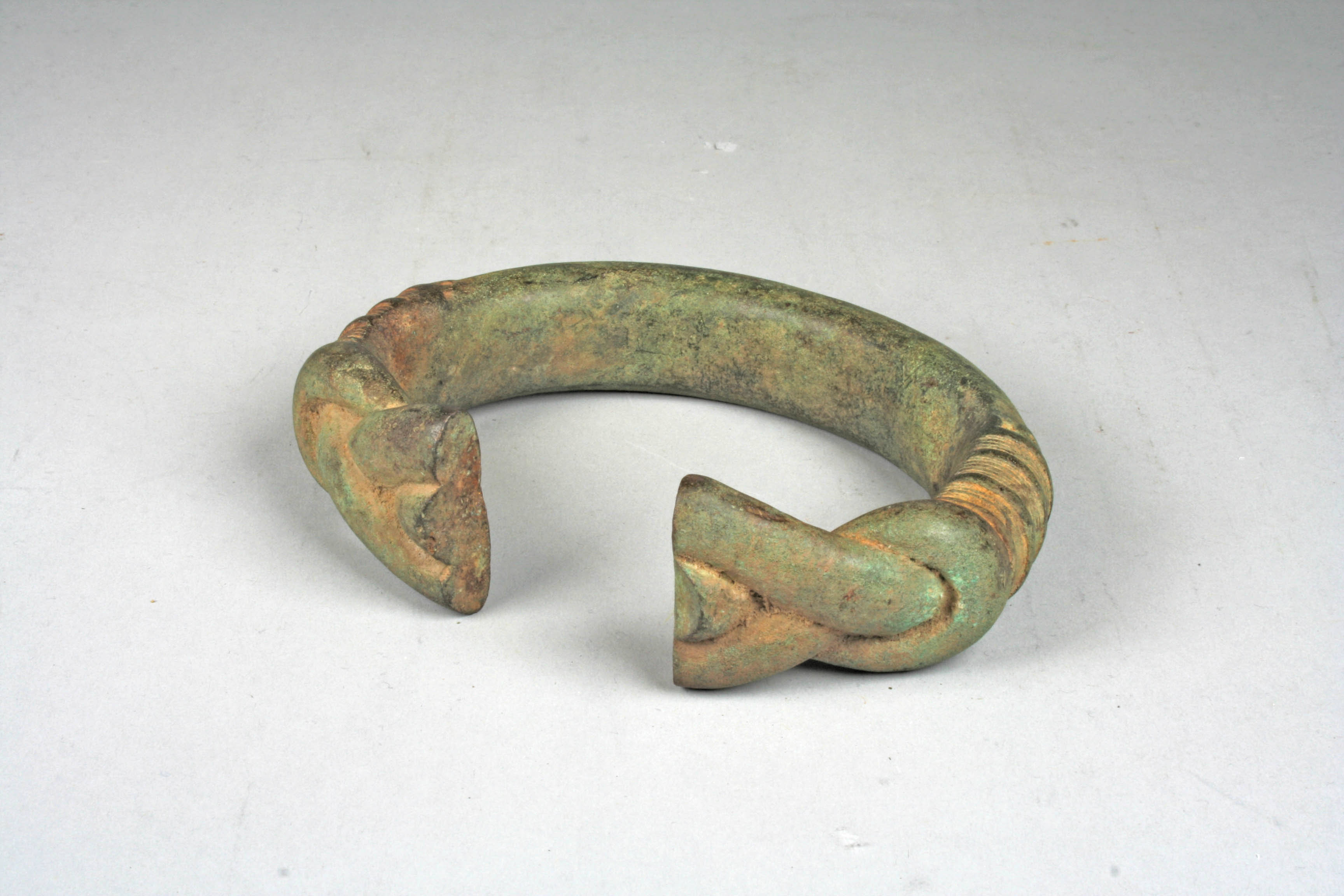
Heritage Analysis: The Middle Niger Copper Alloy Bracelet
This strategic heritage analysis examines the symbolic, historical, and spiritual dimensions of a copper alloy bracelet originating from the Middle Niger civilization (circa 300 BCE – 1600 CE), one of West Africa’s most sophisticated pre-colonial urban societies. As Lead Heritage Curator for Katherine Fashion Lab, I evaluate this artifact not merely as an ornamental object but as a repository of cultural memory, a testament to artisanal mastery, and a potent symbol for 2026 high-end luxury strategy. The bracelet’s medium—copper alloy—was a material of immense prestige, associated with royal authority, spiritual mediation, and trans-Saharan trade networks. Its reinterpretation offers Katherine Fashion Lab a unique opportunity to anchor its 2026 collection in narratives of power, craftsmanship, and metaphysical resonance, appealing to discerning clients who seek depth beyond aesthetic appeal.
Symbolic Power and Historical Adornment
Material as Metaphor: Copper Alloy in Middle Niger Society
In the Middle Niger civilization, copper alloy was not a common metal; it was a controlled substance, imported through complex trade routes from the Sahara and Mediterranean regions. Its scarcity and luminous, enduring quality made it a material of supreme symbolic power. Archaeological evidence from sites such as Jenne-Jeno and Gao indicates that copper alloy objects were predominantly found in elite burial contexts, suggesting their use as markers of social stratification and political authority. The bracelet, worn on the wrist—a highly visible and active part of the body—functioned as a public declaration of status. Its weight and sheen would have caught light during gestures of command, negotiation, or ritual, reinforcing the wearer’s position within the hierarchical structures of the civilization.
Adornment as Communication
Historical adornment in the Middle Niger tradition was a sophisticated language. Bracelets, necklaces, and anklets were not passive decorations but active communicators of identity, lineage, and occupation. The copper alloy bracelet, often crafted through lost-wax casting or hammering techniques, displayed intricate geometric patterns—spirals, chevrons, and interlocking bands. These motifs were not arbitrary; they likely encoded cosmological beliefs, clan affiliations, or protective symbols. For Katherine Fashion Lab, understanding this historical context is critical. The bracelet’s design was a form of non-verbal literacy, speaking to those who understood its codes. In a 2026 luxury strategy, this translates into the concept of “silent storytelling”—where the object itself carries meaning that is revealed only to the initiated, creating a sense of exclusivity and intellectual engagement for the wearer.
Spiritual Meaning and Ritual Function
The Bracelet as a Threshold Object
Beyond social status, the copper alloy bracelet held profound spiritual meaning. In many West African cosmologies, metal—particularly copper and its alloys—was believed to possess liminal properties, acting as a conduit between the human world and the spirit realm. Copper’s reddish hue was often associated with life force, blood, and the sun, while its durability symbolized eternity. The bracelet, worn on the wrist—a joint that facilitates movement and connection—was considered a threshold object. It marked the boundary between the self and the external world, offering protection against malevolent forces. Ritual specialists, including diviners and healers, likely wore such bracelets to channel spiritual energy during ceremonies. The act of putting on the bracelet was itself a ritual, a moment of transformation where the wearer was imbued with ancestral power or divine favor.
Ancestral Resonance and Contemporary Spirituality
For the 2026 luxury client, spiritual meaning is increasingly a driver of purchase decisions. The modern consumer is not merely buying a product; they are seeking an experiential talisman. The Middle Niger bracelet’s history as a protective, spiritually charged object aligns perfectly with this trend. Katherine Fashion Lab can position its 2026 bracelet collection as a bridge between ancient ritual and contemporary well-being. By referencing the bracelet’s original function—to guard, empower, and connect—the brand can offer a product that serves as a personal anchor in an unstable world. This is not about appropriating spirituality but about honoring its roots through respectful design cues, such as the use of geometric motifs that evoke ancestral patterns, and educational content that explains the artifact’s original context.
Strategic Implications for 2026 High-End Luxury
Material Narrative and Artisanal Integrity
The 2026 luxury market is defined by a shift toward material authenticity and artisanal provenance. Clients are increasingly skeptical of mass-produced goods and seek objects that bear the marks of human hands and historical tradition. The copper alloy bracelet from the Middle Niger civilization offers a compelling material narrative. Copper alloy, with its patina that evolves over time, symbolizes longevity and change—a metaphor for the modern luxury consumer’s desire for pieces that age gracefully and tell a story. Katherine Fashion Lab can leverage this by collaborating with contemporary metal artisans who employ traditional lost-wax casting techniques, ensuring that each bracelet is a unique object. This approach aligns with the brand’s potential positioning as a custodian of heritage, not merely a producer of fashion.
Design Language for 2026: The “Heritage Modern” Aesthetic
Integrating the Middle Niger bracelet’s symbolic power into a 2026 collection requires a nuanced design strategy. The goal is not replication but reinterpretation. The bracelet’s geometric motifs can be abstracted into minimalist, sculptural forms that appeal to contemporary tastes while retaining their historical resonance. For instance, the spiral—a common motif in Middle Niger metalwork—can be reimagined as a sleek, open cuff that wraps around the wrist, symbolizing infinity and protection. The use of matte and polished finishes can mimic the natural patina of ancient copper alloy, adding depth and texture. This “Heritage Modern” aesthetic allows Katherine Fashion Lab to stand out in a crowded luxury market, offering pieces that are both timeless and cutting-edge.
Marketing and Client Engagement: The Curatorial Experience
For 2026, high-end luxury is as much about the experience as the product. Katherine Fashion Lab can develop a curatorial marketing strategy that positions each bracelet as a collectible artifact. This could include limited-edition releases accompanied by digital or printed “heritage cards” that detail the artifact’s original context, symbolism, and the artisan’s process. Exclusive events—such as private viewings at museums with Middle Niger collections or intimate talks with archaeologists—can deepen client engagement. The pricing strategy should reflect the bracelet’s dual value: as a luxury accessory and as a cultural artifact. By setting a high price point, the brand reinforces the object’s exclusivity and its status as an investment piece—both financially and culturally.
Competitive Differentiation in the 2026 Landscape
The luxury market in 2026 will be characterized by a polarization between heritage houses and emerging disruptors. Katherine Fashion Lab, by focusing on a specific, under-explored heritage tradition like the Middle Niger civilization, can carve a unique niche. While competitors may draw from Roman, Egyptian, or East Asian motifs, the Middle Niger offers a fresh and intellectually rich narrative that has not been commodified in mainstream luxury. This differentiation is crucial for capturing the attention of culturally literate, high-net-worth individuals who value originality and depth. The bracelet, as a standalone research subject, becomes the cornerstone of a broader strategy to position the brand as a thought leader in heritage-driven luxury.
Conclusion
The Middle Niger copper alloy bracelet is far more than an ancient ornament; it is a strategic asset for Katherine Fashion Lab’s 2026 high-end luxury vision. Its symbolic power as a marker of authority, its historical role as a communicator of identity, and its spiritual function as a protective talisman offer rich layers of meaning that resonate with contemporary luxury values. By translating these elements into a “Heritage Modern” design language, emphasizing artisanal integrity, and curating an immersive client experience, the brand can create a collection that is both commercially viable and culturally significant. This analysis affirms that the bracelet is not merely a subject of study but a blueprint for a luxury strategy rooted in respect, authenticity, and timeless power.