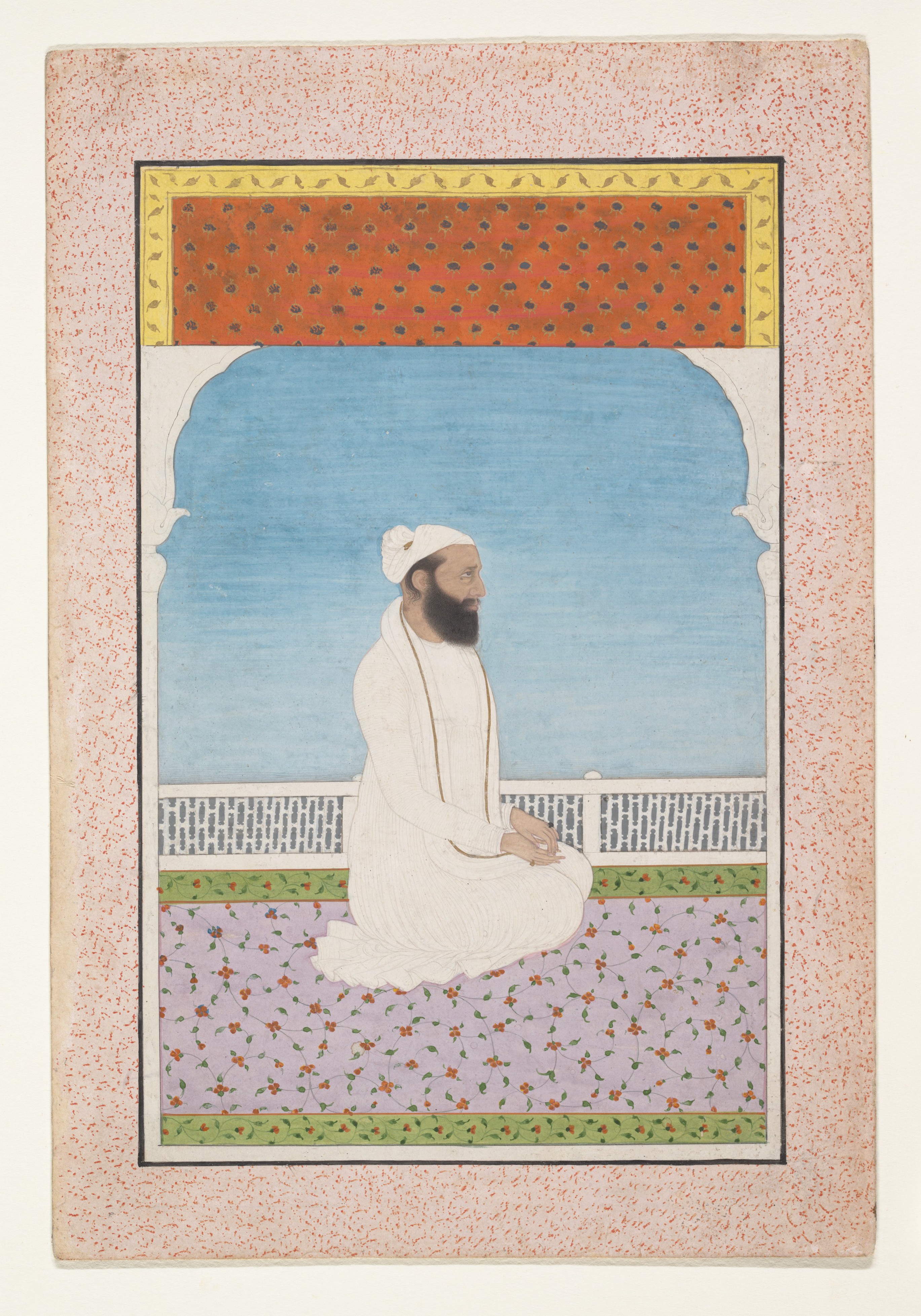
The Ascetic Aesthetic: Deconstructing the Spiritual Silhouette in Katherine Fashion Lab’s “A Holy Man Seated on a Terrace”
In the rarefied air of haute couture, the dialogue between art and garment often seeks transcendence—a moment where fabric ceases to be mere material and becomes a vessel for narrative. Katherine Fashion Lab’s latest analytical study, centered on a late 18th-century Pahari miniature from the Kangra school of the Punjab Hills, titled “A Holy Man Seated on a Terrace,” offers a profound departure from conventional fashion source material. This is not a study of opulence, but of restrained grandeur; not of ornamentation, but of spiritual geometry. Executed in ink and opaque watercolor on paper, this standalone figure—a solitary ascetic—becomes an unexpected lexicon for a new couture vocabulary, one that privileges inner luminosity over external display.
The Architecture of Solitude: The Terrace as a Catwalk
The composition’s setting—a simple, unadorned terrace against a pale, ethereal sky—is the first element of sartorial significance. In fashion, the environment is not backdrop but foundation. The terrace, rendered with precise horizontal lines, evokes the clean, unbroken lines of a couture runway. It is a stage of minimalist perfection, where the absence of clutter amplifies the presence of the subject. For Katherine Fashion Lab, this setting translates directly into a design philosophy of negative space. The holy man’s seat, a low, woven mat, suggests a texture—perhaps a coarse silk jacquard or a hand-loomed cotton—that grounds the silhouette. The terrace’s pale wash of color, a blush of dawn or dusk, informs a future collection’s color palette: muted ochres, faded saffron, and the soft grey of weathered stone. This is not a palette for the faint of heart; it is a palette for the contemplative wardrobe, where each hue carries the weight of stillness.
The Draped Body: Deconstructing the Holy Man’s Silhouette
The central figure, a holy man (likely a yogi or a sadhu), is seated in a posture of meditative repose—one leg folded, the other pendant. His body is not a spectacle of physicality but of spiritual architecture. The garment is a single, unstitched length of cloth, likely a dhoti or a lungi, wrapped around the lower body and tucked with deliberate asymmetry. This is the primordial garment, a precursor to all draped couture. Katherine Fashion Lab’s analysis focuses on the engineering of the drape. The folds are not random; they are a study in tension and release. The cloth gathers at the waist, creating a natural peplum effect, then falls in soft, columnar pleats that break at the ankle. This is a masterclass in zero-waste patterning, where a single rectangle of fabric is transformed into a sculptural form through wrapping and tucking.
The upper body is bare, save for a thin, sacred thread (yajnopavita) crossing the torso. In couture, this absence of covering is not nudity but exposure of the essential. The holy man’s skin, rendered in a warm, translucent wash, becomes the primary textile. Katherine Fashion Lab reinterprets this as a sheer, nude-toned mesh or a second-skin silk georgette, upon which the thread is reimagined as a metallic chainwork embroidery—a delicate, linear motif that traces the body’s energy lines. The bare chest also invites a discussion of tailoring for the male form in luxury fashion: a structured yet soft blazer cut to expose the clavicle, or a vest that mimics the diagonal of the sacred thread, creating an asymmetric neckline that draws the eye upward.
The Ascetic’s Accessories: A Study in Symbolic Adornment
The holy man’s adornments are minimal, yet each carries immense couture weight. His hair is piled in a topknot (jata), a natural crown that suggests an unkempt yet deliberate elegance. For Katherine Fashion Lab, this translates into headwear as sculpture: a turban of raw silk, twisted and knotted without a pin, or a hooded cape that frames the face like a halo. The single earring—a simple gold ring—is a study in singularity of ornament. In a world of layered necklaces and stacked bracelets, this one piece commands attention through its isolation. The lab proposes a signature ear cuff in matte gold, designed to be worn alone, echoing the ascetic’s rejection of excess.
Perhaps the most striking accessory is the water vessel (kamandalu) resting beside him. This gourd or metal pot, used for purification, is reinterpreted as a couture handbag: a spherical, rigid structure in polished brass or lacquered wood, suspended from a leather cord. It is not a bag for utility but for ritual—a statement piece that carries the narrative of the wearer’s inner journey. The holy man’s staff (danda) becomes a walking stick in ebony or bamboo, tipped with a silver finial, transforming the act of walking into a meditative procession.
Color as Contemplation: The Pigment Palette of the Kangra Master
The watercolor technique of the Kangra artist is a lesson in translucency and layering. The holy man’s skin is built from washes of pale umber and rose, while his cloth is a stark, unbleached white, set against a sky of fading indigo. Katherine Fashion Lab extracts a capsule color story from this: “Saffron Dawn” (a deep, spiritual orange), “Stone Sleep” (a warm grey), “Milk of the Earth” (an off-white with a hint of beige), and “Temple Shadow” (a dark, almost black blue). These are not colors that shout; they resonate. In fabric, they are achieved through natural dyeing processes—madder root, indigo, pomegranate rind—that yield a depth and irregularity impossible with synthetics. The lab proposes a “slow dye” technique, where each garment is submerged for weeks, allowing the color to settle like sediment, creating a living patina.
The Spiritual Silhouette: From Miniature to Modernity
How does one translate a 250-year-old painting of a holy man into a modern couture collection? The answer lies in attitude. The holy man’s posture—grounded, yet reaching upward—is the archetype of the ascetic chic. Katherine Fashion Lab envisions a collection titled “The Terrace of Stillness,” where each look is a meditation on the seated figure. A floor-length coat in heavy wool, cut with a single shoulder exposure, mimics the bare torso. A sarong-style skirt in double-faced satin, wrapped and secured with a single knot, echoes the dhoti’s simplicity. The key silhouette is a long, columnar dress or tunic that falls from the shoulders without darts, its only structure coming from the body beneath—a garment that is worn, not constructed.
The collection’s signature piece is a “meditation coat”: a full-length, unlined robe in raw silk, with a hood that can be drawn over the face. It is a garment of withdrawal, designed for the wearer who seeks privacy within the public sphere. The coat’s only embellishment is a single, hand-embroidered thread that traces the spine, a nod to the sacred thread of the holy man. This is not fashion for the extrovert; it is fashion for the inner voyager.
Conclusion: The Luxury of Less
Katherine Fashion Lab’s analysis of “A Holy Man Seated on a Terrace” ultimately challenges the very definition of luxury. In an industry obsessed with more—more sequins, more volume, more logos—this miniature offers a radical alternative: the luxury of subtraction. The holy man’s wealth is not in his possessions but in his presence. His garment is not a display of status but a vessel for being. For the modern couture client, this translates into a wardrobe of pieces that do not compete with the wearer but amplify their stillness. The ascetic aesthetic is not about renunciation; it is about curation—choosing only what is essential. In a world of noise, the holy man on his terrace is the ultimate fashion icon: serene, self-contained, and utterly unforgettable. Katherine Fashion Lab invites the industry to sit with him, to learn the language of the drape, and to find the extraordinary in the ordinary fold.