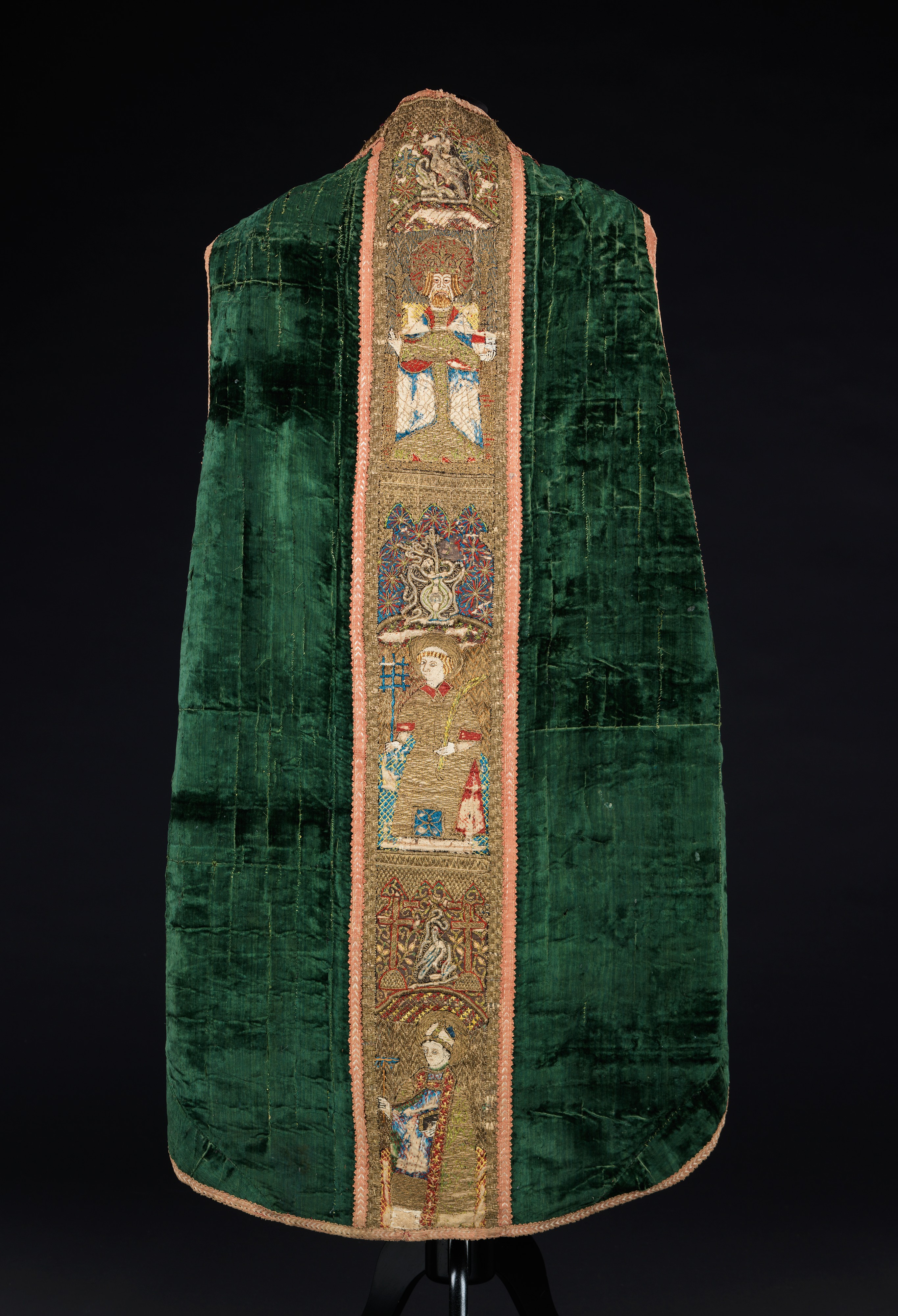
The Chasuble: A Study in Sacred Lineage and Modernist Form
Introduction: The Vestment as Architectural Canvas
In the lexicon of fashion, few garments carry the weight of liturgical history and symbolic gravity as the chasuble. At Katherine Fashion Lab, we approach this vestment not merely as a relic of ecclesiastical tradition but as a living archetype—a canvas where global heritage converges with modernist rigor. This standalone analysis dissects the chasuble through the lens of couture, examining how its origins, materiality, and structural evolution inform a garment that transcends ritual to become a statement of pure, unadorned power. The chasuble, in its essence, is a study in draped architecture: a poncho-like outer garment that envelops the wearer in a cascade of fabric, its very simplicity demanding mastery of proportion, weight, and texture.
Historical Origins: From Liturgical Necessity to Global Heritage
The chasuble’s lineage traces back to the paenula of ancient Rome—a conical, hooded travel cloak adopted by early Christian clergy for its practicality and symbolic resonance. By the 6th century, it had become the primary vestment for the Eucharist, its form evolving from a full, flowing circle to a more tailored, orphrey-adorned shape in the medieval period. Yet, the chasuble’s heritage is not exclusively Western. In the Byzantine East, the phelonion mirrored its form, while in Ethiopian Orthodox tradition, the qemis—a similar draped vestment—emerged from indigenous textile practices. This global diffusion underscores a universal truth: the chasuble represents a primordial human instinct to drape the body in sacred geometry. For Katherine Fashion Lab, this heritage is not a constraint but a springboard—a dialogue between the Roman catholicus (universal) and the localized expressions of faith across Asia, Africa, and the Americas. The garment’s history is a testament to how form follows function, yet evolves through cultural exchange.
Materiality: The Triad of Silk, Metal, and Linen
The choice of materials in this analysis—silk, metal, and linen—is deliberate, each contributing a distinct voice to the chasuble’s narrative. Silk, with its luminous sheen and fluid drape, evokes the celestial: a fabric that catches light like stained glass, transforming the wearer into a moving icon. Historically, Byzantine silk weavers in Constantinople produced the finest samite for imperial and ecclesiastical use, its weight and luster signifying divine authority. In our couture interpretation, raw-edge silk charmeuse or heavyweight douppioni creates a surface that is both opulent and tactile, its slight irregularities a nod to handcraft.
Metal introduces tension and structure. Whether through metallic thread embroidery, gilded orphrey bands, or subtle chain-mail accents, metal grounds the chasuble’s ethereal flow. In medieval examples, gold thread was woven into opus anglicanum—an English embroidery technique so dense it rendered the fabric nearly rigid. At Katherine Fashion Lab, we reimagine this with modern alloys: fine silver mesh inserted along the shoulders, or copper-wire appliqué that traces the spine, creating a visual and physical axis. Metal is not decoration; it is architecture. It defines the garment’s silhouette, preventing the silk from collapsing into formlessness.
Linen provides the counterpoint—a material of humility and earthiness. Its coarse, irregular weave speaks to the chasuble’s monastic origins, where simplicity was a virtue. In our construction, a linen underlayer or lining absorbs perspiration and adds weight, while the outer silk and metal elements float above it. This tripartite structure mirrors the garment’s theological resonance: the linen as the human, the silk as the divine, the metal as the bridge between them. The result is a fabric matrix that breathes, moves, and ages with grace—a living record of its own creation.
Structural Analysis: The Drape as a Discipline
The chasuble’s form is deceptively simple: a single piece of fabric, often circular or oval, with a central opening for the head. Yet, its execution demands precision. At Katherine Fashion Lab, we reject the notion of the chasuble as a mere blanket. Instead, we approach it as a study in negative space—the void between fabric and body becomes as important as the fabric itself. The garment’s weight distribution is critical: a 360-degree hem that falls from the shoulders must be balanced to avoid pulling asymmetrically. We achieve this through strategic darts and pleats at the neckline, invisible to the eye but essential to the drape.
The sleeve-less armholes, or colobium, are cut wide to allow for movement, yet the fabric must not gape. Here, metal weights—tiny, sewn-in lead or brass beads—are hidden in the hem, a technique borrowed from haute couture evening gowns. These weights create a controlled fall, ensuring the chasuble remains anchored even in motion. The back panel, often left unadorned in traditional vestments, becomes a canvas for a single, sweeping line of metallic embroidery that echoes the spine’s curvature. This is not ornamentation for its own sake; it is a structural rib, guiding the eye and the fabric downward.
Cultural Resonance: The Chasuble as a Universal Symbol
In an era of globalized fashion, the chasuble’s resonance extends beyond the church. Its silhouette has been appropriated by designers from Yohji Yamamoto to Rei Kawakubo, who see in its form a rejection of Western tailoring’s constraint. For Katherine Fashion Lab, the chasuble is a unisex garment, its generous proportions welcoming all bodies. It speaks to a contemporary yearning for ritual, for garments that slow time and demand presence. The chasuble is not fast fashion; it is a meditation. In our studio, we encourage wearers to consider its weight, its warmth, its ability to transform a room’s acoustics. This is a garment that does not shout but envelops, a quiet assertion of authority and grace.
Conclusion: The Future of the Sacred
The chasuble, as reimagined by Katherine Fashion Lab, is a bridge between epochs. Its global heritage—from Roman cloaks to Ethiopian vestments—reminds us that fashion is a continuum, not a series of ruptures. By marrying silk’s luminosity, metal’s structure, and linen’s humility, we create a garment that is at once ancient and avant-garde. This standalone study posits the chasuble not as a costume, but as a philosophical statement—a testament to the enduring power of drape, material, and meaning. In a world of disposable trends, the chasuble endures, a silent, luminous witness to the sacred in the everyday.