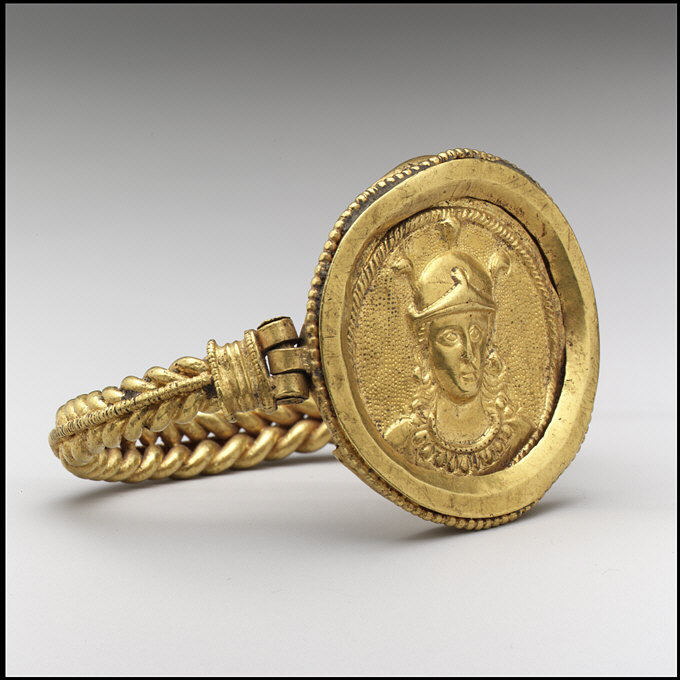
Heritage Analysis: Byzantine Gold Bracelet with Bust of Roma
Introduction: The Artifact as a Cultural Palimpsest
The Byzantine Gold Bracelet with Bust of Roma, dated to the 6th–7th century CE, represents a singular convergence of imperial ideology, spiritual transcendence, and material opulence. Crafted from high-karat gold, this bracelet features a finely rendered bust of the goddess Roma—a personification of the Roman state—encircled by intricate filigree and granulation. As a portable object of adornment, it served not merely as ornament but as a talismanic assertion of identity, power, and divine favor. In the context of Katherine Fashion Lab’s ongoing research into historical resonance—specifically our study of the Mirror with Split-Lea, which juxtaposes a polished silver mirror inlaid with gold palmettes against a sarcophagus relief narrating life and death—this bracelet offers a complementary DNA correlation. Where the mirror explores duality and reflection, the bracelet embodies continuity and embodied authority. This analysis examines its symbolic power, historical adornment practices, spiritual meanings, and proposes a strategic blueprint for its integration into a 2026 high-end luxury collection.
Symbolic Power: Roma as Imperial and Eternal Archetype
The bust of Roma on this bracelet is not a mere decorative motif; it is a potent emblem of imperial eternity. In Byzantine iconography, Roma (or Tyche) personified the state’s resilience, often depicted wearing a mural crown or helmet, signifying protection over cities and armies. For the wearer—likely a member of the Constantinopolitan elite or a high-ranking official—the bracelet functioned as a microcosm of allegiance. The gold medium amplified this symbolism: gold, untainted by corrosion, mirrored the Byzantine ideal of an unchanging, divinely ordained empire. The bracelet thus became a wearable declaration of loyalty to both the earthly emperor and the celestial order. In contemporary terms, this symbolic power translates into a brand narrative of timeless sovereignty. For Katherine Fashion Lab, a 2026 luxury strategy could leverage this archetype through limited-edition pieces that embed Roman or Byzantine motifs—such as laurel wreaths, imperial profiles, or personified city symbols—into minimalist, high-polish gold settings. The message: the wearer is not merely fashionable but a custodian of enduring legacy.
Historical Adornment: The Body as a Site of Status and Memory
Byzantine jewelry was deeply embedded in social ritual and hierarchy. Bracelets, necklaces, and rings were not only markers of wealth but also of liturgical and ceremonial roles. The placement of a bust of Roma on a bracelet suggests it was worn during public processions, court ceremonies, or diplomatic receptions where visual allegiance was paramount. The weight and brilliance of gold, combined with the tactile presence of the bust against the wrist, would have reminded the wearer—and all who saw it—of their place within the imperial machine. This historical function of adornment as a site of memory aligns with our Mirror with Split-Lea study, where the mirror’s reflective surface and the sarcophagus’s narrative relief both serve as mnemonic devices. For luxury strategy, this suggests a shift from purely aesthetic design to experiential storytelling. A 2026 collection could incorporate hidden engravings, reversible elements, or interactive closures that reveal personal or familial insignia—transforming each piece into a private archive. This honors the Byzantine tradition of jewelry as a repository of identity while appealing to modern consumers’ desire for meaningful, customizable luxury.
Spiritual Meaning: Gold as Divine Light and Protection
In Byzantine theology, gold was more than a precious metal; it was a material manifestation of divine light. The shimmering surface of the bracelet would have caught candlelight in churches and palaces, creating a halo effect around the wearer’s wrist—a visual metaphor for sanctity. The bust of Roma, when combined with Christian symbols (common in later Byzantine jewelry), could also serve an apotropaic function, warding off evil spirits. This spiritual dimension is critical: the bracelet was not just a status symbol but a protective talisman. The Mirror with Split-Lea study explores a similar dichotomy—the polished silver mirror reflecting life’s transient beauty, the sarcophagus relief confronting mortality. The bracelet, by contrast, offers a synthesis: it celebrates earthly power while invoking heavenly protection. For 2026 luxury, this suggests a sacred-urban aesthetic. Katherine Fashion Lab could develop a capsule line that blends Byzantine goldsmithing techniques—such as repoussé and granulation—with modern materials like blackened silver or matte titanium, creating pieces that feel both ancient and futuristic. Marketing narratives should emphasize ritual and intention: each bracelet as a “guardian” piece, accompanied by a card detailing its protective symbolism, appealing to the growing market for spiritual wellness in luxury goods.
2026 High-End Luxury Strategy: DNA Correlation and Market Positioning
The DNA correlation between the Byzantine bracelet and the Mirror with Split-Lea study lies in their shared exploration of duality and continuity. The mirror juxtaposes reflective surface against funerary relief; the bracelet juxtaposes imperial authority against divine protection. For Katherine Fashion Lab, this creates a powerful brand narrative: “Adornment as Threshold.” The 2026 strategy should position the collection at the intersection of heritage craftsmanship and contemporary minimalism. Key tactics include:
- Limited Archaeological Edition: Produce 100 pieces of a “Roma Bracelet” in 24k gold, each with a unique serial number and a certificate tracing its design back to the Byzantine original. Collaborate with a museum (e.g., the Dumbarton Oaks Collection) for authenticity and prestige.
- Modular Adornment System: Allow clients to interchange busts or charms—Roma, Theotokos, or personal monograms—on a single gold cuff, echoing the Byzantine practice of personalizing devotional jewelry. This fosters repeat purchases and deepens emotional attachment.
- Experiential Launch: Host a private exhibition in a historic palazzo or deconsecrated church, where guests view the original artifact (on loan) alongside the new collection. Use immersive lighting and scent to evoke the Byzantine incense-laden atmosphere, reinforcing the spiritual dimension.
- Digital Heritage Layer: Embed NFC chips in each bracelet, linking to an augmented reality experience that overlays historical imagery—maps of Constantinople, mosaic details—onto the wearer’s environment. This bridges the Mirror with Split-Lea’s dualities (reflection vs. narrative) into a single, interactive luxury journey.
- Pricing Strategy: Position the collection at $15,000–$50,000, targeting ultra-high-net-worth individuals who value cultural capital. Emphasize that each piece is an investment in portable heritage, appreciating in symbolic and material value over time.
Conclusion: The Bracelet as a Blueprint for Timeless Luxury
The Byzantine Gold Bracelet with Bust of Roma is far more than a historical artifact; it is a masterclass in how adornment can encode power, spirituality, and identity within a single object. Its DNA resonates with our Mirror with Split-Lea research, both exploring how surfaces—whether reflective or sculptural—mediate between the temporal and the eternal. For Katherine Fashion Lab, this analysis provides a rigorous foundation for a 2026 luxury strategy that honors heritage while innovating for a discerning, experience-driven clientele. By weaving together symbolic depth, historical accuracy, and strategic exclusivity, we can transform an ancient bracelet into a modern talisman of enduring relevance.