Sacred Silhouettes: A Couture Analysis of La Déposition des Vêtements de la Sainte Vierge
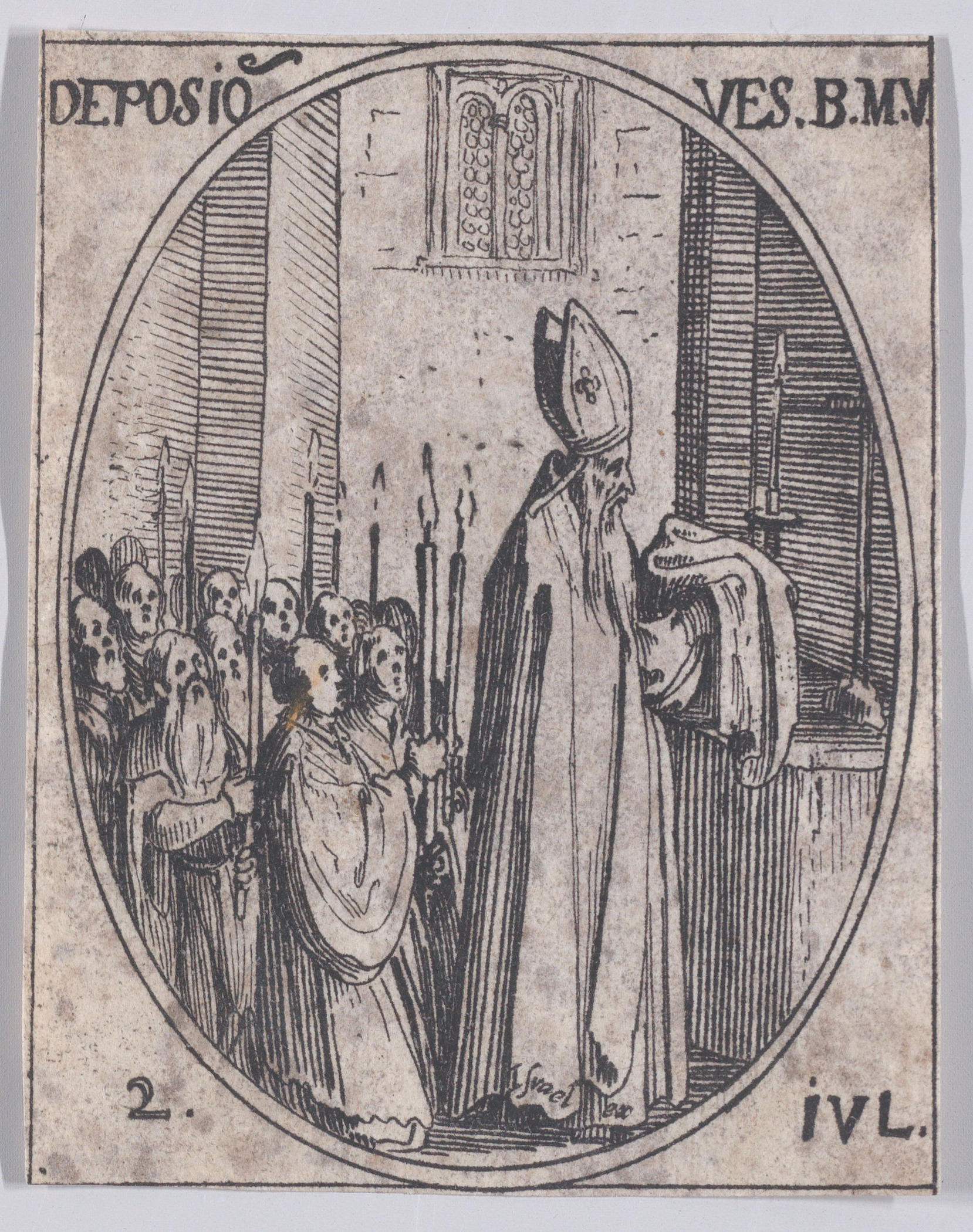
In the hallowed annals of religious iconography, few moments possess the quiet gravity of the scene depicted in La Déposition des Vêtements de la Sainte Vierge, observed on July 2nd. This etching, part of the seminal series Les Images De Tous Les Saincts et Saintes de L'Année, transcends its devotional purpose to offer a profound meditation on the materiality of the sacred. For Katherine Fashion Lab, this 17th-century French print—a second state of two, per Lieure—serves as an unexpected yet fertile text for a couture analysis. Here, the act of disrobing is not merely a liturgical event but a masterclass in the language of fabric, form, and the transcendent power of negative space. The garment, in this context, becomes the ultimate protagonist, its removal a narrative of humility, sacrifice, and eternal grace.
The Etching as a Textile Archive: Materiality and Line
The etching medium itself demands a unique reading of fashion. Lacking the chromatic richness of painting, it relies on the interplay of line, density, and void to suggest texture. In La Déposition des Vêtements, the artist employs a delicate yet deliberate cross-hatching to render the Virgin’s garments. The folds of her mantle, likely a deep blue in a painted version, are here translated into a cascade of parallel lines that evoke the weight of wool or heavy silk. The undergarment, perhaps a linen shift, is depicted with lighter, more widely spaced strokes, suggesting a softer, more translucent material. This technical distinction is critical for the couture analyst: it reveals a hierarchical understanding of fabric properties, where the outer layer signifies protection and majesty, while the inner layer speaks to vulnerability and intimacy.
The act of deposition—the removal of these vestments—is captured at a moment of suspended animation. The Virgin’s hands, often depicted as passive in such scenes, here seem to guide the fabric’s descent. The etching freezes the textile’s movement, creating a visual rhythm of vertical folds that mimic the flow of ritual. This is not a chaotic disrobing but a choreographed unveiling, where each pleat and crease is imbued with theological and aesthetic significance. The negative space around the garment—the empty air that now claims the cloth—functions as a silent collaborator, emphasizing the garment’s former role as a second skin for the divine.
The Silhouette of Sanctity: Form and Function in Sacred Dress
From a couture perspective, the Virgin’s attire in this etching adheres to the principles of sacred drapery, a tradition that prioritizes volume over form. The silhouette is expansive, with the mantle creating a triangular base that grounds the figure in stability and eternity. The waist is not cinched; instead, the fabric falls from the shoulders in an unbroken line, subverting the terrestrial corsetry of contemporary fashion. This deliberate avoidance of a defined waistline serves a dual purpose: it universalizes the figure, removing markers of a specific body type, and it emphasizes the garment’s role as a vessel for spiritual rather than physical identity.
The neckline, though partially obscured by a veil, suggests a high, modest closure—a detail that reinforces the Virgin’s purity. Yet, the etching subtly complicates this modesty. The removal of the outer garment reveals a glimpse of the undergarment’s neckline, which appears slightly lower, creating a layered effect that is both protective and revealing. This interplay of concealment and exposure is a hallmark of high couture, where the designer orchestrates a narrative of unveiling. In La Déposition des Vêtements, the fashion story is one of surrender: the garment is not discarded but offered, its very removal a form of adornment.
Color and Texture in Monochrome: The Etching’s Chromatic Language
While the etching is monochromatic, its chromatic implications are rich. The absence of color forces the viewer to project hue based on iconographic convention. The Virgin’s mantle, traditionally blue, would symbolize celestial truth and heaven. The undergarment, often white or cream, signifies purity and the physical body. The etching’s black and white palette, however, transforms these colors into a study in contrast. The deep black of the ink, applied densely to the mantle’s folds, creates a visual weight that anchors the composition. The lighter lines of the undergarment, by contrast, appear almost ethereal, threatening to dissolve into the paper’s white ground. This tension between substance and void mirrors the theological paradox of the Incarnation: the divine made material, now being unmade.
For the contemporary couturier, this etching offers a lesson in the power of monochromatic storytelling. The absence of color does not diminish the garment’s impact; rather, it amplifies the importance of line, texture, and form. A modern collection inspired by this work might explore the interplay of heavy and light fabrics—perhaps a wool crepe against a silk organza—using only black and white to emphasize the sculptural qualities of draping. The etching’s second state, with its refined lines and adjusted contrasts, suggests a designer’s iterative process: the pursuit of perfect balance between opacity and transparency, weight and air.
Ritual and the Runway: The Deposition as Performance
The scene’s liturgical context—the deposition of the Virgin’s clothes as a feast day—transforms the garment into an object of veneration. This is not a quotidian act of dressing or undressing; it is a ritualized performance. In fashion, such ritualistic removal is echoed in the runway’s final reveal, where a model’s coat is shed to unveil a gown, or in the ceremonial unveiling of a couture piece. The etching’s frozen moment captures the tension between the public and the private, the sacred and the mundane. The garment, once worn, becomes a relic; its removal, a testament to the body’s transient relationship with cloth.
Katherine Fashion Lab might interpret this as a call to design for transformative dressing. A garment that can be deconstructed or layered, where the act of removal is as intentional as the act of wearing. The etching suggests that the most powerful fashion moments occur in transition—when the garment is neither fully on nor off, but in a state of becoming. This aligns with contemporary sustainability narratives, where versatility and the ability to adapt a piece over time are prized. The deposition is, in essence, a metaphor for the lifecycle of a garment: from creation to use to eventual surrender.
Global Heritage and the Etching’s Enduring Influence
As a work of Global Heritage, this etching transcends its French Catholic origins to speak to universal themes of dress and devotion. The Virgin’s clothing, while specific to 17th-century European iconography, echoes the draped garments of ancient Greece, the layered robes of Byzantine art, and the ceremonial vestments of many world religions. The etching’s global relevance lies in its portrayal of clothing as a vehicle for the sacred, a concept that resonates across cultures. For the fashion historian, it is a reminder that couture has always been intertwined with the spiritual, the ritualistic, and the symbolic.
The second state of the etching, with its refined details, suggests an artist’s commitment to perfection—a value shared by the haute couture atelier. The careful adjustment of lines, the deepening of shadows, and the clarification of the garment’s folds mirror the designer’s obsessive pursuit of the perfect drape. In this sense, La Déposition des Vêtements de la Sainte Vierge is not merely a religious image but a fashion artifact, a blueprint for the interplay of fabric, faith, and form. It challenges us to see the sacred in the seam, the divine in the drape, and the eternal in the act of undressing.
For Katherine Fashion Lab, this etching is a call to elevate the garment beyond the ephemeral. It is a study in the power of removal, the poetry of line, and the profound beauty of a cloth that has been touched by the divine. In the silence of the deposition, we find the loudest statement of all: that fashion, at its most transcendent, is a form of prayer.