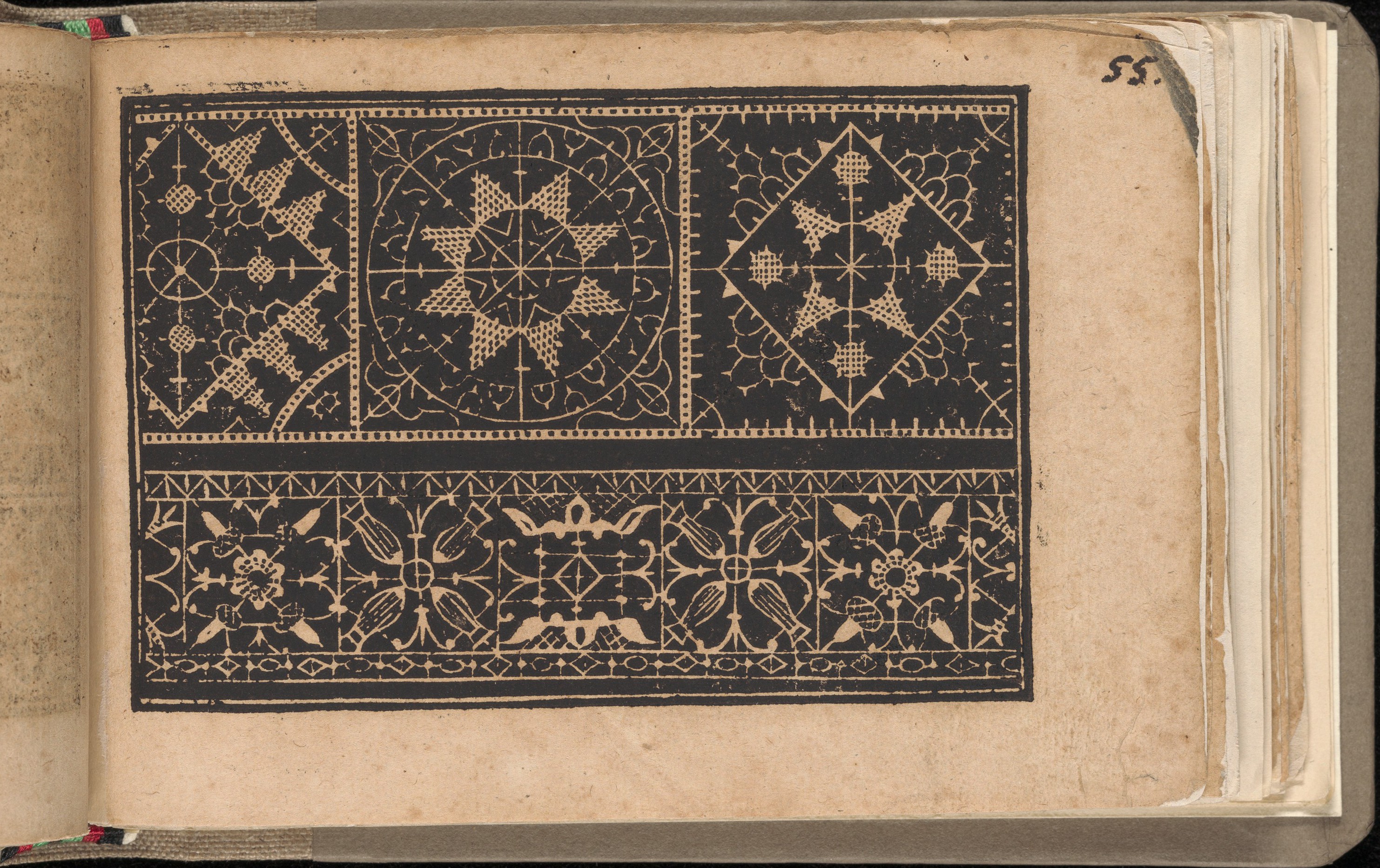
A Couture Analysis of Schön newes Modelbuch (Page 55r)
Introduction: The Unlikely Muse of Early Modern Dress
In the rarefied world of haute couture, inspiration often emerges from the most unexpected archives. For the Katherine Fashion Lab, the Schön newes Modelbuch (Page 55r)—a woodcut pattern book originating from the late 16th century—represents a profound dialogue between artisanal craft and sartorial innovation. This Global Heritage artifact, rendered in the stark medium of woodcut, transcends its historical context to offer a masterclass in structural rigor, ornamentation, and the interplay of line and form. As a standalone study, this analysis dissects the page’s visual vocabulary, its material culture implications, and its resonance with contemporary couture methodologies. The woodcut, far from being a mere decorative template, emerges as a blueprint for disciplined creativity—a lesson in how constraints can birth elegance.
The Woodcut as a Couture Blueprint
The materiality of the woodcut itself is the first point of analysis. Unlike the fluid sketches of modern fashion designers, the woodcut demands precision; each line is carved, irreversible, and deliberate. On Page 55r, the pattern depicts a richly ornamented garment—likely a woman’s bodice and overskirt—with geometric motifs, floral arabesques, and symmetrical borders. The black-and-white starkness of the medium forces a focus on silhouette and structure over color or texture. For the couturier, this is a lesson in foundational architecture. The garment’s silhouette is defined by a rigid, conical bodice that tapers to a narrow waist, flaring into a bell-shaped skirt. This hourglass geometry is reminiscent of the corseted forms that would dominate European fashion for centuries, yet the woodcut’s abstraction strips away artifice, leaving only the essential lines of power and posture.
From a construction perspective, the woodcut reveals a sophisticated understanding of pattern drafting. The motifs are not arbitrarily placed; they follow the body’s contours, with vertical lines elongating the torso and horizontal bands emphasizing the hips. This directional logic is a precursor to modern draping techniques, where fabric grain and seam placement dictate movement. The Katherine Fashion Lab interprets this as a call to re-evaluate the role of the pattern in couture: not as a secondary step, but as the primary narrative of the garment.
Ornamentation as Cultural Cartography
The decorative elements on Page 55r are far from mere embellishment. The woodcut features interlocking circles, stylized leaves, and diamond-shaped nodes—motifs that echo the global trade networks of the 16th century. During this period, European pattern books like Schön’s were influenced by Ottoman textiles, Indian chintzes, and Chinese silks. The Global Heritage designation is thus apt: the woodcut is a palimpsest of cross-cultural exchange. The floral arabesques, for instance, bear the hallmark of Islamic geometric traditions, while the symmetrical borders recall the precision of Renaissance mathematical treatises. For the modern couturier, this offers a framework for narrative ornamentation—where each stitch, bead, or embroidery motif carries cultural resonance.
In practical terms, the woodcut’s ornamentation is scale-aware. The motifs are large enough to be legible from a distance, yet intricate enough to reward close inspection. This dual-scale approach is a hallmark of couture: the garment must read as a cohesive whole while offering layers of detail. The Katherine Fashion Lab draws inspiration from this hierarchical embellishment, where the primary motifs define the garment’s character, and secondary patterns provide depth. The woodcut’s repetition of motifs also suggests a proto-industrial logic—a modularity that anticipates modern beadwork and lace production, yet retains the handcrafted soul of artisanal work.
Structural Rigor and the Body as Canvas
Page 55r’s garment is explicitly architectural. The bodice is a rigid shell, likely boned or stiffened with buckram, creating a carapace-like form that abstracts the natural body into an idealized silhouette. This structural extremism is a recurring theme in couture—from the wasp waists of Dior’s New Look to the sculptural shoulders of Balenciaga. The woodcut reminds us that fashion is not merely about clothing the body, but about redefining it. The garment on Page 55r does not follow the body’s curves; it imposes its own geometry, turning the wearer into a living monument.
For the contemporary analysis, this raises questions about agency and constraint. The woodcut’s rigid form can be read as a symbol of social discipline, yet it also empowers the wearer through its commanding presence. The Katherine Fashion Lab views this as a dialectic of control: the garment restricts movement but amplifies presence. In a couture context, this translates to engineered silhouettes that prioritize visual impact over comfort—a choice that defines the genre. The woodcut’s lack of drape (inherent to the medium) becomes a virtue, emphasizing the garment’s role as a static sculpture rather than a dynamic fabric.
Color and Texture in Monochrome
Despite its black-and-white palette, the woodcut conveys a rich textural vocabulary. The cross-hatching and line weights suggest different materials: fine, parallel lines for silk or satin; denser clusters for velvet or brocade; and open spaces for linen or lace. This tactile illusionism is a masterclass in visual storytelling. For the couturier, it underscores the importance of material selection in achieving a desired effect. The woodcut’s implied textures—smooth, rough, shiny, matte—can be translated into fabric choices: a duchesse satin for the bodice’s sheen, a jacquard for the patterned overskirt, and metal-thread embroidery for the motifs.
Furthermore, the monochrome forces a focus on value contrast—the interplay of light and shadow. The woodcut’s highlights (uninked areas) and shadows (dense lines) create a three-dimensional illusion that guides the eye. In couture, this translates to strategic placement of embellishments to catch light, or the use of pleating and draping to create depth. The Katherine Fashion Lab interprets this as a call for tonal discipline: even in a colorful collection, the value structure must be intentional to ensure visual coherence.
Conclusion: The Eternal Relevance of the Pattern Book
Schön newes Modelbuch’s Page 55r is not a relic but a living document. Its woodcut lines speak to the timeless principles of couture: structure, ornamentation, and cultural dialogue. For the Katherine Fashion Lab, this standalone study affirms that the most innovative designs often emerge from the most constrained mediums. The woodcut’s rigid precision and global heritage offer a counterpoint to the digital fluidity of contemporary fashion, reminding us that true craftsmanship is built on a foundation of deliberate, irreversible choices. As the fashion industry grapples with sustainability and authenticity, this 16th-century pattern book stands as a testament to the enduring power of handcrafted intelligence—a muse that demands not imitation, but interpretation.