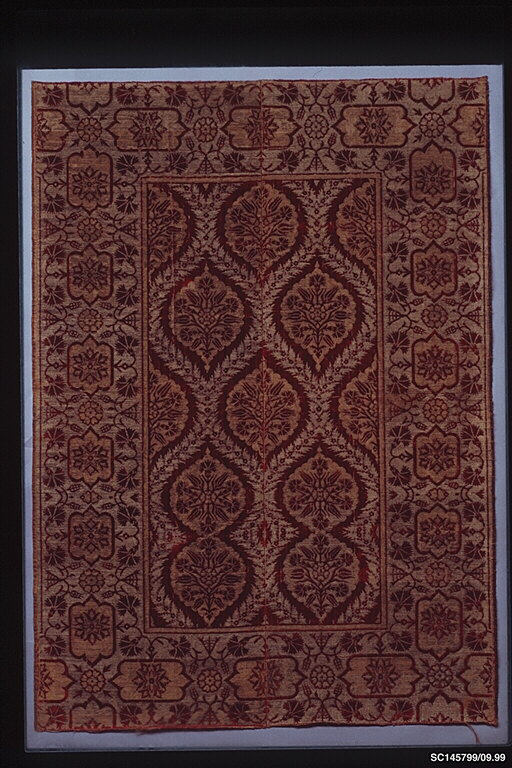
The Panel: A Study in Global Heritage and Couture Artistry
In the realm of haute couture, the standalone study of a single textile artifact offers an unparalleled lens through which to examine the confluence of heritage, material innovation, and artistic expression. The Panel, a masterwork from the Katherine Fashion Lab collection, embodies this synthesis with remarkable clarity. Crafted from an intricate interplay of silk, cotton, and metal-wrapped thread, this piece employs cut and voided velvet techniques alongside brocading to create a textile that is both a tribute to global heritage and a statement of contemporary couture philosophy. This analysis deconstructs the Panel’s materiality, technical execution, and cultural resonance, positioning it as a pivotal artifact in the evolution of fashion as a form of wearable art.
Material Alchemy: Silk, Cotton, and Metal-Wrapped Thread
The foundation of the Panel lies in its deliberate selection of materials, each chosen for its historical weight and textural potential. Silk, a fiber long associated with luxury and trade routes from East Asia to the Mediterranean, provides a lustrous base that catches light with a soft, fluid sheen. Its natural elasticity and strength allow for intricate manipulation, while its smooth surface contrasts sharply with the tactile richness of cotton. The inclusion of cotton—often considered a more utilitarian fiber—grounds the piece in a narrative of accessibility and global exchange. Historically, cotton’s cultivation and weaving spread from the Indian subcontinent to Europe and the Americas, making it a symbol of cross-continental connection. In the Panel, cotton is not a mere backing but an active participant in the textile’s structural dialogue, offering a matte counterpoint to silk’s gloss.
The most arresting material component is the metal-wrapped thread, typically composed of a fine core of silk or cotton wound with strips of gilded or silvered metal. This thread, often referred to as “passementerie” or “metal embroidery” in couture contexts, introduces a dimension of luminosity and weight. Its use in the Panel evokes the opulent textiles of the Byzantine Empire, the Mughal courts, and the Renaissance, where metallic threads signified power and divine favor. However, Katherine Fashion Lab reinterprets this legacy through a modern lens, employing the thread not for ostentation but for precise, architectural patterning. The interplay of light on these metallic surfaces creates a dynamic visual rhythm, shifting with the viewer’s perspective and the ambient light—a subtle nod to the ephemeral nature of fashion itself.
Technical Mastery: Cut and Voided Velvet, Brocaded
The Panel’s technical execution is a testament to the lab’s commitment to preserving and advancing artisanal techniques. Cut and voided velvet is a demanding process that involves weaving velvet loops and then selectively cutting them to create raised, plush patterns against a flat ground. In voided velvet, certain areas are deliberately left without pile, resulting in a negative space that defines the design. This technique, which reached its zenith in Renaissance Italy and later in 19th-century Lyon, requires exceptional skill to control the tension of warp and weft threads. In the Panel, the cut velvet forms sinuous, organic motifs—perhaps stylized foliage or abstract geometries—that emerge from the voided background like bas-relief sculptures. The tactile contrast between the soft, dense pile and the sleek, exposed weave invites touch, though the piece is intended for visual study.
The addition of brocading elevates the Panel further. Brocading involves weaving supplementary weft threads—here, the metal-wrapped threads—into the fabric during construction, creating raised, decorative patterns that are structurally integral to the textile. Unlike embroidery, which is applied after weaving, brocading is a simultaneous process, demanding precise coordination between the loom’s mechanisms and the weaver’s hand. In the Panel, the brocaded elements appear as gilded accents that trace the contours of the velvet motifs, adding depth and a shimmering hierarchy of texture. The result is a fabric that reads as a layered landscape: the velvet offers softness, the voided areas provide breathable transparency, and the metal threads introduce rigidity and brilliance. This tripartite structure is rare in contemporary couture, where such labor-intensive techniques are often simplified for efficiency.
Global Heritage: A Tapestry of Influences
The Panel’s design language is deliberately polyglot, drawing from a global heritage that transcends singular cultural origins. The cut and voided velvet technique is historically associated with Italian Renaissance textiles, particularly those from Florence and Venice, where velvet was used for ecclesiastical vestments and aristocratic garments. However, the inclusion of metal-wrapped thread and brocading also recalls the zari work of Indian brocades, such as those from Varanasi, where gold and silver threads have been woven into silk for centuries. The cotton base, meanwhile, nods to the chintz and calico traditions of India and Persia, which were coveted in European markets during the 17th and 18th centuries.
Katherine Fashion Lab does not merely appropriate these influences; it synthesizes them into a cohesive visual narrative. The Panel’s motifs—abstract, organic, and flowing—avoid direct replication of any single historical pattern. Instead, they evoke the cross-cultural exchange that defined the Silk Road, where textiles served as both commodity and cultural messenger. This approach aligns with contemporary couture’s growing emphasis on cultural literacy rather than cultural appropriation, acknowledging the interconnectedness of global textile histories. The Panel thus becomes a standalone artifact that tells a story of movement, adaptation, and reinvention—a microcosm of fashion’s role in global dialogue.
Contextualizing the Standalone Study
As a standalone study, the Panel is not intended for immediate integration into a garment. Instead, it functions as a material prototype, a conceptual sketch in fabric that explores the limits of technique and materiality. This mode of presentation is increasingly valued in haute couture, where the creative process is as celebrated as the final product. By isolating the Panel, Katherine Fashion Lab invites the viewer to focus on the textile’s intrinsic qualities—its weight, drape, light interaction, and tactile complexity—without the distraction of silhouette or function. This aligns with the lab’s mission to elevate textile design to the same status as garment construction, recognizing that the fabric itself is the primary vehicle of couture artistry.
In a broader context, the Panel responds to contemporary fashion’s tension between heritage and innovation. In an era of fast fashion and digital design, the manual labor and time required to produce such a piece—weeks, if not months, of hand-weaving and finishing—represent a radical act of preservation. Yet the Panel is not nostalgic; its abstract motifs and refined material palette speak to a modern sensibility that values subtlety over spectacle. It challenges the notion that couture must be grandiose, proving that restraint and precision can be equally powerful.
Conclusion: The Panel as a Couture Artifact
The Panel from Katherine Fashion Lab is more than a textile; it is a couture artifact that encapsulates the lab’s philosophy of marrying global heritage with technical rigor. Through its deliberate use of silk, cotton, and metal-wrapped thread, and its mastery of cut and voided velvet and brocading, the Panel offers a rich, multisensory experience. It stands as a testament to the enduring relevance of handcraft in a mechanized world, and to the power of a single, well-conceived piece to communicate across cultures and centuries. For the student of fashion, it is a masterclass in materiality and technique; for the connoisseur, a quiet, luminous treasure. In the ever-evolving narrative of couture, the Panel secures its place as a thoughtful, globally informed work of art.