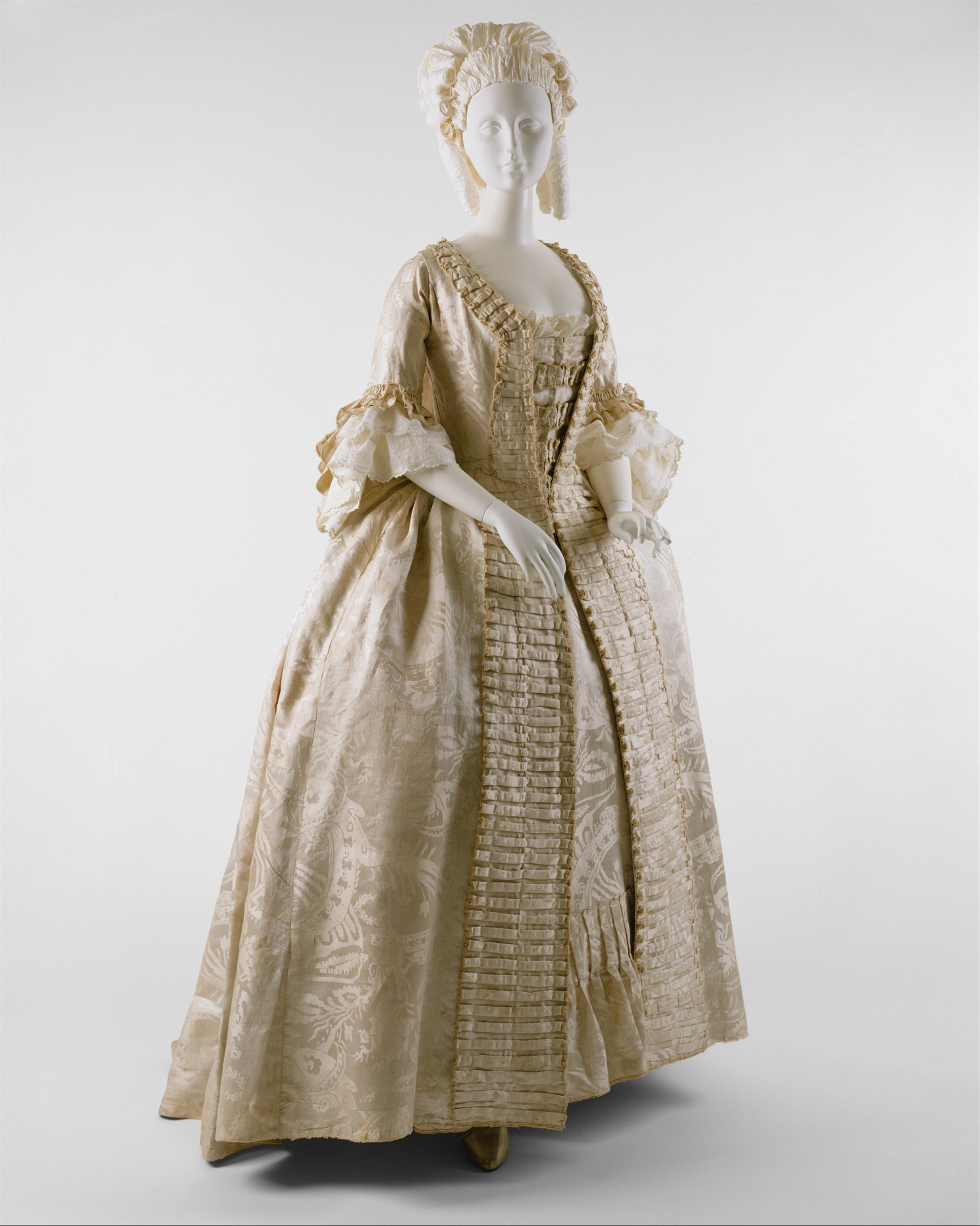
The Robe à la Française: A Study in Silk and Structural Opulence
Within the hallowed archives of Katherine Fashion Lab, the Robe à la Française stands as a singular testament to the intersection of aristocratic power, textile engineering, and sartorial theater. Originating in the mid-to-late 18th century French court, this garment transcends mere clothing to become a three-dimensional artifact of cultural diplomacy. In this standalone analysis, we dissect the piece not as a relic, but as a living case study in how silk—a material synonymous with luxury—was manipulated to project authority, grace, and meticulous craftsmanship.
The Architectural Silhouette: Freedom Within Structure
At first glance, the Robe à la Française appears to defy the rigid corsetry of its era. Its hallmark is the sacque back—a cascade of fabric falling from the shoulders in deep, uninterrupted folds that move with the wearer. This is not a garment of constraint, but one of orchestrated fluidity. The silk, typically a brocade or façonné weave, is cut with generous yardage to allow the pleats to drape from the neckline to the floor, creating a visual rhythm that mimics the architecture of Versailles itself: grand, symmetrical, yet alive with the pulse of courtly motion.
Yet this freedom is deceptive. The front of the gown is meticulously structured. The bodice, often boned and laced, cinches the torso into a conical shape, while the overskirt—parted to reveal an elaborately decorated underskirt or jupe—is pinned back to form the iconic pannier silhouette. The result is a dichotomy: the back breathes with baroque excess, while the front speaks to the mathematical precision of neoclassical order. For the modern couturier, this duality offers a masterclass in balancing volume with control—a lesson in how fabric can be both a flowing river and a rigid wall.
Silk as a Medium of Power and Prestige
The choice of silk is not incidental. In 18th-century France, silk was the currency of status. The Grande Fabrique of Lyon held a monopoly on the production of these textiles, and the Robe à la Française became a canvas for displaying the weaver’s art. Our specimen employs a silk satin ground with a complex lampas weave, where supplementary wefts create raised floral motifs—often incorporating pomegranates, acanthus leaves, and exotic birds—that shimmer under candlelight. The palette is restrained yet potent: a deep aubergine (a color derived from costly lichen dyes) accented with silver-threaded brocade that catches light like the chandeliers of the Hall of Mirrors.
This silk is not merely decorative; it is a political statement. The density of the weave, the complexity of the pattern, and the sheer volume of fabric (often requiring 10–15 meters) signaled the wearer’s proximity to the throne. The Robe à la Française was the uniform of the ancien régime, a visual contract between the monarchy and its elite. For Katherine Fashion Lab, the lesson is clear: materiality is never neutral. Silk, in this context, becomes a tool of soft power—a way to communicate wealth, taste, and allegiance without a single word.
Deconstructing the Construction: Technique as Narrative
A closer examination of the garment’s construction reveals the artisanal genius behind its illusion of effortlessness. The sacque back is achieved through a series of box pleats stitched at the shoulder seams, then left to fall freely. This requires an intuitive understanding of fabric behavior: the silk must be weighted enough to drape, yet pliable enough to gather without puckering. The pleats are not merely decorative; they serve as a structural hinge, allowing the wearer to move through crowded rooms or descend staircases with a liquid grace that belies the gown’s heft.
Equally critical is the stomacher—a triangular panel, often embroidered separately, that fills the front opening of the bodice. This piece is a marvel of modular design. It could be swapped out to change the gown’s color or motif, allowing a single Robe à la Française to serve multiple occasions. The stomacher in our study is embroidered with chenille thread and sequins in a pattern of gilded wheat sheaves, symbolizing abundance and the divine right of the monarchy. Each stitch is a micro-narrative of labor: a team of embroiderers would have spent weeks on this single element, their work hidden beneath the wearer’s gaze yet fully visible to the court’s discerning eye.
Cultural Context: The Gown as Social Performance
To understand the Robe à la Française is to understand the theater of the French court. Worn during levées, balls, and diplomatic receptions, this gown was a tool of social navigation. The pannier silhouette, which could extend up to 12 feet in width, forced the wearer to move sideways through doorways, creating a ritual of passage that emphasized her importance. The rustle of silk, the glint of silver thread, the deliberate sway of the sacque back—all were sensory cues that announced the wearer’s rank before she spoke.
Yet the gown also carried subversive potential. By the 1770s, Marie Antoinette famously rejected the rigid Robe à la Française in favor of the simpler chemise à la reine, a proto-fashion rebellion that signaled a shift toward pastoral simplicity. Our study piece, however, predates that shift. It represents the zenith of the form—a time when the gown was not yet a symbol of decadence, but of unassailable elegance. For the modern analyst, this context is crucial: couture is never divorced from its political moment. The Robe à la Française is a mirror of the ancien régime’s values—hierarchy, opulence, and the performance of divine order—all woven into silk.
Legacy and Relevance for Contemporary Couture
Katherine Fashion Lab’s study of this garment is not an exercise in antiquarianism. The Robe à la Française offers enduring principles for the contemporary designer. Its draping techniques inform how we manipulate volume in ball gowns. Its modular construction (the interchangeable stomacher) prefigures modern concepts of sustainable fashion and mix-and-match luxury. Its use of silk as a narrative medium challenges us to consider how fabric can carry meaning beyond its aesthetic surface.
In the atelier, this gown teaches patience. The hand-finishing of seams, the weighted hem that ensures perfect fall, the invisible stitching that secures the pleats—these are techniques that cannot be rushed. They demand the same reverence for material that defined the 18th-century marchandes de modes. For the connoisseur, the Robe à la Française is not a costume; it is a philosophy of dress. It reminds us that true luxury is not about excess, but about intention—every fold, every thread, every shimmer of silk is a decision, a declaration, and a piece of history.
As we close this analysis, we are left with a profound respect for the garment’s complexity. The Robe à la Française is a masterpiece of balance—between freedom and structure, opulence and restraint, tradition and innovation. It is, in the truest sense, a standalone study of what happens when silk becomes more than a fabric: it becomes the architecture of a world.