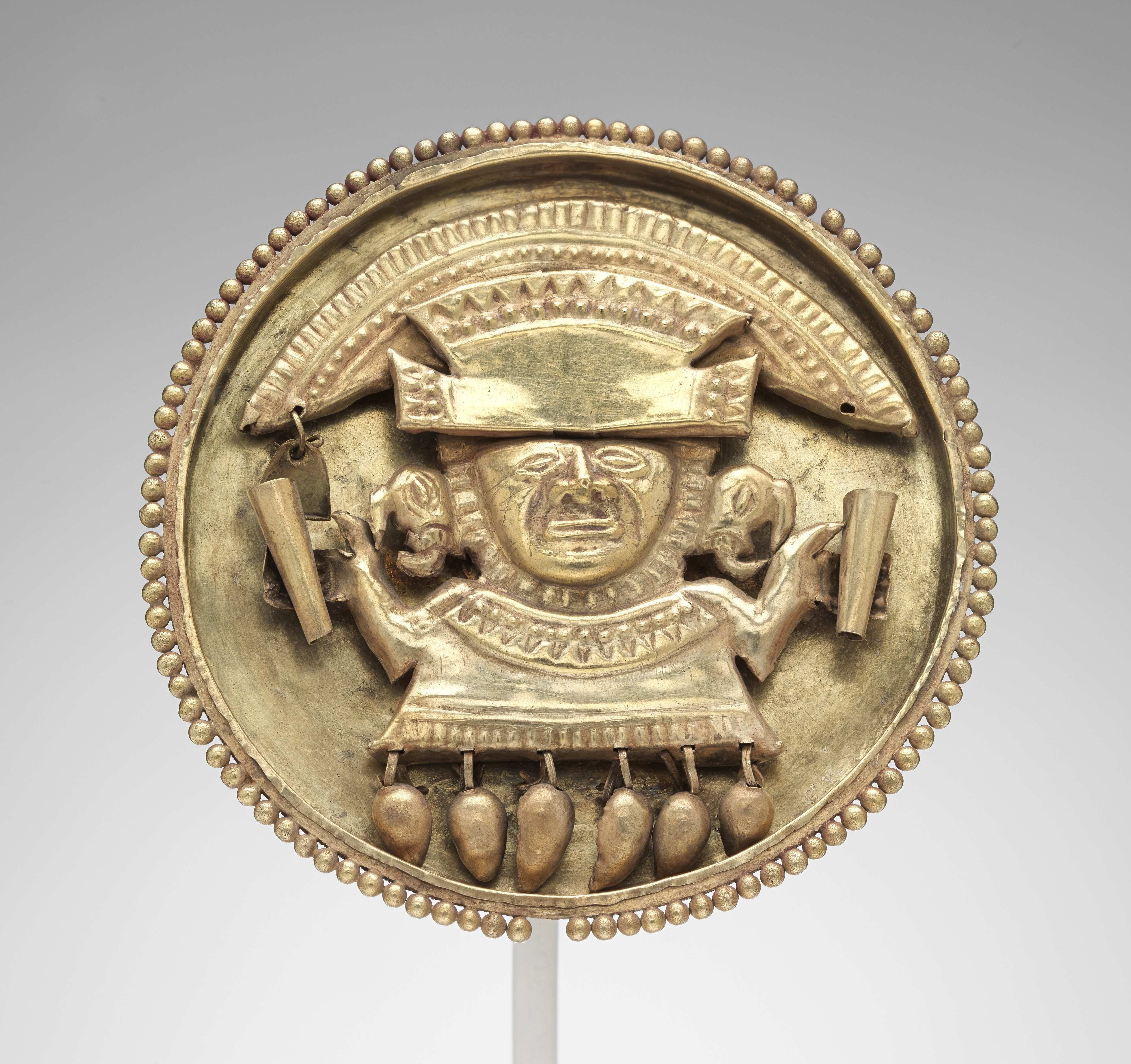
Heritage Analysis: Chimú Earflare with Figure Holding Beakers
Introduction: The Artifact as a Nexus of Power and Symbolism
The Earflare with figure holding beakers, a masterwork of Chimú goldsmithing, represents far more than a decorative object. It is a concentrated emblem of political authority, spiritual intermediation, and cosmological order within the pre-Columbian Andes. Crafted from hammered and repoussé gold, this earflare—worn as a hallmark of elite status—depicts a central figure, likely a ruler or deity, grasping two beakers. The beakers, often associated with ritual drinking of maize beer (chicha), signify the bearer’s role as a conduit between the earthly and divine realms. For Katherine Fashion Lab, this artifact offers a profound case study in how historical adornment encodes power, and how that encoding can be translated into a 2026 high-end luxury strategy rooted in symbolic authenticity.
The Chimú civilization (c. 900–1470 CE), centered at Chan Chan on Peru’s northern coast, was a hierarchical society where gold was not merely a metal but a material of sacred resonance. Gold was associated with the sun, the divine, and the immutable. The earflare’s placement—on the ear, a site of hearing and receptivity—further amplifies its symbolic power: the ruler, by wearing this ornament, was believed to “hear” the gods and transmit their will to the people. This dual function of adornment as both status marker and spiritual tool aligns with our ongoing study on the “Mirror with Split-Leaf” motif, which explores the tension between reflective surfaces (gold, silver) and narrative depth (stone reliefs). Here, the earflare’s gold surface is not a passive mirror but an active amplifier of authority.
Symbolic Power: The Figure and the Beakers
The central figure on the earflare is typically interpreted as a Chimú ruler or a high-ranking priest, adorned with a headdress and ear spools—the latter echoing the earflare’s own form. The beakers he holds are not arbitrary; they are keros, ritual vessels used in libations to honor ancestors and deities. The act of holding two beakers suggests a symmetrical balance, perhaps representing the dualities of life and death, earth and sky, or the ruler’s role as a mediator between opposing forces. This symmetry is a recurring theme in Andean art, where geometric order reflects cosmic order.
In the context of historical resonance, the earflare’s symbolism of power through ritual consumption finds a parallel in our earlier study on the Mirror with Split-Leaf. That artifact, with its polished silver surface and gold inlay, presented a dichotomy: one side reflecting the viewer’s immediate reality, the other narrating a story through relief. The earflare similarly operates on multiple levels. The gold’s brilliance, when worn, would catch sunlight and create a halo effect, visually deifying the wearer. The beakers, however, root this power in a tangible, communal act—the sharing of chicha during ceremonies. This blend of transcendence and immanence is critical for luxury branding: it suggests that true prestige is not isolated but embedded in ritual and collective memory.
Historical Adornment: The Earflare as a Marker of Elite Identity
In Chimú society, earflares were not mere accessories; they were insignia of rank. The size and material of an earflare directly correlated with the wearer’s status. Gold earflares were reserved for the highest echelons—the alaec (lord) and his kin. The act of wearing them was a public declaration of lineage and divine favor. The earflare with a figure holding beakers would have been particularly significant, as it depicted the wearer’s own role in the ritual economy. By donning this image, the ruler literally embodied his function as the provider of sustenance (chicha) and the guarantor of cosmic balance.
This concept of adornment as identity resonates with modern luxury. In 2026, high-end consumers increasingly seek objects that tell a story and confer a sense of belonging to a lineage of taste and power. Katherine Fashion Lab can draw from this by designing pieces that are not just beautiful but narrative-driven. For instance, a contemporary earflare-inspired piece could incorporate a hidden motif—a beaker, a figure—visible only to the wearer, creating intimacy and exclusivity. The gold medium, with its historical weight, becomes a carrier of cultural capital.
Spiritual Meaning: The Beaker as a Vessel of Life and Death
The beakers held by the figure are deeply spiritual. In Chimú cosmology, chicha was believed to be a drink of the gods, and its consumption during rituals allowed the living to communicate with the dead. The earflare, therefore, is not just a symbol of power but a ritual object in its own right. It likely accompanied the wearer into the afterlife, as evidenced by its recovery from elite tombs. The figure’s gesture—holding two beakers—may also represent the offering of libations to both the sun (Inti) and the moon (Mama Quilla), two central deities in Andean religion.
This spiritual dimension offers a rich layer for luxury strategy. The 2026 consumer is increasingly drawn to mindful luxury—objects that connect them to deeper meanings and histories. Katherine Fashion Lab can position pieces like a reinterpreted earflare as talismans, not just jewelry. By referencing the beaker motif, the brand can evoke themes of sustenance, communion, and transcendence. The gold, historically a solar metal, becomes a symbol of enlightenment and permanence. This aligns with the “Mirror with Split-Leaf” study, where the reflective surface (silver) and narrative relief (stone) were juxtaposed to explore the tension between surface and depth. Here, the earflare’s gold surface and figure-and-beaker motif similarly invite the wearer to reflect on their own role in a larger cosmic narrative.
2026 High-End Luxury Strategy: Translating Heritage into Modernity
For Katherine Fashion Lab, the Chimú earflare offers a blueprint for a 2026 luxury strategy that prioritizes symbolic resonance, craftsmanship, and narrative depth. The following strategic pillars emerge from this analysis:
1. Symbolic Power as Brand Identity
Just as the earflare encoded political and spiritual authority, Katherine Fashion Lab can build its brand around icons of power. The figure holding beakers becomes a recurring motif—a logo of sorts—representing balance, ritual, and leadership. This motif can be subtly integrated into jewelry, scarves, or even packaging, creating a visual language that speaks to consumers who value heritage and distinction. The gold medium, sourced ethically and crafted with artisanal techniques, reinforces the message of enduring value.
2. Narrative-Driven Design
The earflare’s story is not in its form alone but in its cultural context. Katherine Fashion Lab should adopt a curatorial approach to design, where each piece comes with a “provenance story” that educates the consumer about its origins. For example, a 2026 earflare collection could include a digital companion—an augmented reality experience that shows the original Chimú artifact, its ritual use, and its symbolic meaning. This creates emotional engagement and justifies a premium price point.
3. Spiritual and Ritual Dimensions
The beaker motif, tied to ritual drinking and libation, can be adapted into transformative luxury. Consider a line of “ritual jewelry” designed for specific moments—a pair of earrings for a ceremony, a cuff for a milestone. The act of wearing becomes a personal ritual, connecting the consumer to ancient practices of offering and gratitude. This taps into the 2026 trend of experiential luxury, where the object is a catalyst for meaning.
4. Material and Craftsmanship as Heritage
Gold, as used by the Chimú, was not just decorative but sacred. Katherine Fashion Lab must elevate its use of precious metals by emphasizing artisanal techniques—hand-hammering, repoussé, and granulation—that mirror pre-Columbian methods. This aligns with the growing demand for slow luxury and sustainability. Each piece becomes a limited-edition artifact, akin to the earflare itself, which was a unique expression of the wearer’s status.
5. Cross-Cultural Resonance
Finally, the Chimú earflare’s resonance with the “Mirror with Split-Leaf” study highlights the importance of cross-cultural dialogue. Katherine Fashion Lab can position itself as a brand that bridges ancient wisdom and modern aesthetics, drawing from diverse traditions to create a universal language of luxury. The earflare’s symmetry and duality can inspire collections that explore balance—between light and shadow, tradition and innovation, the individual and the collective.
Conclusion: The Earflare as a Strategic Archetype
The Chimú earflare with figure holding beakers is more than a historical artifact; it is a strategic archetype for how luxury brands can harness symbolic power, historical adornment, and spiritual meaning to create enduring value. For Katherine Fashion Lab, this analysis underscores the importance of narrative depth in an era where consumers seek authenticity and connection. By translating the earflare’s motifs—the ruler, the beakers, the gold medium—into a contemporary luxury language, the brand can achieve a 2026 high-end strategy that is both culturally resonant and commercially viable. The earflare reminds us that true luxury is not about excess but about meaning—a lesson that transcends time and geography.