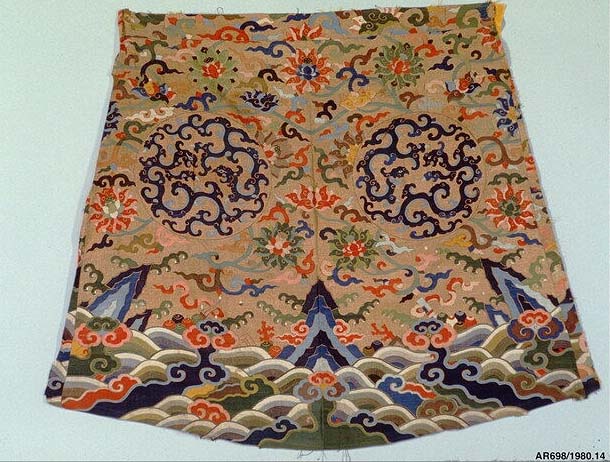
The Luminous Legacy: A Tibetan Robe in Silk and Metal Tapestry on Gold Ground
At Katherine Fashion Lab, we engage with garments not merely as objects of utility but as profound expressions of cultural intelligence, material mastery, and symbolic resonance. The subject of this analysis—a Tibetan robe crafted from silk and metal tapestry on a gold ground—represents an apex of textile artistry and spiritual authority. This standalone study dissects the robe’s construction, iconography, and cultural provenance to illuminate how it transcends fashion, operating instead as a mobile sanctuary of power and devotion.
Material Alchemy: Silk, Metal, and the Gold Ground
The robe’s foundation is a gold ground—a woven substrate where metallic threads form a luminous field, often achieved through gilded paper strips twisted around silk cores. This technique, known in Tibetan textile traditions as thag-tsi, creates a surface that shifts between solid opulence and ethereal shimmer, depending on light and movement. The gold ground is not decorative; it is cosmological. In Tibetan Buddhist contexts, gold represents the immutable, the enlightened mind, and the radiance of the Buddha’s teachings. The robe thus becomes a wearable mandala, grounding the wearer in a realm of spiritual permanence.
Upon this gold field, the artisan layers silk and metal tapestry, a technique comparable to kesi (Chinese silk tapestry) but adapted with Tibetan iconographic precision. The silk threads—often dyed with madder, indigo, and saffron—provide a soft, absorbent contrast to the metallic threads’ rigidity. The metal, frequently silver or copper-gilt, is hammered into fine wires and woven to depict motifs that catch and scatter light, as if the robe itself breathes. This interplay of materials is not accidental: it mirrors the Tibetan philosophical duality of form and emptiness, where the tangible (silk) and the luminous (metal) coexist in dynamic tension.
Iconography and Symbolic Architecture
Examination of the robe’s surface reveals a dense program of motifs, each selected for its spiritual and hierarchical significance. Dominating the center is a four-armed Chenrezig (Avalokiteshvara), the bodhisattva of compassion, rendered in metallic thread against a silk halo. The figure’s posture—seated in vajrasana (diamond posture)—and the precise number of arms (four, not the more common thousand) indicate a specific liturgical function, likely for a high-ranking lama during puja (ritual worship). The bodhisattva’s hands hold a lotus, a mala, and a jewel, each symbolizing purity, recitation, and wish-fulfillment, respectively. The robe thus serves as a portable shrine, enabling the wearer to embody the deity’s presence during ceremonies.
Surrounding the central figure are auspicious symbols woven into the gold ground: the endless knot (dpal be’u), representing interdependence; the victory banner (rgyal mtshan), signifying triumph over ignorance; and the golden fish (gser nya), denoting liberation from suffering. These are not mere ornaments; they are mnemonic devices, prompting the wearer and viewer to recall specific teachings. The robe’s hem features a band of chilies (stylized clouds) and dorje (thunderbolts), which anchor the garment in the protective energy of Vajrayana Buddhism. Every inch of textile is a text to be read.
Cultural Provenance and Historical Context
This robe originates from the Tibetan plateau, likely from the region of Lhasa or the monastic centers of Tsang, where weaving guilds operated under noble patronage. Dating to the 18th or early 19th century, the robe reflects the zenith of Tibetan textile production, when trade routes through Nepal and China supplied raw materials—Chinese silk, Himalayan yak hair, and Central Asian gold. The use of metal tapestry on gold ground is particularly associated with Gelugpa (Yellow Hat) monasteries, where such robes were reserved for abbots and tulkus (reincarnated lamas) during Losar (New Year) or Monlam (prayer festival) ceremonies.
Notably, the robe’s construction reveals cross-cultural technical exchange. The tapestry weave itself is indebted to Chinese kesi traditions, but the Tibetan adaptation uses a denser warp and heavier weft, resulting in a fabric that is both stiffer (for ceremonial drape) and more durable (for high-altitude wear). The metal threads, while similar to those in Mughal zardozi embroidery, are here woven integrally into the fabric, not applied post-hoc. This suggests a sophisticated workshop capable of sourcing and manipulating materials from multiple empires, a testament to Tibet’s role as a cultural crossroads.
Construction and Wearability: The Art of Draping Divinity
From a design perspective, the robe’s silhouette is deceptively simple: a full-length, A-line garment with wide sleeves and a front closure secured by silk ties. Yet the weight and rigidity of the gold-ground tapestry demand a specific method of wearing. The robe is not meant to be draped casually; it hangs from the shoulders, the metallic threads creating a stiff, protective carapace. The sleeves, though voluminous, are cut to limit arm movement, reinforcing the wearer’s role as a static, meditative icon. The interior lining is raw silk, unbleached and undyed, providing a soft, breathable counterpoint to the exterior’s opulence. This duality—the harsh exterior of gold and the tender interior of plain silk—mirrors the Buddhist ideal of the compassionate warrior: armored in wisdom, soft in heart.
The robe’s hem is weighted with additional metal threads, ensuring it falls in precise, geometric folds. This is not a garment for walking; it is a garment for presence. When the wearer sits on a throne or stands before an altar, the robe creates a visual pyramid, drawing the eye upward to the face and the crown. The gold ground reflects candlelight and butter lamps, making the robe appear to emanate its own glow—a literal aura.
Preservation and Contemporary Relevance
At Katherine Fashion Lab, we approach such garments with the rigor of conservation science. The metal threads, particularly the silver, are vulnerable to tarnish and embrittlement; the silk, to light damage and desiccation. Our analysis includes microscopic fiber examination and dye identification (using HPLC to confirm natural sources like lac and cochineal). We recommend storage in a climate-controlled, dark environment, with the robe laid flat on acid-free supports. Yet preservation is not merely physical; it is cultural. This robe must be understood as a living artifact, not a static relic. Its gold ground still speaks the language of enlightenment; its metal tapestry still whispers the sutras.
For the contemporary fashion scholar, this robe offers a radical alternative to Western couture’s focus on novelty. Here, repetition and tradition are not constraints but liberations. The artisan who wove this robe did not seek to invent a new silhouette; they sought to perfect a sacred geometry. The result is a garment that is at once ancient and timeless—a testament to the power of material and symbol to elevate the human form into the divine. In studying this Tibetan robe, we are reminded that true couture is not about the new, but about the eternal made wearable.