The Armchair as Couture: A Study in Global Heritage, Material Mastery, and Spatial Narrative
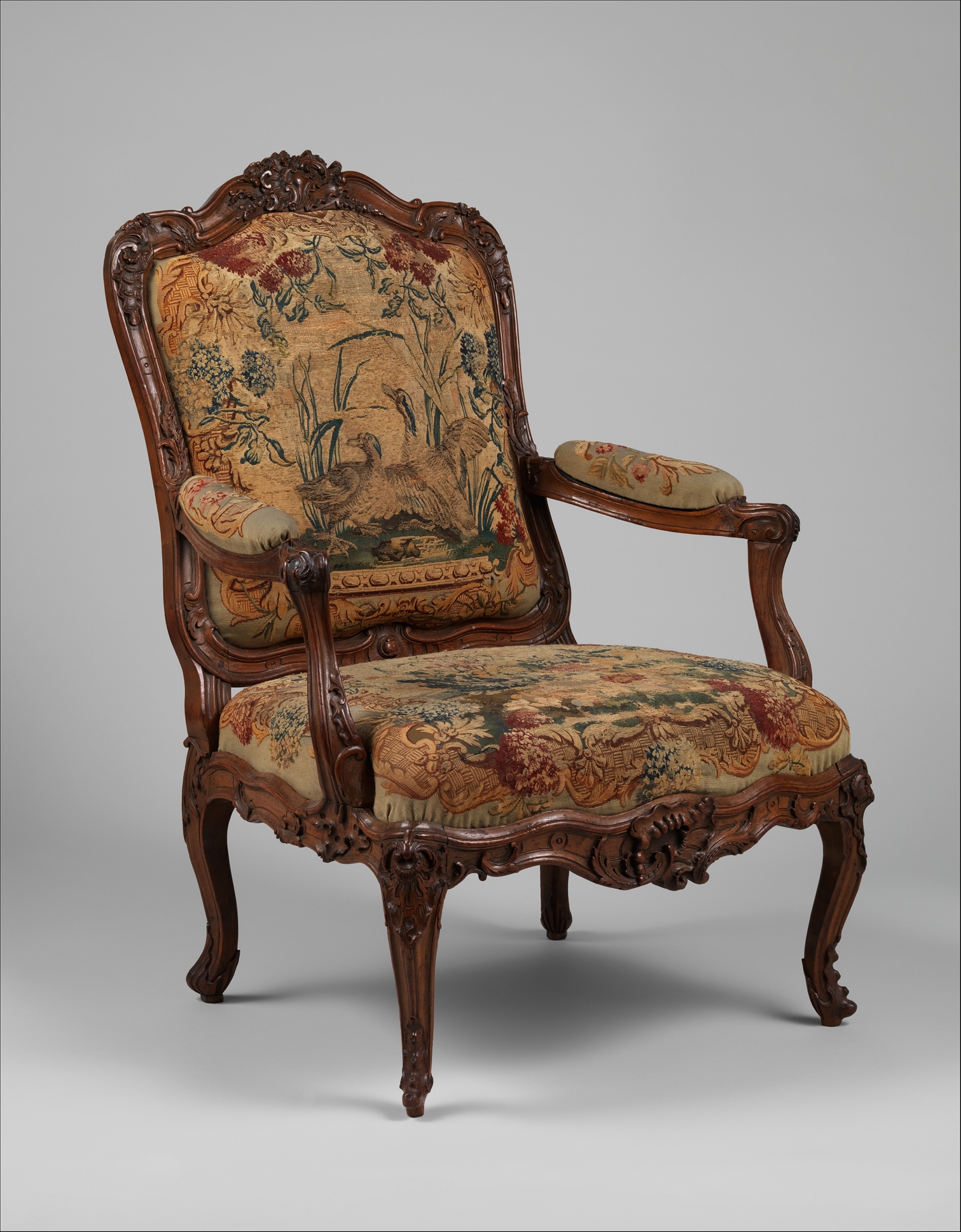
In the lexicon of high fashion, the armchair is rarely considered a mere furnishing. At Katherine Fashion Lab, we approach it as a three-dimensional garment—a sculptural expression of identity, history, and the tactile poetry of materials. This analysis deconstructs a singular artifact: an armchair crafted from carved walnut and dressed in Beauvais tapestry upholstery, rooted in a global heritage that transcends geography. Positioned as a standalone study, this piece is not a passive object but a protagonist in a narrative of cultural synthesis. Its presence commands a room, demanding the same scrutiny we apply to a couture gown’s silhouette, drape, and provenance.
The Architectural Silhouette: Carved Walnut as Structural Couture
Walnut, with its deep, chocolate-hued grain and formidable density, has long been a medium for artisans who understand that wood is not a static material but a living archive of growth rings and organic memory. In this armchair, the carved walnut frame performs the role of a structured corset—a foundation that dictates posture and presence. The intricate hand-carving along the armrests and backrest evokes the scrollwork of Renaissance cabinets, yet the silhouette is intentionally pared down, avoiding Baroque excess. This restraint is a hallmark of couture thinking: every curve and volute is a deliberate punctuation, not a decorative afterthought.
The walnut’s patina, developed over decades of handling and light exposure, introduces a nuanced color palette—from amber highlights to deep umber shadows—that no synthetic finish could replicate. In fashion terms, this is the equivalent of a garment’s natural fade from wear, a signature of authenticity. The chair’s proportion is generous yet not overwhelming; its scale suggests a throne, but the asymmetrical carving on the left armrest introduces a quiet subversion, a couture-level detail that rewards close inspection. This asymmetry disrupts symmetry’s predictability, aligning with the Lab’s ethos of controlled dissonance in design.
Beauvais Tapestry: The Fabric of Global Memory
The upholstery is a Beauvais tapestry, a textile tradition that originated in 17th-century France but whose threads are woven from a global heritage. The wool and silk fibers, dyed with natural pigments from indigo, madder, and cochineal, carry the botanical and mineral histories of Asia, the Americas, and Europe. The tapestry’s pattern—a pastoral scene with exotic birds and stylized foliage—is not merely decorative; it is a cartographic record of colonial trade routes and botanical exchange. The parrot motifs, for instance, reference the macaws of South America, while the acanthus leaves echo Greco-Roman ornamentation, filtered through French ateliers.
In couture, fabric is never neutral. The Beauvais tapestry’s texture is a study in contrast: the raised pile of the wool ground against the lustrous sheen of silk highlights. This interplay creates a chiaroscuro effect that shifts with the light, much like a Chanel tweed or a Fortuny pleat. The tapestry’s durability, originally intended for wall hangings in drafty châteaux, now serves as a tactile armor for the chair, inviting touch while resisting wear. The pattern’s density also demands a specific spatial context: it thrives in solitude, where the eye can journey across its narrative without visual competition.
Global Heritage: A Convergence of Artisanal Traditions
The armchair’s heritage is not a singular lineage but a confluence of global crafts. The walnut carving technique traces its roots to the guilds of 18th-century France and Italy, where master woodworkers (menuisiers) trained for decades. Yet the wood itself may have been sourced from the Carpathian Mountains or the forests of the American Midwest, transported via maritime networks that connected continents. The Beauvais tapestry, meanwhile, represents a synthesis of Flemish weaving traditions, French royal patronage, and Asian textile influences absorbed through trade with the Ottoman Empire and China.
This cultural hybridity is not a postmodern invention but a historical reality. At Katherine Fashion Lab, we recognize that the most compelling designs emerge from such cross-pollination. The armchair’s standalone context amplifies this heritage: without a sofa or side table to anchor it, the piece becomes a monolith of memory, a solitary witness to the global exchanges that shaped its form. It asks the viewer to consider how materials travel, how techniques migrate, and how a single object can embody the labor of multiple continents.
Spatial Narrative: The Standalone Study as a Stage
Placing this armchair as a standalone study is a curatorial decision of profound consequence. In fashion, a garment is never fully realized until it is worn; similarly, this chair’s meaning is activated by its environment. The study—a room dedicated to contemplation, reading, or writing—provides the psychological backdrop for the chair’s narrative. The absence of companion pieces forces the chair to command the space, much like a couture gown on a minimalist runway. The surrounding silence becomes a fabric in itself, allowing the walnut’s grain and the tapestry’s threads to speak.
The chair’s orientation matters. Positioned at an angle to the window, it catches morning light that illuminates the tapestry’s silk threads, while afternoon shadows deepen the walnut’s contours. This choreography of light is a couture-level consideration, akin to how a designer drapes fabric to catch a model’s movement. The study’s walls, perhaps painted in a muted verdigris or warm parchment, serve as a neutral backdrop that does not compete with the chair’s chromatic richness. The result is a tableau that invites prolonged engagement—a visual essay that unfolds over time.
Material Integrity and the Ethics of Preservation
In an era of mass production, this armchair’s materials demand a reverence for craft that aligns with Katherine Fashion Lab’s commitment to sustainability. Carved walnut is a finite resource; each chair consumes a tree that took centuries to grow. The Beauvais tapestry, woven by hand at a pace of inches per day, represents hours of human labor that cannot be automated. Owning such a piece is an act of custodianship, not consumption. The natural dyes in the tapestry will fade gracefully, and the walnut’s patina will deepen with time—a living process that mirrors the aging of a well-loved leather jacket or a vintage silk scarf.
This ethic extends to repair. A tear in the tapestry should be rewoven by a specialist, not patched with synthetic thread. A scratch on the walnut should be oiled, not painted. The chair’s value lies not in pristine preservation but in the honest history of use it accumulates. This approach rejects the disposable logic of fast fashion and instead embraces a philosophy of material permanence.
Conclusion: The Armchair as a Manifesto
In the context of Katherine Fashion Lab, this carved walnut and Beauvais tapestry armchair is more than an antique or a design object. It is a manifesto for how we should consider the objects that surround us: as garments for the spaces we inhabit, woven from global stories, demanding to be touched, seen, and understood. Its standalone placement in a study is a quiet rebellion against clutter and distraction, a testament to the power of singular focus. For the discerning collector, it offers not just a seat but a dialogue with centuries of craft, a reminder that the most profound fashion is not worn—it is lived with.