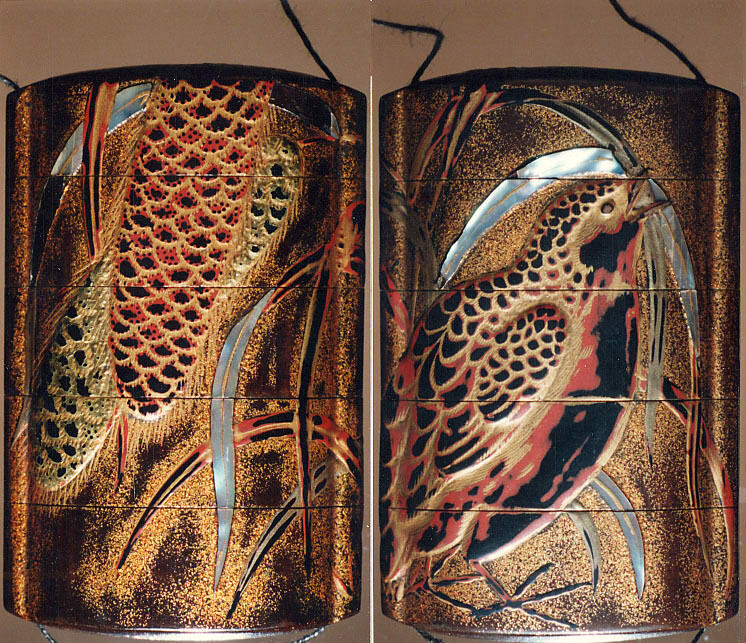
Heritage Analysis: Case (Inrō) with Design of Quail Standing beside Millet Stalks
Introduction: The Artifact as a Strategic Asset
The Case (Inrō) with Design of Quail Standing beside Millet Stalks is a masterwork of Japanese Edo-period craftsmanship, executed in lacquer with roiro (polished black ground), rubbed nashiji (pear-skin gold flecks), gold, black, and red hiramakie (flat maki-e), and raden (mother-of-pearl inlay). Its interior employs roiro and fundame (matte gold), with each case bearing a gold metal label. For Katherine Fashion Lab, this object transcends mere ornament; it is a strategic standalone research asset that reveals how symbolic power, historical adornment, and spiritual meaning can inform a 2026 high-end luxury strategy rooted in narrative depth and cultural authenticity.
Symbolic Power: Quail and Millet as Emblems of Resilience and Prosperity
The pairing of a quail with millet stalks is not arbitrary. In Japanese cultural symbolism, the quail (uzura) embodies humility, vigilance, and protection. Its ground-nesting habits and quiet demeanor connote a quiet strength—an ideal metaphor for the discerning luxury consumer who values understated elegance over ostentatious display. The millet (awa), a staple grain in pre-industrial Japan, signifies abundance, sustenance, and the cycle of harvest. Together, they form a visual allegory of resilience through simplicity: the quail thrives among the millet, drawing sustenance from the earth while remaining alert to its surroundings.
For Katherine Fashion Lab, this symbolic pairing offers a brand narrative of grounded luxury. In a market saturated with overt logos and transient trends, the quail-and-millet motif signals a return to meaningful craftsmanship and enduring values. The 2026 luxury consumer, increasingly driven by conscious consumption and emotional resonance, will find alignment with an artifact that celebrates quiet perseverance and natural harmony rather than aggressive status signaling.
Historical Adornment: The Inrō as a Portable Statement of Identity
The inrō (a tiered case worn suspended from the obi sash) was a quintessential accessory of the Edo-period samurai and merchant classes. Far from being merely functional—carrying seals, medicines, or tobacco—the inrō was a canvas for personal expression and social signaling. Its lacquered surface, often adorned with intricate maki-e and raden, communicated the wearer’s aesthetic sensibility, social status, and cultural literacy. The gold metal labels on each case further indicate a provenance of high value, likely commissioned by a patron of refined taste.
Historically, the inrō was worn as part of a coordinated ensemble, including the netsuke (toggle) and ojime (bead). This system of modular adornment allowed the wearer to curate a personal narrative through material, motif, and technique. For Katherine Fashion Lab, this concept of portable, customizable luxury resonates powerfully with 2026 trends: consumers increasingly seek versatile, collectible pieces that can be layered, swapped, or displayed as part of a larger personal archive. The inrō’s tiered structure also anticipates the modern capsule wardrobe—a few carefully chosen, high-quality items that speak to a coherent identity.
Spiritual Meaning: Lacquer as a Medium of Transcendence
The materials and techniques used in this inrō carry profound spiritual resonance. Lacquer (urushi) is derived from the sap of the Toxicodendron vernicifluum tree, a process that requires patience, ritual, and mastery. The roiro ground—polished to a mirror-like black—symbolizes the void (mu) in Zen Buddhism, a space of infinite potential. The rubbed nashiji, with its scattered gold flecks, evokes the transience of beauty (mono no aware), while the hiramakie technique—where designs are built up in relief with gold and colored powders—suggests the layering of reality and illusion. The raden inlay, using iridescent shell, introduces a cosmic dimension, reflecting light in ever-changing patterns.
Spiritually, the quail and millet also align with Shinto animism, where natural elements are inhabited by kami (spirits). The quail’s presence among millet stalks suggests a sacred interdependence between creature and crop, echoing the Japanese concept of satoyama—a harmonious landscape where human activity and nature coexist. For Katherine Fashion Lab, this spiritual layer offers a narrative of sustainability that transcends mere eco-consciousness. It positions the brand as a custodian of intangible heritage, where each piece is imbued with a soulful intentionality that resists mass production.
2026 High-End Luxury Strategy: Translating Heritage into Contemporary Value
To leverage this artifact’s heritage for a 2026 luxury strategy, Katherine Fashion Lab must move beyond replication and toward conceptual translation. The following strategic pillars emerge from this analysis:
1. Narrative-Driven Product Architecture
The inrō’s tiered structure and symbolic motifs suggest a collection of modular, story-rich accessories. Katherine Fashion Lab could develop a limited-edition series of “portable talismans”—small leather goods, jewelry cases, or tech accessories—that feature quiet, nature-inspired motifs (e.g., quail and millet) executed in precious materials (lacquer finishes, mother-of-pearl inlays, gold accents). Each piece would include a digital provenance marker (e.g., NFC chip) linking to a narrative about the motif’s cultural meaning, the artisan’s technique, and the material’s spiritual significance.
2. The “Custodianship” Model
Drawing from the inrō’s historical role as a personal heirloom, Katherine Fashion Lab can introduce a lifecycle service that mirrors the lacquer restoration tradition. Clients would receive annual maintenance (e.g., polishing, repair) and the option to recommission a piece with new symbolic elements as their life evolves. This transforms a singular purchase into a generational relationship, aligning with the 2026 luxury consumer’s desire for longevity and emotional investment over disposability.
3. Experiential Retail as Ritual
The spiritual dimension of lacquer—its slow creation, its mirror-like finish—can be translated into immersive retail experiences. Katherine Fashion Lab could design “contemplation spaces” in flagship stores, where clients engage with the process of makie through live demonstrations, scent (urushi’s distinctive aroma), and sound (the rhythmic polishing of lacquer). The quail-and-millet motif could anchor a seasonal capsule tied to the Japanese harvest calendar, with limited drops timed to cultural festivals (e.g., Tsukimi, the moon-viewing festival).
4. Collaborative Artisan Partnerships
To ensure authenticity, Katherine Fashion Lab should partner with living National Treasure lacquer artists from Japan, commissioning bespoke pieces that blend traditional techniques with contemporary form (e.g., a lacquered clutch or smartwatch band). These collaborations would be documented in a short film series, exploring the spiritual and symbolic layers of each motif, and released as exclusive content for high-value clients. This positions the brand as a bridge between heritage and innovation, appealing to the 2026 luxury consumer’s appetite for cultural connoisseurship.
Conclusion: The Inrō as a Blueprint for Meaningful Luxury
The Case (Inrō) with Design of Quail Standing beside Millet Stalks is far more than a decorative artifact; it is a strategic repository of symbolic, historical, and spiritual intelligence. For Katherine Fashion Lab, its lessons are clear: luxury in 2026 must be narrative-rich, emotionally resonant, and materially honest. By embracing the quail’s quiet vigilance and the millet’s enduring abundance, the brand can forge a path that honors tradition while meeting the demands of a discerning, values-driven clientele. The inrō’s lacquered surface reflects not just light, but the depth of a culture—and that reflection is the ultimate luxury.