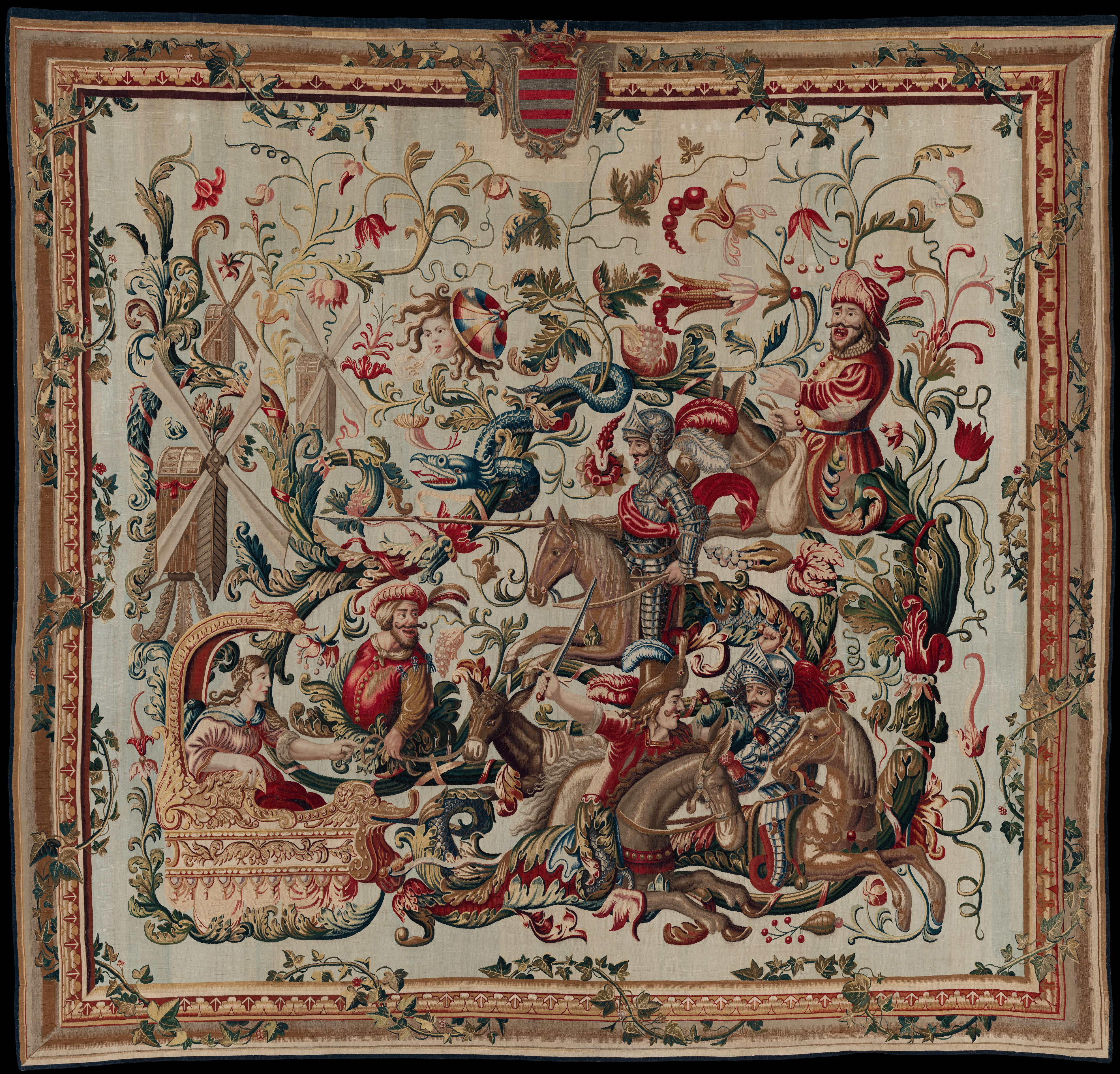
Heritage Analysis: Don Quixote Tilting at Windmills – A Strategic Study for Katherine Fashion Lab
This heritage analysis examines the tapestry panel “Don Quixote Tilting at Windmills,” from the series Don Quixote in Grotesques, as a source of symbolic power, historical adornment, and spiritual meaning. Commissioned for Katherine Fashion Lab’s 2026 high-end luxury strategy, this study positions the artifact not merely as decorative textile, but as a foundational narrative asset for brand differentiation in an era of cultural commodification. The medium—wool, silk, and precious metal-wrapped threads—elevates the piece beyond craft into the realm of ritualistic statement, offering a blueprint for how ancient civilizations encoded status, morality, and transcendence into wearable and interior forms.
Symbolic Power: The Knight as Archetype of Futile Nobility
The Windmill as Metaphor for Modern Luxury
At its core, the image of Don Quixote charging at windmills embodies a paradox: the collision of delusion with determination. In ancient civilizations, such as those of the Mediterranean and Near East, tapestry weaving served as a medium for mythic storytelling, where heroes like Gilgamesh or Odysseus grappled with forces beyond human control. The Quixote figure, though fictional, taps into this archetype of the noble fool—a warrior whose valor is misdirected yet spiritually pure. For Katherine Fashion Lab’s 2026 strategy, this symbolic power translates into a brand ethos that celebrates “willful idealism” over pragmatic conformity. In a luxury market saturated with fast trends, the Quixote motif signals a return to narrative-driven design, where each garment or accessory carries the weight of a story—one that acknowledges the absurdity of perfection while striving for it.
Precious Metal-Wrapped Threads as Status Currency
The use of gold and silver-wrapped threads in this tapestry is not incidental. In ancient civilizations, metallic threads were reserved for deities, rulers, and sacred objects, as they reflected light—a symbol of divine presence or solar power. By incorporating these materials, the artifact asserts symbolic dominance over its viewer, much like a luxury brand’s logo or monogram. For Katherine Fashion Lab, this suggests a strategy of “material storytelling” in 2026: using precious metals not as mere embellishment, but as carriers of meaning. A Quixote-inspired evening gown, for instance, could feature embroidered windmills in gold thread on a black silk ground, transforming the wearer into a living tapestry—a walking monument to the tension between aspiration and reality.
Historical Adornment: The Tapestry as Wearable Heritage
From Wall to Body: The Evolution of Textile Power
In ancient civilizations, tapestry was not exclusively for walls; it adorned bodies in the form of ceremonial cloaks, tunics, and headdresses. The “Don Quixote in Grotesques” series, though later in origin, inherits this tradition of textile as armor—both physical and psychological. The grotesque figures surrounding the knight (often part-human, part-animal) serve as guardians or warnings, much like the protective motifs found in Scythian or Persian textiles. For Katherine Fashion Lab’s 2026 collection, this suggests a revival of “adornment as protection.” Garments could feature abstracted windmill silhouettes or grotesque creatures woven into lapels, cuffs, or linings, offering the wearer a sense of narrative armor against the chaos of modern life. The wool and silk blend, historically used for durability and drape, also signals a return to tactile luxury—a counterpoint to digital fashion’s ephemerality.
Craftsmanship as Ritual
The medium of wool, silk, and precious metal threads required immense labor in ancient times, often involving workshops that operated like spiritual guilds. Each thread was imbued with intention, making the finished piece a repository of collective effort. This ritualistic craftsmanship is a cornerstone of Katherine Fashion Lab’s heritage strategy. In 2026, the brand can position itself as a patron of “slow luxury,” where each piece is produced in limited editions using hand-weaving techniques inspired by ancient methods. The Quixote tapestry becomes a case study in how to market craftsmanship: not as a technical feature, but as a spiritual practice. Marketing materials could highlight the hours, the materials, and the lineage of weavers, transforming a purchase into an act of cultural preservation.
Spiritual Meaning: The Quixote as Pilgrim
The Windmill as Cosmic Wheel
Beyond its literary context, the windmill in ancient symbolism often represented the wheel of fate, the cyclical nature of life, or the spinning of cosmic order. In Hindu and Buddhist traditions, the wheel (dharmachakra) symbolizes the path to enlightenment; in Celtic and Norse myth, spinning wheels connect to fate and time. Don Quixote’s attack on windmills thus becomes a spiritual allegory: the human struggle against forces larger than oneself, whether divine, societal, or psychological. For Katherine Fashion Lab’s 2026 high-end luxury strategy, this spiritual dimension offers a transcendent marketing narrative. The brand can align itself with the concept of “the noble struggle”—a theme that resonates with affluent consumers seeking purpose beyond consumption. A limited-edition scarf or shawl featuring the Quixote motif could be marketed as a “pilgrim’s cloak,” a wearable reminder of one’s personal quest for meaning.
Sacred Geometry in Grotesque Form
The “grotesques” in the series—often distorted figures blending human, animal, and plant forms—carry spiritual weight. In ancient art, such hybridity was not monstrous but sacred, representing the interconnectedness of all life. For Katherine Fashion Lab, incorporating grotesque elements into luxury design (e.g., embroidery of half-human figures or abstract windmill blades) can evoke a “mystical heritage” that appeals to the 2026 consumer’s desire for authenticity and depth. This is not ornamentation for its own sake, but a visual language that speaks to the soul. The brand could collaborate with contemporary artists to reinterpret these grotesques, creating a dialogue between ancient spirituality and modern luxury.
2026 High-End Luxury Strategy: From Artifact to Asset
Positioning the Tapestry as a Brand Origin Story
Katherine Fashion Lab can leverage this heritage analysis to position “Don Quixote Tilting at Windmills” as a foundational narrative for its 2026 collection. The artifact becomes a “brand totem,” referenced in store design, packaging, and digital content. For example, flagship boutiques could feature tapestry-inspired wall panels, while e-commerce platforms use animated windmill motifs. The key is consistency: every touchpoint reinforces the theme of noble struggle and transcendent beauty. This strategy aligns with the luxury sector’s shift toward “cultural capital” over mere product, where consumers invest in stories that elevate their personal identity.
Pricing and Exclusivity through Heritage
The medium of wool, silk, and precious metal threads—historically reserved for elite patrons—justifies premium pricing. Katherine Fashion Lab can adopt a “heritage surcharge” model, where pieces inspired by the tapestry are priced significantly higher than standard collections. This is not arbitrary; it reflects the cost of sourcing ethical silk, hand-spun wool, and recycled precious metals, as well as the expertise of artisans trained in ancient techniques. In 2026, transparency in sourcing and production will be a key differentiator. The brand can publish a “Heritage Report” alongside each collection, detailing the tapestry’s provenance and how it informs design decisions. This builds trust and reinforces the brand’s position as a custodian of cultural history.
Collaborative and Experiential Marketing
To maximize impact, Katherine Fashion Lab should partner with museums, textile historians, and contemporary artists to create immersive experiences around the Quixote tapestry. Pop-up exhibitions, weaving workshops, and virtual reality tours of the original artifact’s creation process can generate buzz and deepen consumer engagement. In 2026, luxury is not just owned—it is experienced. By offering clients the chance to “walk through the tapestry” or “meet the weavers,” the brand transforms a heritage object into a living, breathing asset. This experiential approach also yields rich content for social media, where the story of the tapestry can be told in serialized episodes, building anticipation for the collection’s launch.
Conclusion: The Windmill as a Brand Compass
The tapestry “Don Quixote Tilting at Windmills” is far more than a decorative relic; it is a strategic compass for Katherine Fashion Lab’s 2026 high-end luxury strategy. Its symbolic power—the noble fool’s eternal quest—resonates with a consumer base seeking meaning in an age of excess. Its historical adornment techniques—wool, silk, and precious metal threads—offer a blueprint for craftsmanship that transcends trend. Its spiritual meaning—the windmill as cosmic wheel—provides a narrative of transcendence and struggle that elevates the brand above mere commerce. By weaving these elements into a cohesive strategy, Katherine Fashion Lab can position itself not just as a fashion house, but as a custodian of cultural heritage, where each garment carries the weight of history and the light of aspiration. In 2026, the windmill is no longer an obstacle—it is the destination.