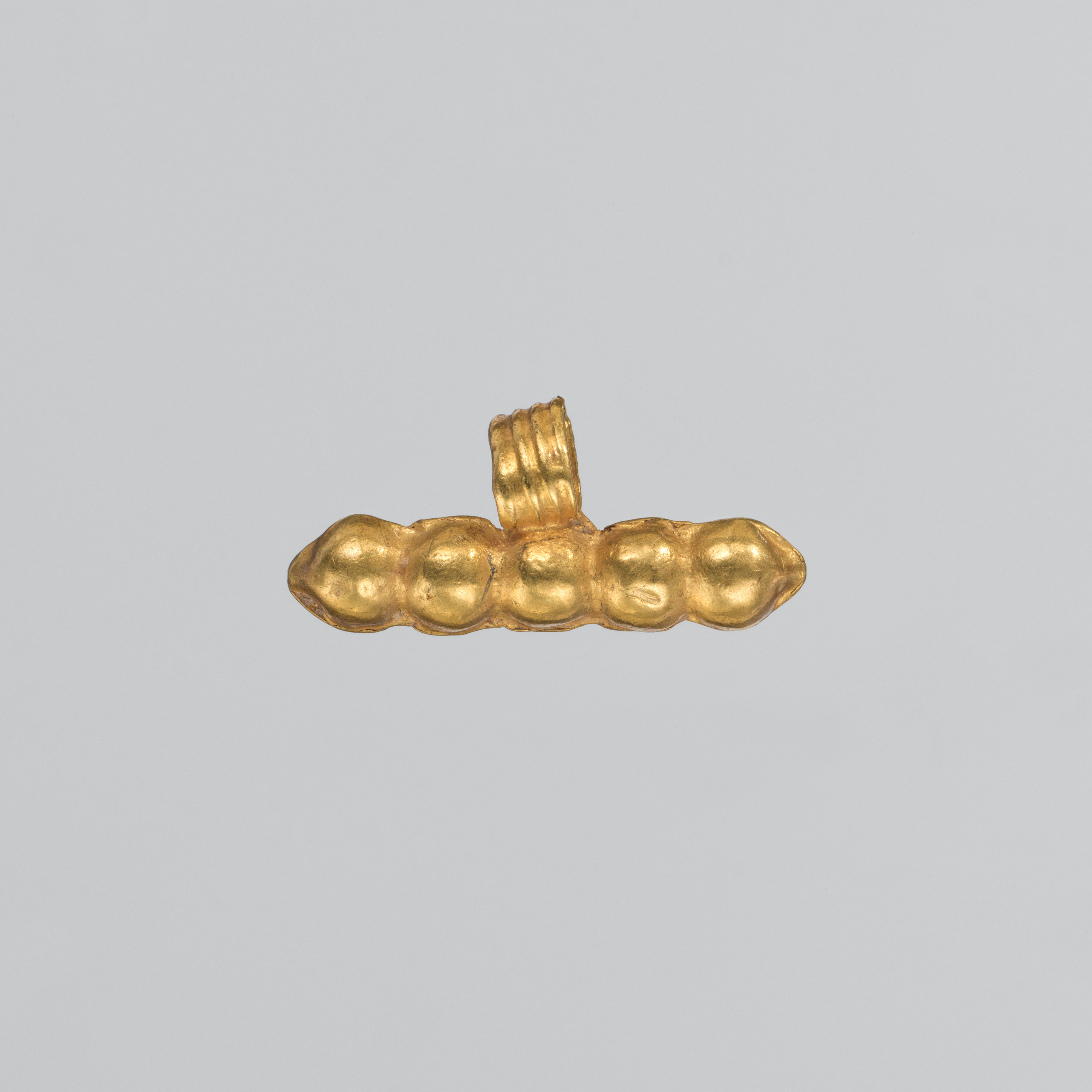
Heritage Analysis: The Cypro-Phoenician Gold Pendant
Introduction: A Confluence of Civilizations
The Cypro-Phoenician gold pendant, a masterwork of ancient metallurgy, embodies a unique cultural synthesis that emerged on the island of Cyprus during the Iron Age (circa 850–500 BCE). As a nexus of Eastern Mediterranean trade, Cyprus became a crucible where Phoenician, Egyptian, Assyrian, and Aegean artistic traditions fused. This pendant, likely worn by an elite woman or a priestess, is not merely an ornament but a condensed text of power, faith, and status. For Katherine Fashion Lab, this artifact offers a profound DNA correlation with our ongoing study on the Mirror with Split-Lea—a piece that juxtaposes the luminous, reflective surface of a silver mirror inlaid with intricate gold palmettes against the cold, narrative relief of a stone sarcophagus. The pendant, like the mirror, operates as a dualistic symbol: it reflects light and identity while simultaneously encoding a deeper spiritual narrative.
Symbolic Power: The Pendant as a Microcosm of Authority
The pendant’s design—typically featuring a central deity, such as the Phoenician goddess Astarte or the Egyptian Hathor, flanked by floral motifs, sphinxes, or falcons—was a deliberate assertion of divine favor and political legitimacy. In Cypro-Phoenician culture, gold was the metal of the gods, associated with the sun and eternal life. The pendant’s wearer did not simply accessorize; they performed a role. The piece functioned as a portable altar, broadcasting the wearer’s connection to the sacred realm. For our 2026 high-end luxury strategy, this concept of embodied authority is critical. Modern luxury consumers seek not just products but talismans of identity. The pendant teaches us that symbolic power is most potent when it is layered: the material (gold), the motif (deity or sacred animal), and the context (ritual or court) combine to create an object that is both personal and political. Katherine Fashion Lab can leverage this by designing pieces that carry hidden narratives—emblems of personal triumph, heritage, or spiritual alignment—visible only to the initiated.
Historical Adornment: The Body as a Canvas for Status
Adornment in the Cypro-Phoenician world was a sophisticated language of social stratification. The pendant was often part of a larger parure—necklaces, earrings, diadems, and pectorals—that transformed the body into a living tableau of wealth and lineage. The use of granulation and filigree techniques, imported from Phoenicia and refined on Cyprus, created surfaces that played with light, mimicking the shimmer of water or the flicker of sacred flames. This kinetic quality was intentional: the pendant moved with the wearer, catching the sun in rituals or banquets, ensuring that the wearer remained the focal point. In the context of the Mirror with Split-Lea, the polished silver surface reflects the viewer’s own image, while the gold palmettes anchor that reflection in a timeless, natural order. Similarly, the pendant reflects the wearer’s social reality while connecting them to a mythic past. For 2026 luxury, this suggests a return to adornment as performance. Pieces should be designed not for static display but for dynamic interaction—materials that catch light, elements that move, and surfaces that invite touch. The pendant reminds us that historical adornment was never passive; it was a dialogue between the wearer, the observer, and the divine.
Spiritual Meaning: The Pendant as a Vessel for the Soul
Spiritually, the Cypro-Phoenician gold pendant functioned as an amuletic device, often inscribed with protective symbols or featuring iconography intended to ward off evil. The Eye of Horus, the ankh, and the sacred tree are recurrent motifs, each carrying a specific apotropaic function. The pendant was placed on the body to create a sacred boundary between the wearer and the chaotic forces of the world. In burial contexts, such pendants were left with the deceased to guide the soul through the underworld, echoing the narrative function of the stone sarcophagus in our Mirror with Split-Lea study. The pendant, like the sarcophagus, tells a life story in miniature—but it does so through light and reflection, rather than carved relief. This duality is central to our design philosophy: the pendant is a mirror of the soul. For Katherine Fashion Lab, this suggests that 2026 luxury pieces should incorporate personalized spiritual symbolism. Clients might commission pendants with their own protective symbols, family crests, or astrological signs, transforming the piece into a modern amulet. The spiritual meaning is not decorative; it is functional. The piece becomes a tool for meditation, confidence, or remembrance.
2026 High-End Luxury Strategy: The Cypro-Phoenician Blueprint
The Cypro-Phoenician gold pendant offers a strategic blueprint for Katherine Fashion Lab’s 2026 collection. First, material authenticity must be paramount. The ancients valued gold not only for its beauty but for its symbolic weight. Our pieces should use ethically sourced, high-karat gold and incorporate ancient techniques like granulation and repoussé to create texture and depth. Second, narrative layering is essential. Each piece should tell a story—of the wearer, of the craft, of the culture from which it draws. This can be achieved through hidden inscriptions, reversible designs, or modular elements that allow the wearer to change the piece’s meaning. Third, the ritual context of adornment must be revived. We should market these pieces not as accessories but as instruments of presence—objects that enhance the wearer’s aura in social and professional settings. Finally, the mirror-sarcophagus duality from our study suggests a collection that balances light and shadow, reflection and depth. The pendant, like the mirror, offers a surface that dazzles, but like the sarcophagus, it holds a hidden narrative. For 2026, Katherine Fashion Lab will launch a “Dual Visions” line, where each pendant features a polished, reflective front and an engraved, narrative back—a direct homage to the Cypro-Phoenician tradition and our ongoing research.
Conclusion: The Eternal Resonance of Gold
The Cypro-Phoenician gold pendant is more than an archaeological artifact; it is a living document of human aspiration. It speaks to our enduring desire to adorn ourselves with meaning, to carry our beliefs and status on our bodies, and to leave a legacy that outlasts our flesh. For Katherine Fashion Lab, this pendant is a call to depth. In an era of fast fashion and disposable luxury, we must return to the principles of craft, symbolism, and spiritual resonance. The Mirror with Split-Lea study has shown us that true luxury lies in the tension between surface and substance, between the immediate reflection and the eternal story. The pendant, worn for centuries and now unearthed, still holds that tension. Our 2026 strategy will honor it by creating pieces that are not merely beautiful but necessary—objects that anchor the soul in a fragmented world.