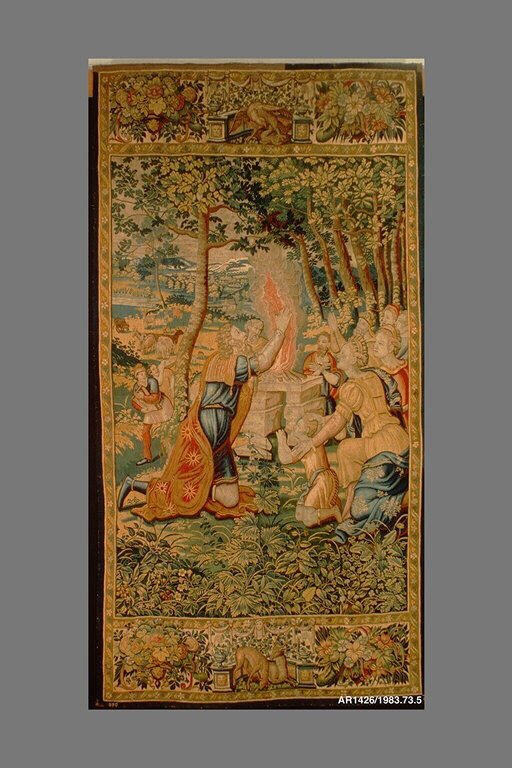
An Oath in Thread: Covenant and Sacrifice in Textile Narrative
The story of Jacob is a chronicle of complex covenants, a narrative tapestry woven with divine promises, human cunning, and hard-won reconciliations. Within this epic, the pact forged with his uncle Laban stands as a pivotal, earthly agreement—a tense resolution to two decades of mutual deception concerning flocks, labor, and daughters. The moment of "Jacob sacrificing after making a covenant with Laban" (Genesis 31:43-55) is not one of serene piety but of profound relational archaeology. It is a ceasefire ritual, establishing a boundary of stone and a shared meal that seeks to transmute a history of exploitation into a stable, if distant, future. For Katherine Fashion Lab, this scene presents a formidable challenge: to manifest in wool and silk the weight of a sworn oath, the solemnity of a communal sacrifice, and the enduring tension of a border that must both separate and connect.
Material as Covenant: The Structural Integrity of Wool and Silk
The specified materials—wool and silk—are not merely luxurious choices; they are narrative agents. The 18 warps per inch (a precise, high-density weave) speaks to the meticulous, almost legalistic nature of the covenant itself. This tight, resilient ground, likely in a robust wool, represents the rugged, enduring landscape of Gilead and the unyielding terms of the agreement: "This heap is a witness, and this pillar is a witness, that I will not go past this heap to your harm, and you will not go past this heap and this pillar to my harm." The density of the weave creates a textile of formidable structure, a fabric-border, impermeable and strong, mirroring the stone pillar and heap erected by Jacob and Laban.
Upon this foundational wool warp, the silk weft operates as the complex human and divine narrative. Silk, with its inherent luminosity and strength, embodies the threads of kinship, aspiration, and the divine oversight that undergirds even this earthly pact. Its introduction in a 6–7 per cm. count allows for detailed, shimmering passages—perhaps the flicker of firelight on the faces of the gathered kin, the gleam of the stone pillar anointed with oil, or the silent witness of the God of Abraham and the God of Nahor. The interplay between the matte, terrestrial wool and the luminous, transcendent silk visually articulates the scene's core tension: an agreement mired in human conflict, yet solemnized before a higher authority.
Narrative Stitchcraft: Iconography of Separation and Communion
The design must hold two opposing forces in exquisite balance: separation and communion. The covenant is, at its heart, a formalized separation. This can be rendered through a central, vertical axis—a stark, textured column representing the pillar of stone. This axis could be constructed with a raised, almost architectural technique in the weave, perhaps using a heavier, undyed wool to suggest raw, hewn rock. Radiating from this central divide, a field of intricate pattern might tell the preceding story: subtle, warping chevrons for the disputed flocks, interlaced motifs for the tangled lineages of Leah and Rachel, and distorted geometries for the "twenty years" of shifted wages and changed fortunes.
Yet, on either side of this divide, the composition must also speak to the act of sacrifice and shared meal. Here, the silk weft becomes paramount. In the areas designated for the sacrificial feast, the weave could open slightly, the pattern dissolving into fluid, flame-like motifs in deep crimson, burnt umber, and gold—the colors of consecration, earth, and oath. These elements would not cross the central boundary but would mirror each other on either side, a visual echo of the identical ritual performed by both parties. The sacrifice, a communal act of sealing, thus becomes the aesthetic bridge across the structural divide, its reflective symmetry a testament to the mutual, if wary, acceptance of the terms.
The Couture Silhouette: Architecture of Witness
As a standalone study, the garment's form must itself be a monument. Imagine a structured coat or mantle, its back panel dominated by the central pillar motif, extending from a high, stiff collar down to the hem, physically dividing the garment into two distinct planes. The front closures might be asymmetrical, perhaps with complex, knotted fastenings reminiscent of tied covenants, that come together only with deliberate effort. The sleeves could be wide and authoritative, their cuffs embroidered with a continuous frieze of livestock and pastoral symbols, the disputed wealth that led to this moment.
The interior of the garment would reveal the hidden cost. Lined in a contrasting, perhaps somber silk, it might feature more chaotic, entangled stitching—the private strife, the whispered grievances of two decades, the personal sacrifices of Rachel and Leah. To don this piece is to literally wrap oneself in the garment of witness, to feel the weight of the boundary along the spine and the contrasting narratives of conflict and resolution on the interior and exterior. It is wearable historiography, where every seam and selvedge carries juridical and emotional weight.
Conclusion: A Legacy Woven in Tension
Katherine Fashion Lab’s analysis concludes that this subject demands a couture philosophy where materiality is morality, and structure is story. The piece born from "Jacob sacrificing after making a covenant with Laban" would be a masterwork of textured tension. It would not celebrate easy unity but would honor the painful, necessary architectures humans build to manage their complex histories. The high-density wool warp provides the unyielding law of the border; the luminous silk weft provides the grace notes of ritual and the possibility of future peace. In this textile, the covenant is not a forgotten document but a living, tactile environment. It stands as a testament to the profound idea that sometimes, the most sacred and stable futures are built not on the erasure of a difficult past, but on its meticulous, witnessed, and woven formalization.