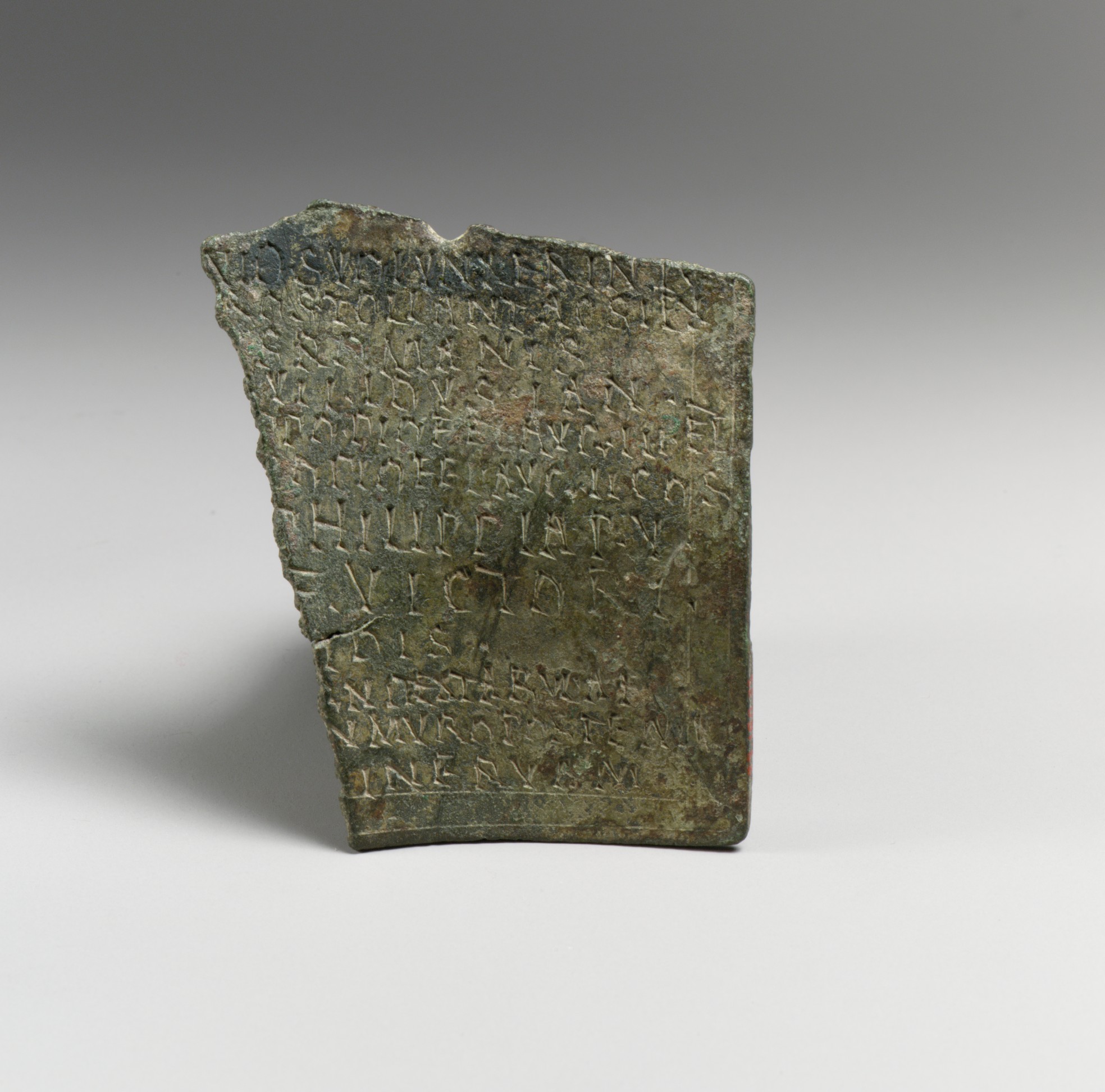
Heritage Analysis: The Bronze Military Diploma Fragment
Introduction: The Resonance of Authority and Transformation
The bronze military diploma fragment from the Roman Empire, dated approximately to the 2nd century CE, represents far more than a mere administrative artifact. It is a testament to the symbolic power embedded in material culture, serving as a conduit between imperial authority and individual identity. This analysis, conducted for Katherine Fashion Lab, explores the fragment’s historical adornment, spiritual meaning, and its strategic relevance to our 2026 high-end luxury strategy. The study is framed within the context of our ongoing research on 《Rock in the form of a fantastic mountain》 and 《Jar in the shape of bronze container (hu)》, two seemingly disparate objects that, when examined through the lens of heritage DNA, reveal a shared narrative of transformation, status, and transcendence. This correlation underscores how ancient artifacts—whether military, natural, or ceremonial—encode principles of power and permanence that can inform modern luxury brand positioning.
Symbolic Power: The Diploma as a Marker of Social Elevation
The Roman military diploma was a bronze plaque issued to retired auxiliary soldiers, granting them Roman citizenship and legal privileges. Its symbolic power lies in its function as a tangible instrument of social metamorphosis. For the soldier, the diploma represented a transition from peripheral status to full integration into the Roman civic body. This object was not merely a record; it was a talisman of belonging, a proof of loyalty rewarded. In the context of our heritage research, the diploma mirrors the transformative symbolism found in 《Rock in the form of a fantastic mountain》, which embodies the natural world’s capacity to shape and elevate human perception. The rock, like the diploma, is a symbol of endurance and ascension—a physical marker of a journey from the mundane to the extraordinary. For Katherine Fashion Lab, this suggests that high-end luxury in 2026 must emphasize artifacts of transformation: pieces that signify a client’s personal evolution, status elevation, or cultural integration. The diploma’s power lies in its ability to confer identity; similarly, luxury goods must serve as symbols of the wearer’s narrative of achievement and belonging.
Historical Adornment: The Aesthetics of Authority
While the bronze military diploma was not worn as personal adornment in the conventional sense, its production and display involved meticulous craftsmanship that aligns with principles of historical adornment. The fragment’s incised text and decorative borders—often featuring military standards, eagles, or imperial portraits—were designed to convey authority and permanence. The bronze medium itself, resistant to corrosion, symbolized durability and value. This aesthetic of authority resonates with 《Jar in the shape of bronze container (hu)》, a ceremonial vessel that combines functional form with symbolic ornamentation. The jar’s shape, derived from ancient bronze prototypes, speaks to a tradition of adornment through form—where the object’s silhouette itself becomes a statement of cultural lineage. In both cases, adornment is not superficial; it is embedded in the object’s materiality and construction. For our 2026 luxury strategy, this implies a return to artisanal integrity. High-end pieces should prioritize material authenticity—bronze, precious metals, or rare stones—and design language that references historical archetypes of power. The diploma fragment teaches us that luxury adornment must be legible as a signifier of heritage and authority, not merely as ornament.
Spiritual Meaning: The Fragment as a Conduit for Transcendence
The spiritual dimension of the bronze military diploma extends beyond its legal function. In Roman culture, citizenship was not only a political status but also a spiritual bond to the state and its gods. The diploma, often displayed in domestic shrines or buried with the veteran, served as a protective amulet—a physical link to the divine order of Rome. This spiritual meaning aligns with our study of 《Rock in the form of a fantastic mountain》, which evokes the sacred geography of mountains as places of spiritual ascent and communion. The rock’s fantastic form suggests a portal between earthly and cosmic realms, much as the diploma bridges the mortal soldier with the eternal idea of Rome. Similarly, 《Jar in the shape of bronze container (hu)》 carries spiritual significance as a vessel for offerings, connecting the living with ancestors or deities. The jar’s shape, derived from ritual bronzes, embodies a continuity of spiritual practice. For Katherine Fashion Lab, this indicates that luxury in 2026 must engage with transcendent narratives. Products should be designed not only for aesthetic pleasure but as objects of spiritual resonance—pieces that connect the wearer to broader histories, beliefs, or cosmic orders. The diploma fragment, the rock, and the jar all function as threshold objects, facilitating transitions between states of being. Our brand strategy should leverage this by creating collections that tell stories of transformation, protection, and spiritual elevation.
DNA Correlation: Unifying Threads Across Artifacts
The research context linking the bronze military diploma fragment with 《Rock in the form of a fantastic mountain》 and 《Jar in the shape of bronze container (hu)》 reveals a shared heritage DNA rooted in the interplay of materiality, symbolism, and human aspiration. Despite their apparent differences—one military, one natural, one ceremonial—each artifact encodes a narrative of transformation. The diploma transforms a soldier into a citizen; the rock transforms a landscape into a spiritual metaphor; the jar transforms a container into a ritual object. This correlation suggests that luxury brands must move beyond superficial references to history and instead embed deep structural parallels in their designs. For example, the diploma’s emphasis on inscription and text can inspire personalized luxury items that carry individual narratives. The rock’s organic, fantastic form can influence sculptural jewelry or accessories that defy conventional shapes. The jar’s ritual function can inform limited-edition pieces designed for ceremonial use, such as commemorative objects for milestones. By recognizing these shared DNA threads, Katherine Fashion Lab can develop a cohesive 2026 strategy that positions each collection as part of a larger, timeless dialogue with human heritage.
2026 High-End Luxury Strategy: From Artifact to Archetype
Drawing from this analysis, I propose a three-pronged strategy for Katherine Fashion Lab’s 2026 high-end luxury positioning. First, Symbolic Power as Brand Narrative: Each collection should be framed as a diploma of status, offering clients a tangible marker of their personal journey. Limited-edition pieces can be accompanied by certificates or inscriptions that authenticate the wearer’s connection to a specific heritage narrative. Second, Historical Adornment as Craft Signature: Invest in artisanal techniques that echo the bronze medium’s durability and authority. Use materials like patinated bronze, gold leaf, or enamel that reference ancient craftsmanship, and design forms that evoke the authoritative silhouettes of Roman military regalia, fantastic rock formations, or ritual vessels. Third, Spiritual Meaning as Experiential Luxury: Create immersive brand experiences—such as private exhibitions or digital narratives—that position each piece as a threshold object for personal transformation. This could include collaborations with historians or spiritual guides to deepen the symbolic resonance. By synthesizing the heritage DNA of the diploma, the rock, and the jar, Katherine Fashion Lab can transcend mere fashion to become a curator of timeless artifacts for the modern elite.
Conclusion: The Eternal Fragment
The bronze military diploma fragment, though broken and worn by time, remains a powerful symbol of what luxury should represent: transformation, authority, and spiritual depth. Its resonance with 《Rock in the form of a fantastic mountain》 and 《Jar in the shape of bronze container (hu)》 reveals a universal human desire to hold onto objects that mark our passage through life. For Katherine Fashion Lab, this heritage analysis is not an academic exercise but a strategic blueprint. As we approach 2026, let us design not just products but fragments of eternity—pieces that, like the Roman diploma, will be treasured for their ability to confer identity, adorn with meaning, and connect the wearer to something greater than themselves. This is the DNA of true luxury: the power to transform the ordinary into the extraordinary, and the transient into the eternal.