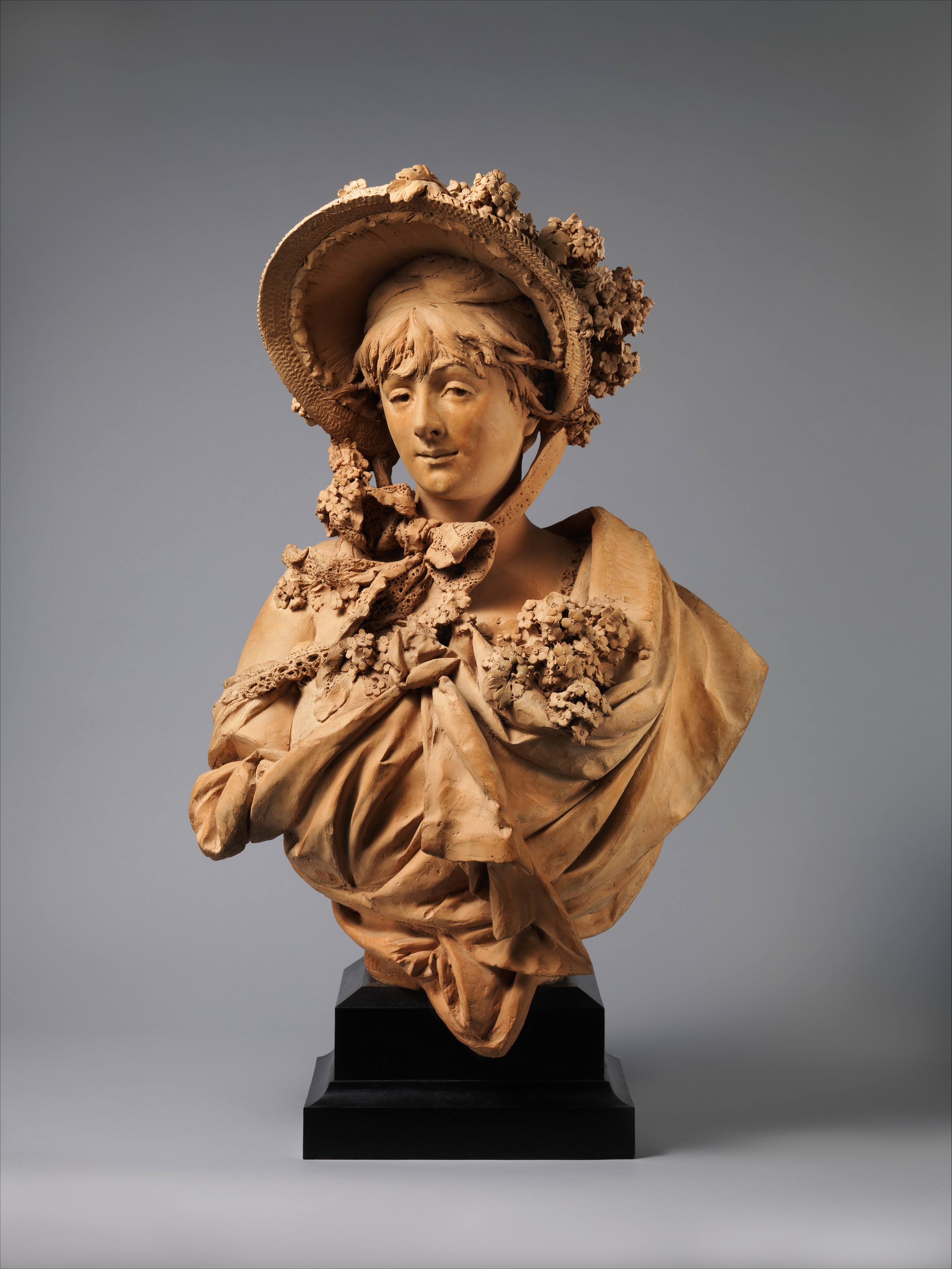
The Poetics of Preservation: Deconstructing "Girl in a Straw Bonnet"
In the rarefied air of haute couture, where fabric meets fantasy and heritage informs innovation, the standalone study of "Girl in a Straw Bonnet" emerges as a profound meditation on materiality and memory. This piece, executed in terracotta upon a wooden base, transcends the conventional boundaries of fashion analysis to become a dialogue between earth, craft, and the ephemeral human form. As Lead Curator at Katherine Fashion Lab, I present this analysis not merely as an appraisal of an object, but as a forensic exploration of how global heritage is encoded into the very molecules of artistic expression.
The Material Lexicon: Terracotta as Textile
Terracotta, literally "baked earth," is a material of ancient provenance, yet its application here is startlingly contemporary. Unlike the supple silks or structured wools typical of couture, this medium demands a redefinition of "fabric." The terracotta is not draped or stitched; it is modeled, carved, and fired. This process imbues the subject—a girl in a straw bonnet—with a geological permanence that contrasts sharply with the transient nature of fashion. The texture is paramount: the rough, porous surface mimics the tactile quality of raw linen or homespun wool, evoking a pre-industrial era where clothing was a direct extension of the land. The straw bonnet, a symbol of pastoral simplicity and labor, is rendered in terracotta with subtle undulations that capture the organic weave of dried grasses. This is not a literal translation but a poetic one—a transubstantiation of fiber into mineral.
The choice of terracotta also speaks to a global heritage that is both diffuse and specific. From the terracotta warriors of Xi'an to the votive figurines of the Mediterranean, this material carries the weight of civilizations. In "Girl in a Straw Bonnet," the material becomes a universal archive, suggesting that the girl's identity is not singular but a composite of countless anonymous hands that have shaped clay across millennia. The wood base, likely oak or walnut, grounds the piece in a different temporality—one of growth, rings, and arboreal history. Together, they form a bimaterial dialogue: the organic warmth of wood against the earthy coolness of terracotta, a tension between the living and the fired, the mutable and the fixed.
The Silhouette of Solitude: Composition and Form
The standalone nature of this study—an isolated figure without narrative context—amplifies its emotional resonance. The girl's posture is one of quiet introspection, her head tilted slightly, as if listening to a distant sound or lost in a memory. The straw bonnet, a circle of shade, frames her face in a way that suggests both protection and concealment. In couture terms, this is a masterclass in negative space. The bonnet's brim creates a halo of shadow, drawing the eye inward to the features that are deliberately understated. The terracotta allows for a spectrum of tones—from ochre to burnt sienna—that mimic the play of light on skin and straw. There is no color beyond the earth itself, yet the piece is chromatic in its subtlety.
The silhouette is deceptively simple. The bonnet's dome rises with a gentle curvature, while the girl's shoulders and neck form a column of earthy mass. This is not the exaggerated hourglass of Western couture nor the structured volume of traditional Asian dress. Instead, it is a universal form—a archetype of girlhood that transcends geography. The wood base provides a horizontal anchor, a stage for this solitary figure. The absence of arms or elaborate drapery forces the viewer to focus on the relationship between head and body, a dialogue between the mind (the bonnet as thought) and the torso (the body as vessel). This minimalist approach is a deliberate curatorial choice, stripping away ornament to reveal the essence of being.
Heritage as Haute Couture: Global Threads
To understand "Girl in a Straw Bonnet" within the context of global heritage, one must consider the straw bonnet as a cultural signifier. In 18th-century Europe, straw bonnets were associated with rural femininity and pastoral ideals, often depicted in the paintings of Gainsborough and Greuze. In the Americas, they became emblematic of agrarian life and, later, of folk art traditions. In Asia, similar headwear appears in the conical hats of rice farmers, a symbol of labor and resilience. By rendering this bonnet in terracotta, the artist collapses these disparate geographies into a single object. The bonnet is no longer a regional artifact but a global archetype of humility and connection to the soil.
This piece also interrogates the concept of cultural appropriation versus appreciation. The terracotta medium, with its roots in multiple ancient cultures, avoids the pitfalls of exoticizing any single tradition. Instead, it creates a new lexicon—a fusion of materials and forms that speaks to a shared human experience. The girl's face, deliberately ambiguous in its features, resists racial or ethnic categorization. She is every girl and no girl, a universal subject rendered in a universal material. This is the highest ambition of global heritage in contemporary art: to create a piece that belongs to all cultures while being beholden to none.
Curatorial Implications: The Standalone as Statement
In the context of a fashion lab, the decision to present this as a standalone study is significant. Without a collection, a narrative, or a body of work to contextualize it, the piece demands a different mode of engagement. It becomes a monolith of meaning, forcing the viewer to confront the object on its own terms. This is a curatorial risk that pays dividends. The absence of a runway or a mannequin strips away the performative aspects of fashion, leaving only the essence of craft. The terracotta, with its fragility and weight, reminds us that fashion is not merely about adornment but about the preservation of identity. The wood base, stable and unyielding, suggests that this identity is grounded in history.
For the collector or the scholar, this piece offers a case study in material storytelling. It challenges the assumption that couture must be wearable, instead proposing that fashion can be sculptural, philosophical, and archival. The girl in the straw bonnet is not a model; she is a memory. The terracotta is not a fabric; it is a fossil. Together, they create a new taxonomy of style—one that prioritizes permanence over trend, and heritage over novelty. As we continue to navigate a world of fast fashion and digital ephemera, "Girl in a Straw Bonnet" stands as a quiet, powerful testament to the enduring art of making.