The Caquetoire: An Architectural Study in Velvet and Walnut
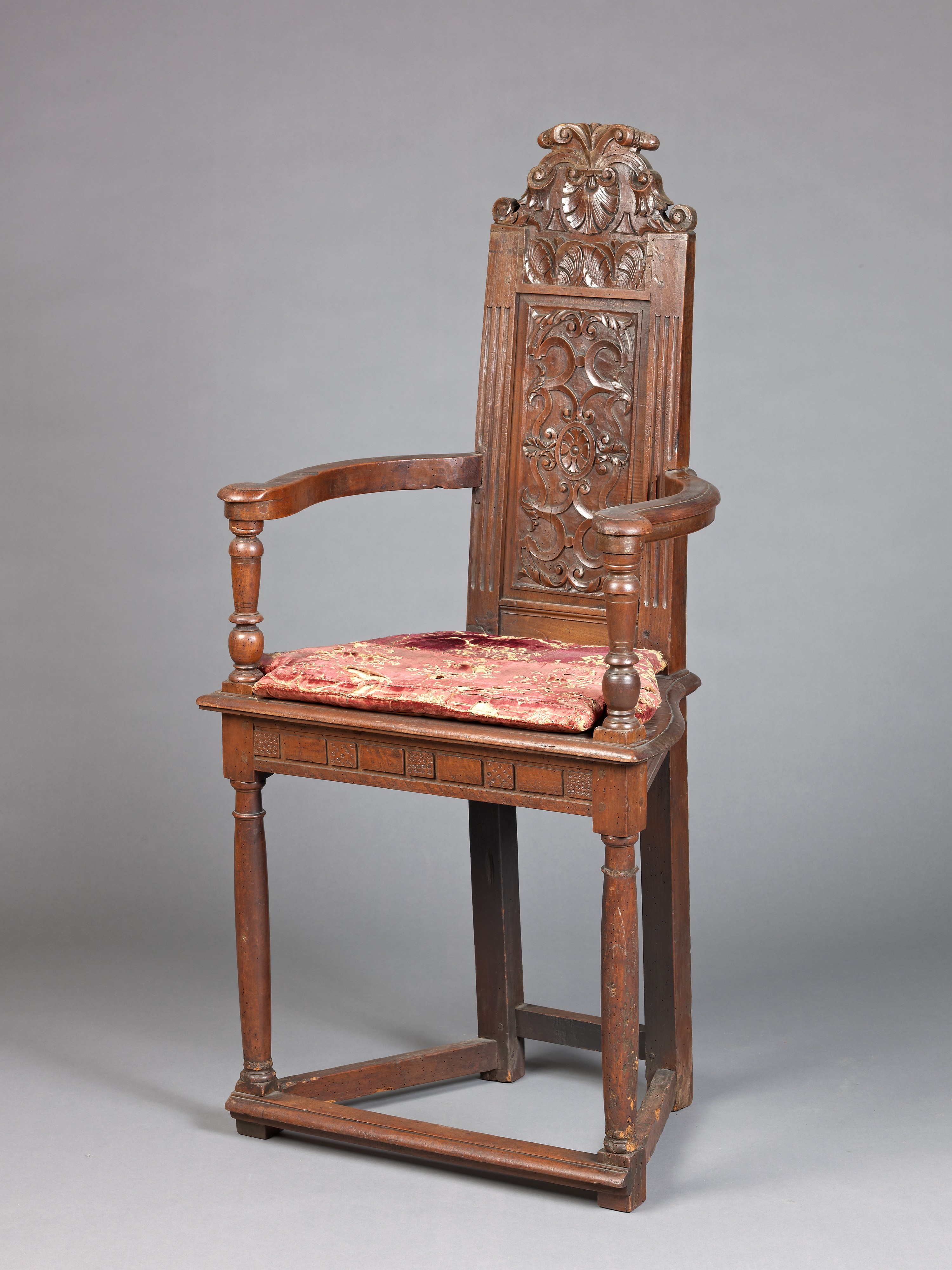
In the rarefied domain of haute couture, inspiration often emerges from the most unexpected of sources. For the latest conceptual exploration at Katherine Fashion Lab, the design team has turned its discerning eye toward a piece of furniture that is as much a social artifact as it is a functional object: the French caquetoire armchair. Crafted from walnut and punctuated with a cushion of cut silk velvet, this 16th-century piece, intended for standalone study, offers a profound lexicon of form, material, and cultural narrative. This analysis deconstructs the caquetoire not as a mere seat, but as a masterclass in structural elegance, textural contrast, and the subtle language of power and intimacy—all of which are being translated into a forthcoming couture collection.
I. The Architecture of Posture: From Social Discourse to Solitary Reflection
Historically, the caquetoire—derived from the French caqueter, meaning to chatter or gossip—was designed for the intimate, lively conversations of the Renaissance salon. Its defining feature, the splayed, outward-curving arms, was not merely decorative. This ergonomic innovation allowed for the voluminous skirts of the era’s gowns to drape gracefully, while simultaneously encouraging a posture of openness, an invitation to dialogue. In the context of a standalone study, however, this same architecture is recontextualized. The outward sweep of the arms now functions as a frame for solitude, a physical demarcation of personal space within a quiet room. The sitter is no longer leaning in to converse, but leaning back to contemplate.
For Katherine Fashion Lab, this dichotomy between social and solitary is a central theme. The caquetoire’s silhouette directly informs the cut of a new evening jacket. The splayed arm motif is translated into a dramatic, wing-like shoulder construction, where the fabric—a heavy, structured wool—is cut to flare outward from the body, creating a powerful, yet contained, volume. This is not a shoulder that demands attention through aggression, but one that commands respect through its quiet, architectural precision. The jacket’s back, conversely, is tailored to a sharp, narrow silhouette, echoing the chair’s upright, supported spine. The garment, like the chair, becomes a portable environment, a shell of personal sovereignty designed for both a crowded gallery opening and a solitary moment of reflection.
II. Material Duality: The Walnut and the Velvet
The material composition of the caquetoire is a study in deliberate contrast. The walnut frame is robust, dark, and inherently structural. Its grain, when polished, reveals a subtle, almost liquid depth, a testament to the wood’s density and the craftsman’s patience. Walnut was prized in Renaissance France not only for its beauty but for its symbolism of stability and permanence. It is the bones of the piece, the unyielding foundation upon which comfort is built.
In direct opposition lies the cut silk velvet cushion. Where walnut is hard and unyielding, velvet is soft and inviting. Where walnut is static, velvet is dynamic, capturing light in a kaleidoscope of shadows and highlights. The “cut” technique—where loops of silk are sheared to create a plush, dense pile—adds a layer of tactile luxury that is almost hypnotic. This is not a fabric for passive viewing; it demands to be touched. In the context of the study, the velvet cushion becomes a zone of sensory indulgence, a counterpoint to the intellectual rigor suggested by the walnut frame.
Katherine Fashion Lab’s interpretation of this duality is a masterful exercise in haute couture construction. The walnut is echoed in a bodice engineered from polished, lacquered wood veneers, applied over a rigid corset structure. This is not a costume piece but a legitimate structural innovation, where thin layers of walnut are bonded to a flexible base, allowing for movement while retaining the visual weight of the original chair. The velvet, meanwhile, is deployed in a cascading, asymmetrical skirt. The cut silk velvet is used in a deep, aubergine tone, its pile manipulated to create a gradient effect—dense and dark at the waist, lighter and more fluid as it falls toward the hem. The contrast between the hard, reflective bodice and the soft, absorbent skirt creates a dialogue of tension and release, mirroring the chair’s own material philosophy.
III. The Cut of Silence: Textural and Visual Narratives
Beyond the primary materials, the caquetoire offers a rich vocabulary of surface details. The walnut frame is often adorned with carved motifs: acanthus leaves, grotesques, or heraldic symbols. These are not random decorations but coded messages of status, intellect, and lineage. For the couture collection, these carvings are reinterpreted as intricate embroidery and hand-applied beading. A single sleeve might feature a three-dimensional acanthus leaf in silver thread and jet beads, rising from the velvet like a carved wooden relief. This is not print or pattern; it is sculpture on fabric, a direct translation of the chair’s decorative language into wearable art.
The cut of the velvet itself is a critical element. In the original cushion, the pile is uniform, creating a field of soft, uninterrupted color. However, the “cut” technique can also be used to create contrasting textures within the same fabric. Katherine Fashion Lab experiments with this by introducing areas of uncut loop velvet alongside the sheared pile. This creates a subtle, tonal pattern—a play of matte and sheen, of rough and smooth—that is only visible upon close inspection. This technique, known as ciselé velvet, is a hallmark of the highest levels of textile craftsmanship, and it directly references the chair’s careful construction. The garment, like the chair, rewards the patient observer with layers of hidden detail, a testament to the value of slow, deliberate artistry.
IV. The Standalone Study: A Philosophy of Presence
Finally, the context of the caquetoire as a piece for a standalone study is perhaps its most profound contribution. The study, in the Renaissance tradition, was a room of intellectual and spiritual retreat. The caquetoire placed within it was not a throne for public display, but a seat for private thought. It was a piece of furniture that asked the sitter to be present, to be still, to engage with the world of ideas rather than the noise of society.
In translating this to couture, Katherine Fashion Lab creates garments that are not for the fleeting moment of a red carpet, but for the enduring act of being. The collection’s final piece—a floor-length coat in walnut-stained leather, lined in the same cut silk velvet—is a portable study. It is heavy, substantial, and demands a certain posture. To wear it is to inhabit a space of quiet authority. The coat’s interior, lined in velvet, is a secret world of comfort, a private cushion against the public realm. This is fashion as existential architecture, a wearable reminder that true luxury is not about visibility, but about the depth of one’s own interior life.
In conclusion, the French caquetoire armchair, in its walnut and velvet splendor, is far more than a historical artifact. It is a blueprint for a design philosophy that values structure over trend, material integrity over flash, and solitary contemplation over social performance. Katherine Fashion Lab’s analysis and subsequent collection honor this legacy, proving that the most profound couture is often born from the quietest sources.