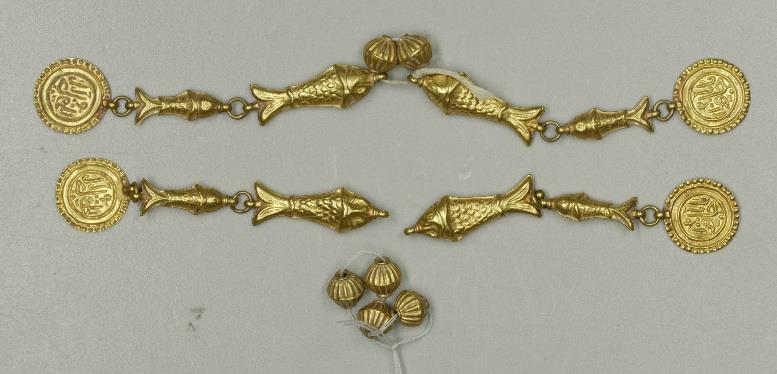
Heritage Analysis: Pendant with Fishes and Amulets, Part of a Set
Introduction: The Artifact as a Cultural Nexus
The Pendant with Fishes and Amulets, a gold artifact from an ancient civilization, represents a masterful convergence of symbolic power, historical adornment, and spiritual meaning. Crafted from gold—a medium that transcends time as both a material of wealth and a conduit for divine energy—this pendant is not merely an ornament but a talismanic object embedded with layered narratives. Its composition, featuring fish motifs and amuletic elements, echoes the dualistic resonance observed in our parallel study of the Mirror with Split-Leaf Palm Motif, where one side reflects polished silver and gold inlay, while the other narrates life through stone-carved relief. This pendant similarly embodies a dialectic: the fluid, life-giving symbolism of fish against the protective, anchoring function of amulets. For Katherine Fashion Lab, this artifact serves as a critical reference point for a 2026 high-end luxury strategy that prioritizes heritage storytelling, spiritual authenticity, and material transcendence.
Symbolic Power: The Fish as a Universal Archetype
In ancient civilizations, fish held profound symbolic weight, often representing fertility, abundance, and the cyclical nature of life. The pendant’s fish motifs, rendered in gold with meticulous detail, likely signified spiritual nourishment and regeneration. In contexts such as Egyptian, Mesopotamian, or Mediterranean cultures, fish were associated with water deities—the primordial source of creation. Their inclusion in a pendant suggests the wearer sought to harness this generative energy, aligning personal identity with cosmic forces. The amulets, meanwhile, amplify this symbolic field by offering apotropaic protection, warding off malevolent spirits or ill fortune. Together, the pendant becomes a microcosm of ancient cosmology: the fish embody movement and life, while the amulets provide stability and defense—a duality that mirrors the Mirror with Split-Leaf Palm’s interplay of reflective surface and narrative depth.
For Katherine Fashion Lab, this symbolic architecture informs a luxury strategy that moves beyond aesthetic appeal. In 2026, high-end consumers seek artifacts that resonate with personal meaning and cultural depth. The fish symbol can be recontextualized as a metaphor for adaptability and flow in a volatile world, while amulets can be reinterpreted as protective talismans for modern anxieties. A collection inspired by this pendant would not just sell jewelry; it would offer narrative armor—pieces that empower the wearer through embedded symbolism.
Historical Adornment: Gold as a Medium of Power and Identity
Gold’s use in this pendant is no accident. In ancient civilizations, gold was considered the flesh of the gods, a material that resisted decay and symbolized eternal life. The pendant’s construction—likely through techniques such as granulation, filigree, or repoussé—demonstrates advanced metallurgical skill, indicating that it was crafted for an elite class. Adornment was not merely decorative; it was a marker of social status, religious authority, and cultural identity. The pendant, as part of a set, would have been worn during rituals, ceremonies, or daily life to project power and divine favor. The fish and amulets, arranged in a harmonious composition, would have caught light and movement, drawing attention to the wearer’s connection to the spiritual realm.
This historical context offers a blueprint for Katherine Fashion Lab’s 2026 strategy. The luxury market is increasingly moving toward experiential and identity-driven consumption. A high-end line inspired by this pendant could emphasize artisanal craftsmanship—reviving ancient goldworking techniques to create pieces that feel both timeless and contemporary. The “set” concept is particularly potent: a necklace, earrings, or bracelet that functions as a cohesive narrative, allowing the wearer to curate their own symbolic ensemble. In a world of mass production, such bespoke sets offer exclusivity and depth, aligning with the quiet luxury trend that values substance over ostentation.
Spiritual Meaning: The Amulet as a Bridge Between Worlds
The amulets integrated into this pendant are not mere decorative elements; they are functional spiritual tools. In ancient belief systems, amulets were charged with protective or augmentative properties, often carved with symbols, inscribed with prayers, or infused with sacred materials. Their placement alongside fish motifs suggests a holistic spiritual framework: the fish invoke life and abundance, while the amulets guard against disruption. This pendant thus served as a portable sanctuary, a physical anchor for the wearer’s spiritual practice. The duality of its design—open, flowing forms of fish versus compact, geometric amulets—mirrors the human experience of navigating between the material and the transcendent.
For Katherine Fashion Lab, this spiritual dimension is a differentiator in a saturated luxury market. In 2026, consumers are prioritizing wellness, mindfulness, and intentionality. A collection that explicitly integrates amuletic principles—through gemstone selections, symbolic engravings, or ritualistic packaging—can tap into this demand. The pendant’s spiritual meaning can be translated into a curatorial experience: each piece comes with a heritage card explaining its symbolism, encouraging the wearer to engage with it as a tool for personal alignment. This elevates jewelry from commodity to companion, fostering deep brand loyalty.
2026 High-End Luxury Strategy: Synthesis and Innovation
Drawing from the pendant’s heritage, Katherine Fashion Lab can construct a 2026 strategy rooted in three pillars: symbolic resonance, artisanal authenticity, and spiritual engagement. The fish-and-amulet motif offers a visual lexicon that can be adapted across categories—from fine jewelry to accessories and even home decor. The key is to avoid mere reproduction; instead, the brand should reinterpret ancient symbolism through a modern lens. For example, fish forms could be stylized into minimalist, sculptural shapes, while amulets might be reimagined as abstract geometric pendants, retaining their protective essence without historical pastiche.
Additionally, the pendant’s “set” nature suggests a modular approach to luxury design. In 2026, consumers value versatility and personalization. A collection where individual pieces can be worn separately or combined—each carrying its own symbolic weight—mirrors the ancient practice of amassing protective amulets. This modularity also aligns with sustainability, as it encourages long-term attachment rather than disposable fashion.
Finally, the brand must invest in narrative marketing. The pendant’s story—its origins, materials, and meanings—should be at the core of all communications. Collaborations with historians, curators, and spiritual practitioners can lend credibility and depth. A limited-edition launch, accompanied by a digital archive or exhibition, can create a sense of cultural prestige. In 2026, luxury is not about price alone; it is about belonging to a lineage of meaning. Katherine Fashion Lab’s heritage analysis of this gold pendant provides the foundational text for that lineage.
Conclusion: The Pendant as a Strategic North Star
The Pendant with Fishes and Amulets is more than an artifact; it is a strategic template for the future of luxury. Its gold medium speaks to permanence, its fish to vitality, and its amulets to protection—a triad that resonates deeply with contemporary desires for security, growth, and purpose. By decoding its symbolic power, historical adornment, and spiritual meaning, Katherine Fashion Lab can craft a 2026 strategy that is both reverent and revolutionary. The pendant’s DNA—its correlation with the Mirror with Split-Leaf Palm’s dualistic narrative—reminds us that true luxury lies in the tension between surfaces and depths, between ornament and story. This is the heritage we carry forward.