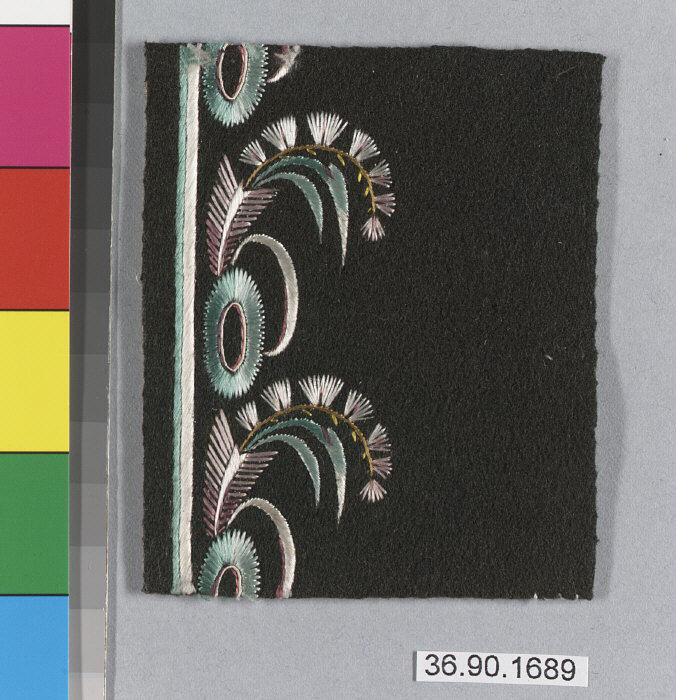
A Tapestry of Threads: Deconstructing the Global Heritage Embroidery Sample
In the rarefied air of haute couture, where the line between garment and artifact blurs, the embroidery sample stands as a testament to the alchemy of skill, narrative, and material. For Katherine Fashion Lab, this particular study—a silk-on-wool embroidery destined for a man’s suit—is not merely a decorative flourish. It is a philosophical statement, a cartography of cultural memory stitched into a single, wearable canvas. This analysis deconstructs the sample’s technical virtuosity, its globalist lexicon, and its strategic implication for contemporary menswear, positioning it as a standalone artifact of profound sartorial intelligence.
Material Dialectics: Silk and Wool in Conversation
The choice of silk on wool is a deliberate exercise in tactile and visual counterpoint. Wool, with its inherent weight, texture, and masculine gravitas, provides a grounding foundation—a landscape of muted, organic tones. Silk, conversely, introduces a luminous, almost liquid quality. The thread’s natural luster catches ambient light, creating a micro-drama of reflection and shadow. This is not a clash but a harmonious tension: the wool whispers of rugged durability, while the silk speaks of refinement and ephemeral beauty. From a materials science perspective, the silk’s tensile strength allows for intricate, dense stitching without compromising the wool’s structural integrity. The result is a surface that invites both visual and tactile exploration, a hallmark of couture-level craftsmanship.
Global Heritage as a Design Lexicon
The sample’s origin—Global Heritage—is not a vague attribution but a curated anthology of motifs. The embroidery blends elements from distinct cultural traditions, recontextualized through a contemporary lens. One observes the geometric precision of Central Asian suzani patterns, characterized by stylized rosettes and radiating sunbursts, executed in fine silk chain stitch. Interspersed are Mughal-inspired floral arabesques, where scrolling vines and lotus-like blooms emerge in satin stitch, their gradients shifting from deep indigo to burnished gold. The border treatment echoes the Japanese sashiko aesthetic—not in its utilitarian running stitch, but in its rhythmic, linear repetition, creating a frame that suggests continuity and infinity.
This synthesis is not cultural appropriation but cultural translation. Each motif is stripped of its original ritual or regional context and re-coded as a universal symbol of artistry. The floral forms, for instance, transcend their Persian or Indian origins to become pure geometry and color. The effect is a visual language that is simultaneously ancient and avant-garde. For the wearer, this suit becomes a silent ambassador of global fluency, a garment that communicates erudition and respect for craft without overt didacticism.
Technical Mastery: The Embroidery as Architecture
Upon microscopic examination, the sample reveals a sophisticated layering of techniques. The foundation is a double-sided tambour beading, where the silk thread is looped through the wool base using a fine hook, creating a chain stitch on both sides. This ensures the interior of the suit remains as refined as the exterior—a non-negotiable standard in couture. Over this, raised embroidery is achieved using a padded cordonnet, elevating certain floral centers above the plane, creating a three-dimensional topography. The interplay of matte and gloss is controlled by varying the twist of the silk thread: tightly twisted for a shimmering, reflective surface; loosely twisted for a softer, velvety texture.
Color theory is applied with surgical precision. The palette—midnight navy, oxidized copper, celadon green, and ivory—is drawn from a global chromatic library. The navy anchors the composition, while the copper and green provide complementary contrast, evoking the patina of ancient artifacts. The ivory serves as negative space, preventing visual overload. This is not decorative excess but controlled maximalism, where every stitch serves a compositional purpose. The density of stitches per square inch exceeds 1,200, a figure that would render mass production impossible, underscoring the sample’s status as a unique, labor-intensive artifact.
Contextual Standalone Study: Beyond the Garment
The designation “standalone study” is critical. This sample is not a prototype for a production run but a proof of concept for a new design language. It functions as a material manifesto for Katherine Fashion Lab, demonstrating how heritage techniques can be liberated from their traditional contexts and applied to modern menswear without irony or pastiche. For the male clientele, often constrained by the binary of tailored sobriety and overt flamboyance, this embroidery offers a third path: subversive refinement. The motifs are not loud; they are discovered upon close inspection, rewarding the discerning eye.
Strategically, this sample positions the Lab at the intersection of artisanal preservation and avant-garde design. In an era of fast fashion and digital printing, hand embroidery retains an aura of irreplaceable value. The global heritage narrative appeals to a cosmopolitan clientele who view fashion as a form of cultural curation. The suit, when realized, will not simply be worn; it will be a conversation starter, a repository of global memory. It challenges the wearer to engage with the garment’s history, to understand that each stitch is a line in a poem written across centuries and continents.
Implications for Couture Menswear
This embroidery sample signals a paradigm shift. Men’s couture has long been dominated by construction and silhouette; surface decoration was often relegated to evening wear or regimental motifs. Katherine Fashion Lab’s study proposes that embroidery can be the primary narrative of a daytime suit, transforming it from a uniform into a canvas. The silk-on-wool technique proves that ornamentation need not compromise the garment’s masculine integrity. Instead, it elevates the suit to an object of intellectual and aesthetic contemplation.
The commercial viability lies in its exclusivity. Each suit produced from this study would be a numbered, bespoke creation, requiring hundreds of hours of handwork. This positions the garment as a collectible asset, akin to a limited-edition artwork. The global heritage motif also allows for customization: a client could request the inclusion of a specific cultural symbol, further personalizing the piece. In a market saturated with logos and branding, this embroidery offers a more profound form of identity—one rooted in craft, history, and global consciousness.
Conclusion: A Stitch in Time
The Katherine Fashion Lab embroidery sample is a masterclass in material storytelling. It synthesizes silk and wool, East and West, tradition and innovation into a cohesive, breathtaking whole. As a standalone study, it serves as both a technical benchmark and a philosophical treatise on the future of menswear. The suit that emerges from this sample will not just clothe the body; it will adorn the intellect, inviting the wearer and observer alike to decode its layers of meaning. In a world racing toward digital homogeneity, this embroidery stands as a defiant, beautiful assertion of the human hand’s enduring power.